Ancient Earth Got Its Crust Pounded Into Shape by Asteroids, Scientists Argue
Geologists propose that ancient asteroid impacts, not plate tectonics, melted Earth's early crust into a thin, gooey layer that eventually cooled into continents.
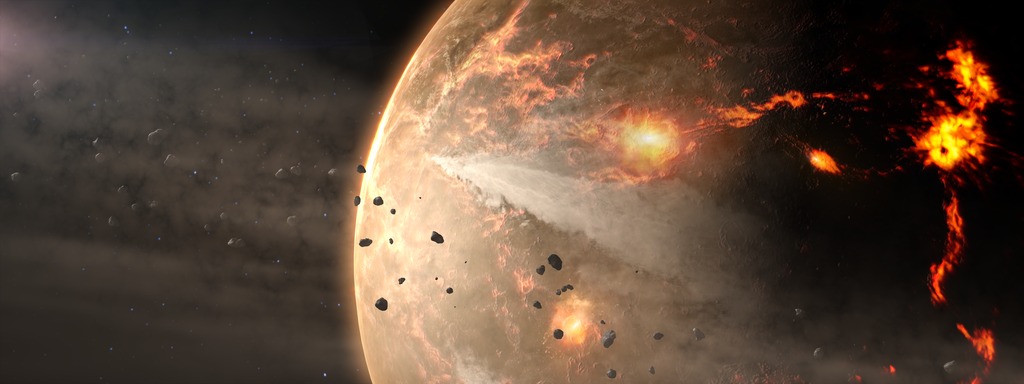
Earth is the only planet we know of with buoyant, silica-rich continents, but geologists still can't agree on how they formed. The oldest continental rock dates back about four billion years, yet Earth is four and a half billion years old - leaving a 500-million-year gap that has fueled decades of debate. Tim Johnson, a geologist at Curtin University in Perth, Australia, and his colleagues now argue that the missing piece of the puzzle is cosmic: an intense, sustained barrage of asteroid impacts kept the early crust hot and thin enough to make buoyant continents possible. In short, the lands we live on are here because ancient space rocks beat the hell out of the planet.
The problem is that geological evidence from Earth's infancy is almost nonexistent. The oldest known continental rocks crystallized around 4.03 billion years ago, at the tail end of the Hadean eon (the first 500 million years). Rare basaltic rocks date back about 4.2 billion years, and a few zircon crystals push the record to 4.4 billion years. Beyond that, there's hardly anything. So scientists have relied on educated guesses, leading to two dominant ideas: plate tectonics was already running in the Hadean, with crust forming above subduction zones, or the early Earth was too hot for rigid plates, and crust formed above mantle plumes (think wax blobs in a lava lamp). Both ideas, however, faced a heat problem. Earth appeared too cold for either process based on internal heat sources alone. As Johnson put it, "Nobody could make it fit because we did not consider the energy coming from outside of Earth."
That outside energy came from asteroid and meteorite impacts, far more frequent when the solar system was young. But Earth has a peculiar way of hiding its scars - plate tectonics recycles the surface back into the mantle. So Johnson's team looked to the Moon, which lacks plate tectonics and still bears the marks of ancient impacts. Calibrating crater counts against dated lunar samples, they estimated how often large bodies hit our celestial neighbor. Scaling that to Earth's larger size and stronger gravity, they concluded the planet must have been hit by thousands of impactors greater than 10 kilometers in diameter. When they calculated the energy delivered, impact heating exceeded radiogenic and core heat for most of the Hadean by roughly an order of magnitude.
Feeding this reworked heat budget into geodynamic simulations, the team found that Earth's crust in the Hadean was thin (less than 5 kilometers thick) and largely molten underneath, with widespread partial melting starting just 2 to 3 kilometers below the surface. At around 5 kilometers depth, melt fractions exceeded 30 percent by volume - well past the point where rock holds together as a coherent slab. Plate tectonics simply couldn't work. "Subduction and plate tectonics require that your lithosphere is rigid and it can jostle around and subduct," Johnson said. "That's just not possible if our calculations are anywhere close to the mark."
The simulations also produced wholesale recycling of crust back into the mantle, with material dripping down to depths of at least 600 kilometers. This explains why so little Hadean crust survived and why shock-deformed zircons are nearly absent - the melt absorbed shock waves before they could leave lasting damage. As the impact flux declined between 3.9 and 3.5 billion years ago, internal heat sources took over, the upper mantle cooled, and the crust thickened to around 30 kilometers by the early Archean. That thicker, cooler, more rigid crust finally supported plate tectonics, and the first continental rocks appear in the geological record around the same time. "As soon as you can create thick crust and you can create a mantle lithosphere underneath, you can start building continents," Johnson said.
The team admits much of the argument rests on physics-based modeling rather than rock samples, but Johnson thinks that's justified given the scarcity of evidence. "We need to start taking seriously the outputs of these models rather than just say, well, we can't find any rocks, so let's give up," he said. Still, ancient rocks may pop up soon - a team recently dated a 4.2-billion-year-old rock from the Nuvvuagittuq Greenstone Belt in Canada, and another group may have found an even older one. As Johnson teased, "Hopefully you will be able to read about it in the next couple of months."
Science, 2026. DOI: 10.1126/science.aeb5402
The Good Times
News in your inbox.
One sardonic roundup, delivered on your schedule. Free. Unsubscribe whenever your tolerance for wit runs out.
Already subscribed but we never reach your inbox? Check your spam folder and hit 'Not spam' (or 'Remove from spam') to bust us out of junk-mail purgatory. You'll be helping everyone else too.
Don't open any of our emails for a month and you'll be automatically removed from the mailing list.
Rewrite Article
Select parts to regenerate with a fresh AI pass. Translations will be updated automatically.
Generate AI Image
Creates a sardonic version of the article image using OpenAI.