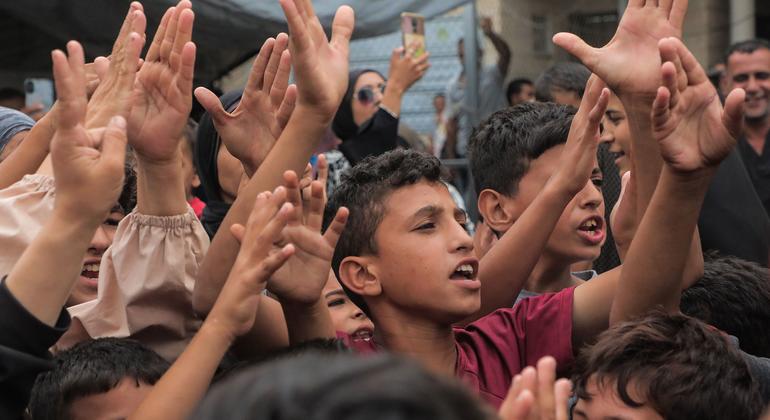
In a stunning display of what happens when you call a pause in fighting a 'ceasefire' but keep fighting anyway, UNICEF reported Thursday that at least 300 children in Gaza have been killed in the 300 days since the supposed truce began last October. That's a neat one-kid-per-day average, if you're into grim statistics.
Edouard Beigbeder, UNICEF's Regional Director for the Middle East and North Africa, put it succinctly: "A ceasefire that leaves an average of one child dead each and every day is failing children." He noted that hundreds more are injured, many severely, and they're all still waiting for the violence to end - a promise that's wearing a bit thin.
The children of Gaza are now crammed into about a third of the Strip, surrounded by rubble, destroyed buildings, and uncleared waste. They're also dealing with acute malnutrition, disease, unsafe water, and broken sanitation systems - because why not pile on? Health workers describe exhausted, hungry mothers showing up at clinics with severely malnourished kids, and there's a worrying uptick in premature births, with some newborns sharing incubators two or three at a time. UNICEF spokesperson Louise Wateridge quipped, "In Gaza, children only days old are already fighting to stay alive, born into partially functioning hospitals lacking equipment and medicine." She added, "This is what the world has chosen to tolerate."
Meanwhile, the UN aid coordination office, OCHA, notes that airstrikes near the 'Yellow Line' and elsewhere are disrupting civilian life, damaging shelters, and driving displacement. Since the ceasefire was announced on 10 October 2025, Gazan health authorities report 1,209 people killed and 3,943 injured. But hey, at least the WHO's medical supplies at Al-Aqsa Hospital got destroyed too, including some the agency had delivered - because nothing says 'peace' like bombing a medical storage facility.
In brighter news, the UN and partners are doing what they can, improving 3,000 makeshift shelters in Gaza City and distributing emergency kits to 9,000 households. UNICEF delivered over 600 pallets of recreational kits, school bags, and soap ahead of the school year, which is supposed to start in two weeks. More than 250,000 kids are in summer learning activities, trying to regain some sense of normalcy and catch up on the education they missed while dodging bombs.
As Beigbeder said, "For children in Gaza, the test is simple. Does the killing stop? Does aid reach them at scale? Do hospitals reopen and water flow? Will children return to school safely in September?" He warned, "Children have heard promises before. This time, agreements must translate into action." Or, as Wateridge put it, "The world calls it a ceasefire but families in Gaza are still burying their children."
The Good Times
News in your inbox.
One sardonic roundup, delivered on your schedule. Free. Unsubscribe whenever your tolerance for wit runs out.
Already subscribed but we never reach your inbox? Check your spam folder and hit 'Not spam' (or 'Remove from spam') to bust us out of junk-mail purgatory. You'll be helping everyone else too.
Don't open any of our emails for a month and you'll be automatically removed from the mailing list.
Rewrite Article
Select parts to regenerate with a fresh AI pass. Translations will be updated automatically.
Generate AI Image
Creates a sardonic version of the article image using OpenAI.