Study Suggests Universe's Biggest Black Holes Are Just Repeat Offenders in Crowded Star Clusters
New research suggests the universe's biggest black holes aren't born from dying stars but grow through repeated collisions in crowded star clusters, with spins that scream 'repeat offender.'
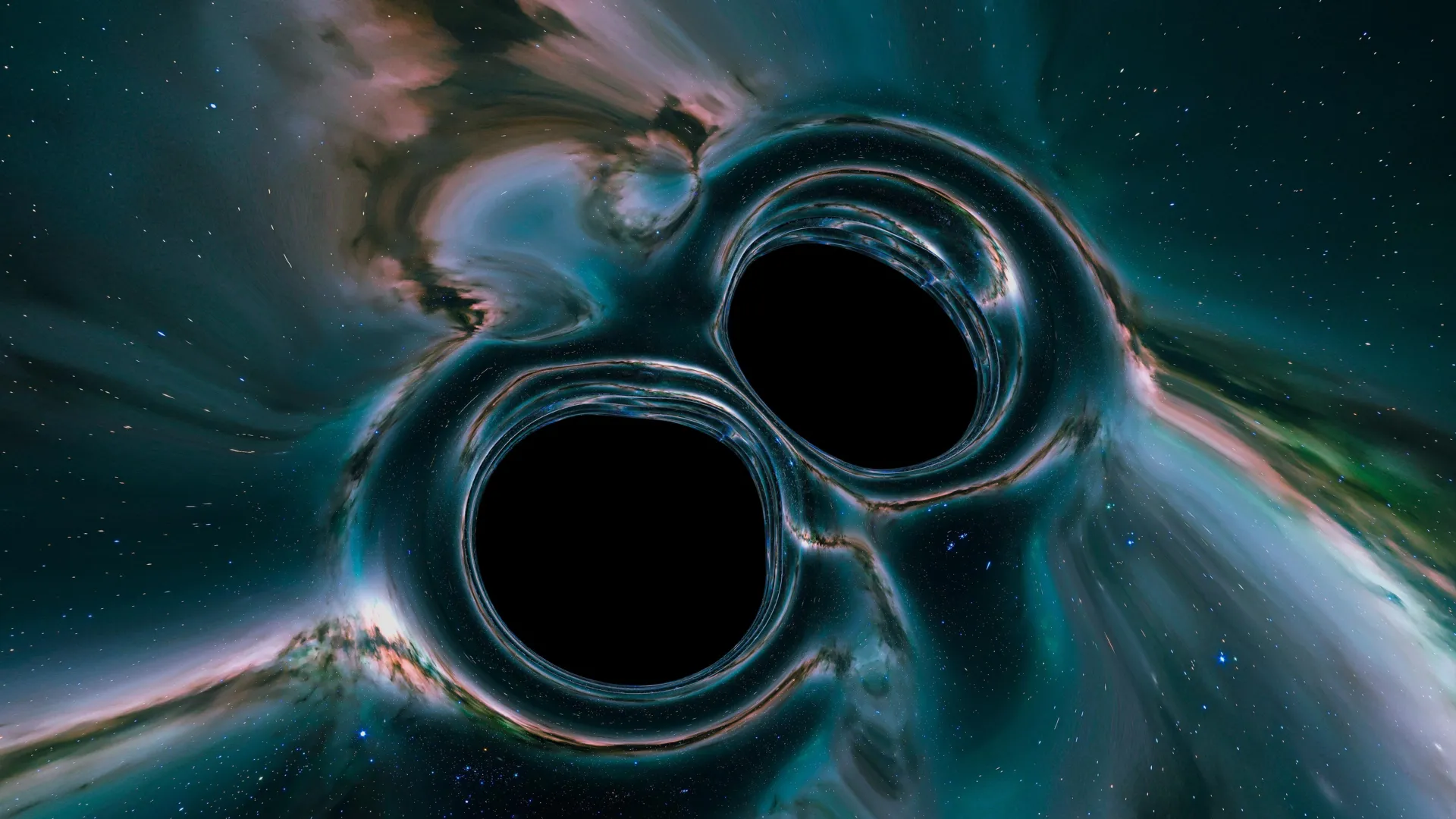
Scientists studying gravitational waves think they've figured out how the universe makes its biggest black holes, and spoiler: it's not the usual dramatic collapse of a dying star. Instead, these cosmic heavyweights appear to be repeat offenders, growing through multiple collisions inside star clusters that are packed tighter than a Tokyo subway at rush hour.
Led by Cardiff University, the research dug into version 4.0 of the LIGO-Virgo-KAGRA Gravitational-Wave Transient Catalog (GWTC4), which logs 153 reliable black hole mergers. The team, publishing in Nature Astronomy, focused on whether the largest black holes were "second-generation" objects - formed when black holes from dead stars smash together, then merge again in dense stellar environments where stars are crammed up to a million times closer than in our solar neighborhood.
"Gravitational-wave astronomy is now doing more than counting black hole mergers," said lead author Dr. Fabio Antonini of Cardiff University. "It is starting to reveal how black holes grow, where they grow, and what that tells us about the lives and deaths of massive stars." The analysis identified two distinct black hole populations, with the heavier ones showing a peculiar spin behavior - rapid spins in random directions, exactly what you'd expect from repeated mergers in dense clusters.
"What surprised us most was how clearly the high-mass black holes stand out as a separate population," added co-author Dr. Isobel Romero-Shaw. "Unlike the lower-mass systems... the higher-mass systems are consistent with having more rapid spins, oriented in seemingly random directions. This is the exact signature you would expect if black holes were repeatedly merging in dense star clusters."
The study also bolsters evidence for a mysterious "mass gap" around 45 solar masses, where stars of a certain size should explode so violently they leave no black hole behind. "The biggest black holes in the current sample seem to be telling us about cluster dynamics, not just stellar evolution," Antonini noted. "Above about 45 solar masses the spin distribution changes... naturally explained if these black holes have already been through earlier mergers in dense clusters."
Looking ahead, the researchers suggest this data could help probe nuclear physics inside massive stars, since the pair-instability mass gap depends on reactions in stellar cores. "In the future, gravitational-wave data may help scientists study nuclear physics," said co-author Dr. Fani Dosopoulou. Because nothing says "nuclear physics" quite like a black hole that's been through multiple cosmic fender benders.
The Good Times
News in your inbox.
One sardonic roundup, delivered on your schedule. Free. Unsubscribe whenever your tolerance for wit runs out.
Already subscribed but we never reach your inbox? Check your spam folder and hit 'Not spam' (or 'Remove from spam') to bust us out of junk-mail purgatory. You'll be helping everyone else too.
Don't open any of our emails for a month and you'll be automatically removed from the mailing list.
Rewrite Article
Select parts to regenerate with a fresh AI pass. Translations will be updated automatically.
Generate AI Image
Creates a sardonic version of the article image using OpenAI.