Quantum Dots Learn to Move, Because Sticking to the Script Is So Last Century
Researchers show that quantum dots can move electrons around without losing quantum information, potentially giving chip-based qubits the flexibility of atoms and ions.
Quantum computing requires a lot of high-quality qubits, and companies are splitting into two camps: those who manufacture qubits on chips (lots of them, but they’re stuck in place) and those who use atoms or ions (fewer, but they can move around, allowing flexible error correction). The chip-based crowd has long envied the mobility of the atom-and-ion set, because being wired into a fixed configuration during manufacturing means you’re stuck with whatever error-correction scheme you chose, even if a better one comes along later. It’s like buying a house with the furniture bolted to the floor.
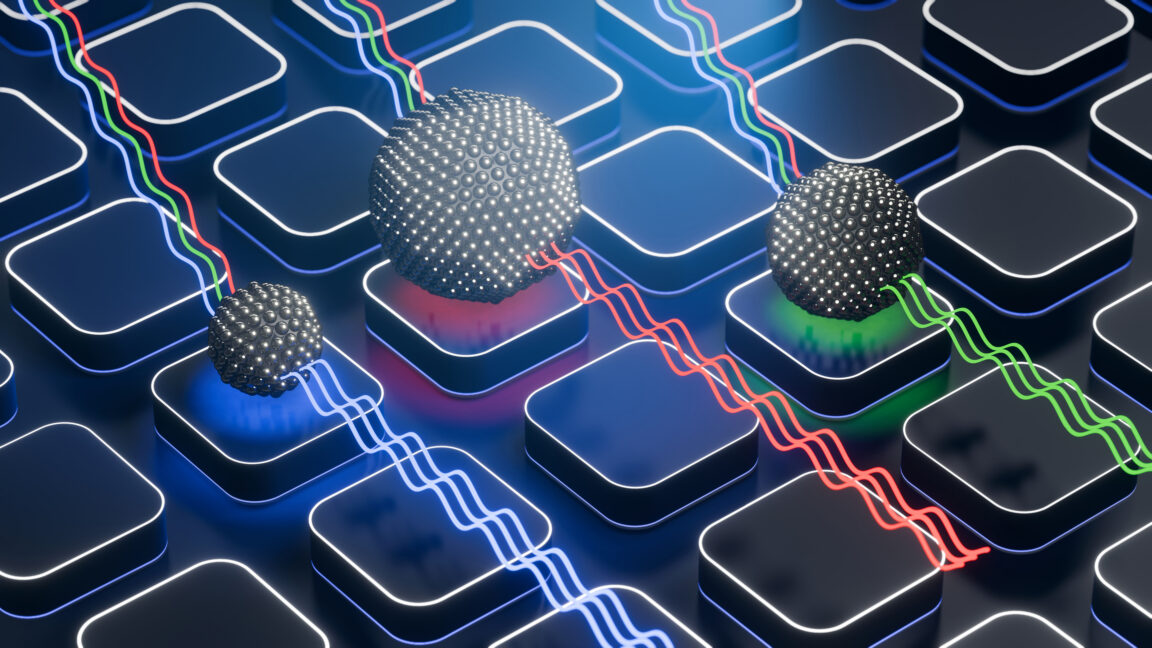
But a new paper from researchers at Delft University of Technology and startup QuTech suggests that quantum dots - manufacturable chip-based qubits that trap a single electron’s spin - can have their cake and move it too. They built a chip with a linear array of six quantum dots, loaded single electron spins at each end, and then used electrical signals to gradually shift the spins inward, bringing them close enough that their spin wavefunctions overlapped. This allowed them to perform two-qubit gates, which are essential for entanglement and error correction.
The researchers then moved the electrons back to their starting positions and confirmed the spins were still entangled. They also demonstrated quantum teleportation (moving a quantum state from one qubit to another, not beaming up Captain Kirk). The two-qubit gates succeeded over 99 percent of the time, and teleportation worked about 87 percent of the time - not yet perfect, but promising for a test device.
The vision: dedicated storage zones for idle qubits, tracks to move them to “interaction zones” for operations, and connectors for long-distance interactions. It sounds suspiciously like the schemes used by neutral atoms and trapped ions, but with the manufacturing advantages of chips. The device is tiny - just six dots - so we’re a long way from a quantum computer that can beat a toddler at counting, but Intel and others are working on improvements.
Whether this mobility will let quantum dots leapfrog competing technologies remains to be seen. The paper was published in *Nature* (DOI: 10.1038/s41586-026-10423-9), and we’ll check back in a few years to see if the dots have learned to dance.
The Good Times
News in your inbox.
One sardonic roundup, delivered on your schedule. Free. Unsubscribe whenever your tolerance for wit runs out.
Already subscribed but we never reach your inbox? Check your spam folder and hit 'Not spam' (or 'Remove from spam') to bust us out of junk-mail purgatory. You'll be helping everyone else too.
Don't open any of our emails for a month and you'll be automatically removed from the mailing list.
Rewrite Article
Select parts to regenerate with a fresh AI pass. Translations will be updated automatically.
Generate AI Image
Creates a sardonic version of the article image using OpenAI.