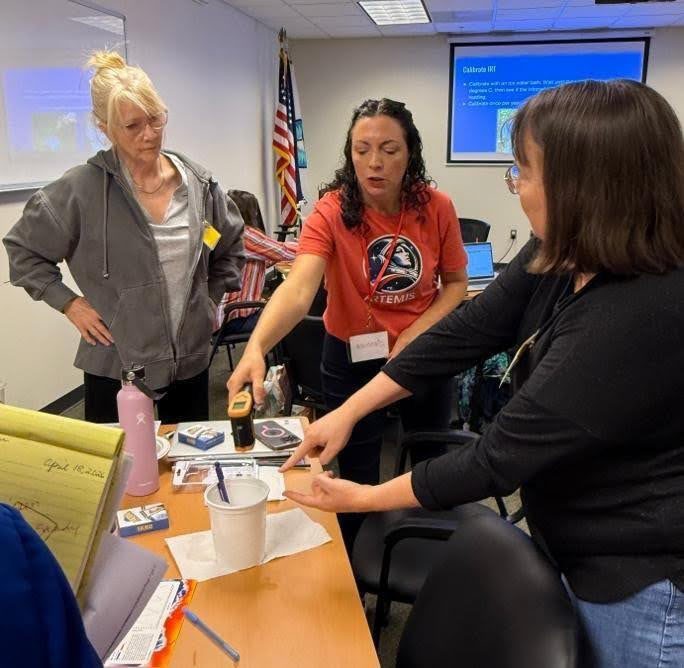
Thirty-eight science educators from seven school districts across Virginia’s Tidewater region recently gathered for a three-hour professional development session that involved pointing infrared thermometers at things and dancing like clouds. The event, held on either March 7 or April 18, 2026, at the National Institute of Aerospace in Hampton, was part of a collaboration between NASA eClips and the GLOBE Program - two initiatives that apparently believe teachers should have access to actual NASA science rather than just a dusty textbook from 1998.
Participants explored how land cover affects surface temperature, how clouds mess with atmospheric conditions, and how soil, despite being dirt, plays a critical role in environmental systems. They calibrated scientific instruments like infrared thermometers and multi-day min/max thermometers, gaining the confidence to collect data that might actually be accurate. They also examined the urban heat island effect (spoiler: cities are hotter than forests), engaged in an “energetic cloud dance” (we're not kidding), and learned to use the GLOBE Observer app to contribute observations. Because nothing says STEM like interpretive movement.
The initiative builds on two years of collaboration among NASA eClips Educators from the National Institute of Aerospace’s Center for Integrative STEM Education, GLOBE scientists from NASA Langley Research Center, and regional school divisions. Funding from the Coastal Virginia STEM Hub, courtesy of the Virginia General Assembly, provided educator stipends and bought essential equipment like weather instrument shelters and soil kits. In a heartwarming twist, those shelters were constructed by Career and Technical Education students in Hampton City Schools and Norfolk Public Schools using GLOBE specifications - proving that teenagers are perfectly capable of building things when it doesn't involve a group project due tomorrow.
As participating school divisions integrate NASA eClips and GLOBE resources into curricula, the goal is to ensure all learners have access to authentic, data-driven science experiences. Because nothing prepares students for the future like knowing how to measure soil temperature while doing a cloud dance.
The Good Times
News in your inbox.
One sardonic roundup, delivered on your schedule. Free. Unsubscribe whenever your tolerance for wit runs out.
Already subscribed but we never reach your inbox? Check your spam folder and hit 'Not spam' (or 'Remove from spam') to bust us out of junk-mail purgatory. You'll be helping everyone else too.
Don't open any of our emails for a month and you'll be automatically removed from the mailing list.
Rewrite Article
Select parts to regenerate with a fresh AI pass. Translations will be updated automatically.
Generate AI Image
Creates a sardonic version of the article image using OpenAI.