
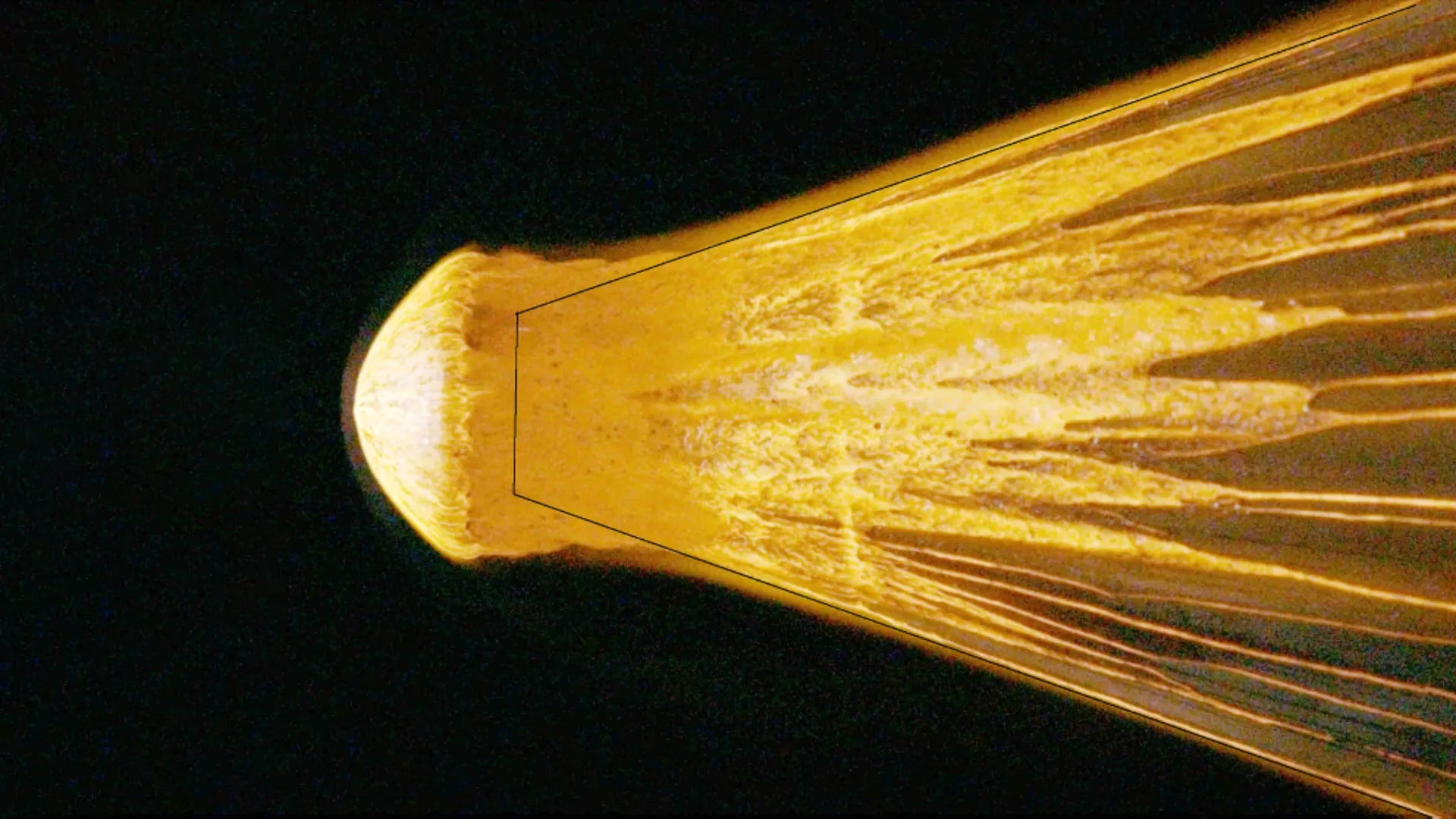
For centuries, humanity has been content to call them 'shooting stars' and move on. But scientists have now taken a closer look at what happens when space rocks plunge into Earth's atmosphere and - crucially - survive the trip. After examining video and photographs of 75 meteorite falls, researchers have identified seven distinct stages that describe how these objects transform into meteorites. The analysis, published in Meteoritics & Planetary Science, reveals that melting and breaking apart play a much greater role than previously believed in determining how much material a rock loses, how quickly it slows down, and where its fragments eventually land.
"We used to think that solid rocks would evaporate from the enormous heat and brilliant light generated in the air collision," said meteor astronomer and lead author Dr. Peter Jenniskens of the SETI Institute and NASA Ames Research Center. "We found instead that first melting and then fragmentation controls how a rock loses mass." In other words, the romantic notion of a rock simply burning up is replaced by a more violent, multi-act drama.
The journey begins in Phase 1, high above Earth, where the atmosphere becomes dense enough for the incoming rock to generate a shock wave ahead of it. As the rock collides with air molecules, both its surface and the surrounding gas heat up and begin to glow, producing the streak of light commonly known as a meteor or "shooting star." During Phase 2, the meteor travels into increasingly dense air, causing its brightness to intensify. Some meteors also display repeating changes in brightness, which can reveal how quickly they are spinning. Among the fastest rotating objects examined, a complete rotation took between 0.5 and 5 seconds - a dizzying spin for a rock.
By Phase 3, the meteor has become much brighter, developing into a fireball. At this point, melting becomes the primary process responsible for removing material from the rock. The intense airflow strips molten material from its surface, producing droplets that continue to evaporate after separating from the main body. "In the laboratory, we cannot generate the amount of radiation that occurs in a natural atmospheric entry at those speeds," said Eric Stern, formerly at NASA Ames and now chief scientist at Hyperspace Technologies, Inc. "Rock could aggressively fragment and erode instead, but then we would not expect the observed systematics in how fireballs brighten." Translation: the lab can't quite replicate the cosmos, but the fireballs are behaving according to script.
The fireball enters Phase 4 at an altitude of approximately 60 kilometers (around 40 miles), when melting reaches a relatively stable balance. During this stage, the fireball's brightness either remains nearly constant or increases at a steady rate. According to the researchers, melting alone can ultimately remove as much as 40 percent of the original rock's mass - a significant diet plan for a space rock.
As the fireball descends into denser layers of the atmosphere, increasing air pressure begins to fracture the rock. This marks the beginning of Phase 5, when pieces separate from the main body and can produce repeated bursts of light. One particularly surprising finding was how early this breakup begins. The researchers found that rocks can start fragmenting when the air pressure acting on their leading surfaces reaches only about one-fifth of the strength measured in meteorites recovered on Earth. They suggest that heating during atmospheric entry, along with cracks left by previous collisions in space, may weaken the rocks enough to explain this unexpected behavior. It is during this stage that the remaining rock begins shrinking rapidly and experiences substantial deceleration. The more extensively it fragments, the faster it loses speed. "We were able to tie that slow-down from fragmentation to the previous mathematical descriptions based on ablation," said co-author Stu Pilorz of the SETI Institute.
The researchers also discovered that the shape of the surviving rock can influence where smaller fragments eventually land. If its rear section remains intact, the main body creates an area of reduced pressure in its wake, drawing smaller pieces along behind it. "Our modeling shows that as long as the back of the space rock remains intact, that rock pulls a vacuum in its wake into which fragments tend to flow," says co-author Darrel Robertson of NASA Ames Research Center. "Those small meteorites fall in a narrow strip on the ground." So much for the scattergun approach; it's more like a celestial vacuum cleaner.
Phase 6 begins when the rear portion of the main rock finally breaks apart. This last major disruption produces a bright flare and sends fragments scattering at greater relative speeds. Because the meteor has already slowed considerably, these final flashes generally appear red, unlike the bright green colors often observed earlier in its descent. "That final disruption sends fragments flying at higher relative speeds," said Jenniskens. "In past falls, we noticed that meteorites larger than about 20g tended to be scattered wider and many came from close to the surface of the original space rock, which must have been its backside." The pieces that ultimately survive to reach Earth's surface began as relatively large fragments. Before landing, however, they experienced additional melting and fragmentation while continuing to lose speed.
During Phase 7, these processes continue until the remaining pieces have slowed enough that they no longer produce visible light. Once melting stops, a thin outer coating known as a fusion crust remains on their surfaces. The darkened fragments then complete their descent, with atmospheric winds potentially pushing them away from their original trajectories before they land as meteorites. It's a bit like a package delivery service that loses your address mid-shipment.
The researchers examined 75 documented meteorite falls involving several different types of space rock. By comparing their behavior, they were able to determine the altitudes at which different materials entered each of the seven phases. These observations offer more than an explanation of how small meteorites reach the ground. They also provide valuable clues about the behavior of much larger asteroids, including objects ranging from the size of cars to entire city blocks that can produce powerful explosions in the atmosphere. By measuring how different solid rocks slow down and fragment during atmospheric entry, scientists can better understand the processes that govern these potentially dangerous asteroid airbursts.
"Asteroids up to tens of meters in size are also solid rocks because they tend to spin faster than do the larger rubble pile asteroids," said Jenniskens. "The 20-m diameter asteroid that caused the airburst over Chelyabinsk, Russia, in 2013 went through the same phases." So the next time you see a shooting star, remember: it's not just burning up. It's undergoing a seven-stage transformation that would make a butterfly jealous - and possibly dropping a few meteorites in a narrow strip on the ground.