James Webb Telescope Finally Gives the Universe’s Cosmic Web the High-Def Treatment It Deserves
NASA's JWST delivers the clearest map of the universe's cosmic web, revealing galaxy evolution from a billion years old - essentially giving the cosmos a sharper LinkedIn profile photo.
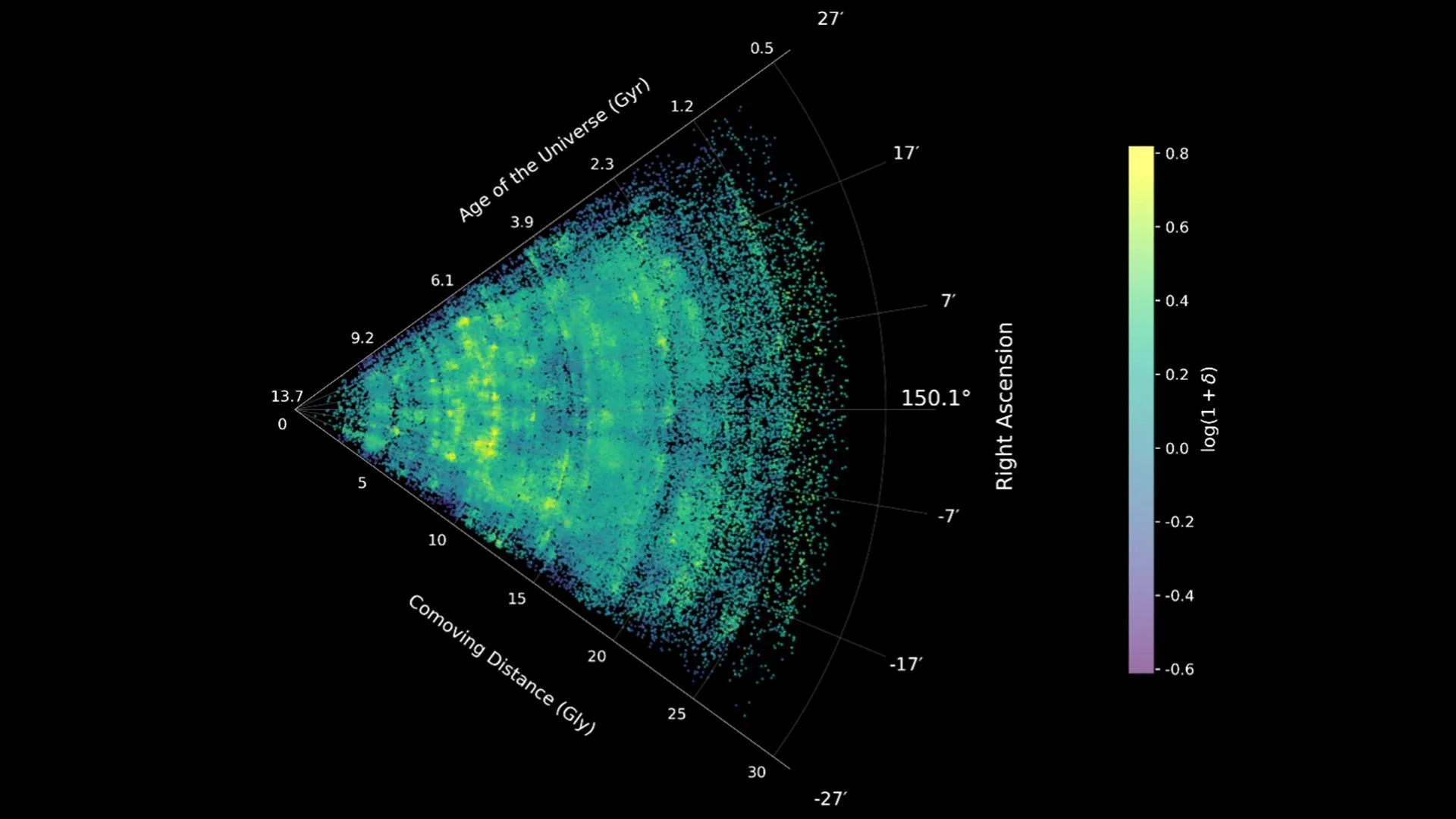
Astronomers using NASA's James Webb Space Telescope (JWST) have produced the most detailed map yet of the cosmic web - the vast, skeleton-like structure that connects galaxies across the universe. Led by researchers at the University of California, Riverside, the team traced this intergalactic scaffolding back to when the universe was a sprightly one billion years old, proving that even cosmic architecture benefits from a good renovation.
The cosmic web, for the uninitiated, is the universe’s structural backbone: filaments and sheets of dark matter and gas surrounding enormous, mostly empty voids. Think of it as the universe’s version of a spider web, except the spiders are galaxies and the silk is invisible dark matter. The findings, published in The Astrophysical Journal, relied on COSMOS-Web, the largest JWST survey to date, which studied how galaxies have arranged themselves within this web over 13.7 billion years of cosmic history.
Since its 2021 launch, JWST has been flexing its infrared muscles, detecting faint galaxies that earlier telescopes could only dream of seeing. The COSMOS-Web survey covers a patch of sky roughly the size of three full Moons, specifically designed to map the cosmic web in all its glory. “JWST has completely changed our view of the universe,” said Hossein Hatamnia, a graduate student at UCR and lead author, adding that for the first time, we can study galaxy evolution from when the universe was a billion years old up to the nearby universe - within about 1 billion light-years of Earth. (A light-year, as a reminder, is about 5.88 trillion miles, or roughly the distance you’d travel if you drove nonstop for a billion years.)
Bahram Mobasher, a distinguished professor at UCR and Hatamnia’s advisor, noted that JWST’s map reveals far more than earlier Hubble observations of the same area. “What used to look like a single structure now resolves into many,” Mobasher said, implying that Hubble was basically using reading glasses while JWST has a full optometrist’s exam. The telescope’s dual strengths - detecting more faint galaxies and measuring distances far more precisely - allow each galaxy to be placed into the correct slice of cosmic time, sharpening the map’s resolution.
In a rare move of scientific generosity, the team has released the large-scale structure maps to the public, including a catalog of 164,000 galaxies, their cosmic density, and a video showing the cosmic web evolving over billions of years. The paper, titled “Large-Scale Structure in COSMOS-Web: Tracing Galaxy Evolution in the Cosmic Web up to z ∼ 7 with the Largest JWST Survey,” involved researchers from the U.S., Denmark, Chile, France, Finland, Switzerland, Japan, China, Germany, and Italy. Funding came from the European Union’s Horizon 2020 program, because even the universe’s structure needs EU grants to be properly mapped.
The Good Times
News in your inbox.
One sardonic roundup, delivered on your schedule. Free. Unsubscribe whenever your tolerance for wit runs out.
Already subscribed but we never reach your inbox? Check your spam folder and hit 'Not spam' (or 'Remove from spam') to bust us out of junk-mail purgatory. You'll be helping everyone else too.
Don't open any of our emails for a month and you'll be automatically removed from the mailing list.
Rewrite Article
Select parts to regenerate with a fresh AI pass. Translations will be updated automatically.
Generate AI Image
Creates a sardonic version of the article image using OpenAI.