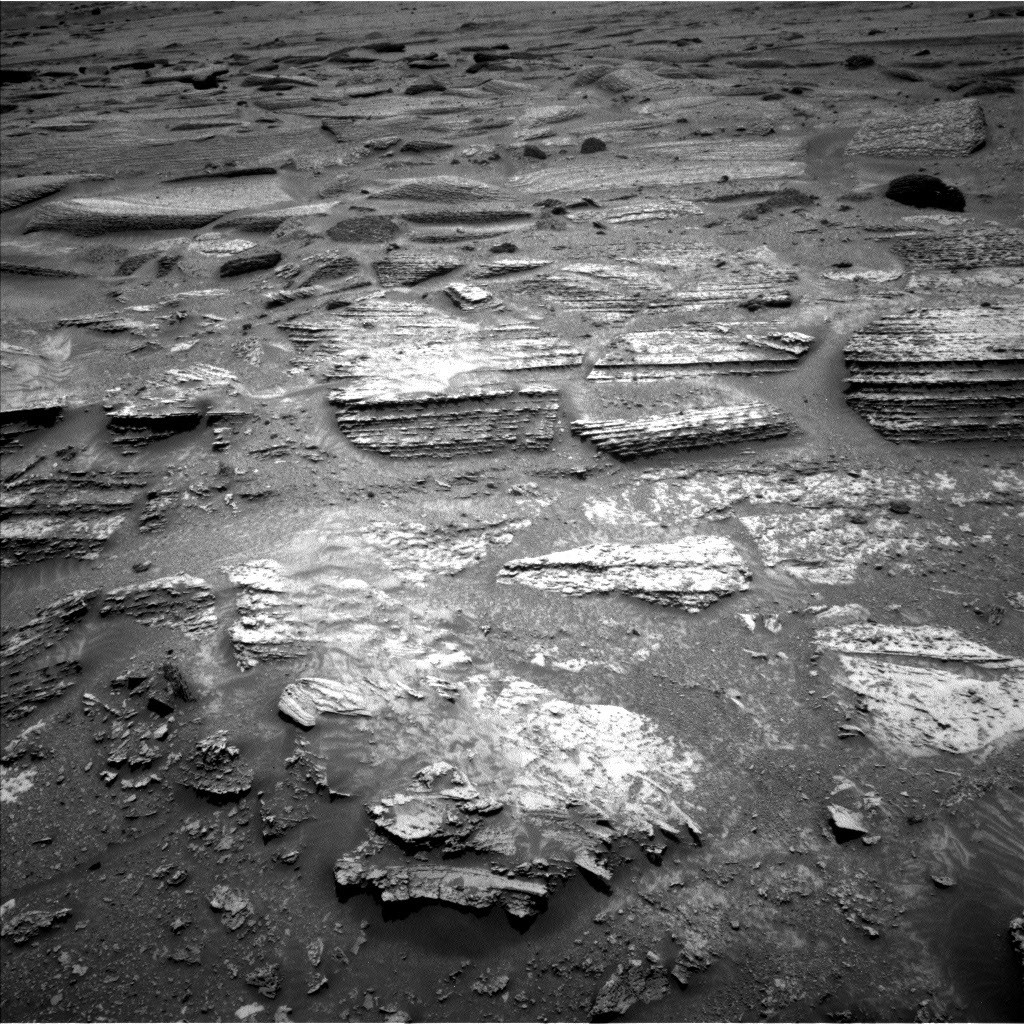
Curiosity Spends Pre-July 4th Week Staring at Martian Rocks, Because Why Not
Curiosity spends a week approaching a geologic boundary, zapping rocks with lasers, and filming dust devils - because on Mars, that’s how you celebrate Independence Day.
NASA’s Curiosity rover, apparently not one for fireworks, spent the week leading up to the Fourth of July doing what it does best: trundling across Mars and poking rocks with lasers. The rover approached a geologic boundary between a smooth, sandy region and a rougher bedrock unit, leaving behind the polygonal terrain that had presumably been keeping it entertained.
On Sol 4939 and 4940, Curiosity arrived at its first stop and dutifully looked for dust devils with its Navcam, performed an AEGIS ChemCam laser-spectroscopy observation, and took Mastcam images of a target it picked out itself. Sadly, there were no large rocks suitable for brushing with the Dust Removal Tool (DRT), so the rover had to make do with zapping smaller ones.
By Sol 4941, the MAHLI camera was ogling light-colored rock fragments named “Malpartida” and “Pico del Tunari,” while APXS performed X-ray spectroscopy to figure out what they’re made of. ChemCam lasered the “Kunturiri” bedrock fragment and passively observed “Mecoyita,” a dark float rock that apparently hitched a ride from elsewhere. The telescopic RMI camera studied sedimentary layers at the base of Cordillera butte, and Mastcam captured mosaics of a sandy ridge called “Sitajana.”
On Sol 4942, Mastcam kept studying “Sitajana,” ChemCam RMI got more views of Cordillera butte, and Navcam filmed a suprahorizon cloud movie and a dust-devil movie. ChemCam also zapped the dark bedrock “Toconce,” while Mastcam imaged “Sierra Vicuña Mackenna” to watch a rock shedding sand in a dune ripple area. That afternoon, Curiosity drove about 36 feet (11 meters) to the edge of the geologic contact and took panoramic mosaics, revealing a field of exposed bedrock with pinstriped layers - Martian fashion at its finest.
For Sol 4944, the rover selected two light bedrock targets, “Laguna Fea” and “Laguna Lejia,” for DRT brushing, MAHLI imaging, and APXS spectroscopy. ChemCam zapped the darker ledge “Hornillos,” which was deemed too rough for brushing - a rare case of a rock being too tough for NASA’s scrub brush. Mastcam took a large mosaic of the striped bedrock outcrop “Cerro Castillo” and a smaller one of a nearby trough. The RMI camera targeted a dark layer on Cordillera butte that appears to be shedding dark boulders, while Navcam recorded more dust devils and clouds.
On Sol 4945, ChemCam re-analyzed “Laguna Lejia” and studied another area at the base of Cordillera butte where large stones suggest ancient ice processes. After more dust-devil surveys and cloud movies, Curiosity drove about 56 feet (17 meters) toward a large, dark boulder in the distance - possibly a meteorite - and performed post-drive imaging. Overnight, APXS conducted a marathon atmospheric observation, because even Mars needs its ambient air quality checked.
The Good Times
News in your inbox.
One sardonic roundup, delivered on your schedule. Free. Unsubscribe whenever your tolerance for wit runs out.
Already subscribed but we never reach your inbox? Check your spam folder and hit 'Not spam' (or 'Remove from spam') to bust us out of junk-mail purgatory. You'll be helping everyone else too.
Don't open any of our emails for a month and you'll be automatically removed from the mailing list.
Rewrite Article
Select parts to regenerate with a fresh AI pass. Translations will be updated automatically.
Generate AI Image
Creates a sardonic version of the article image using OpenAI.