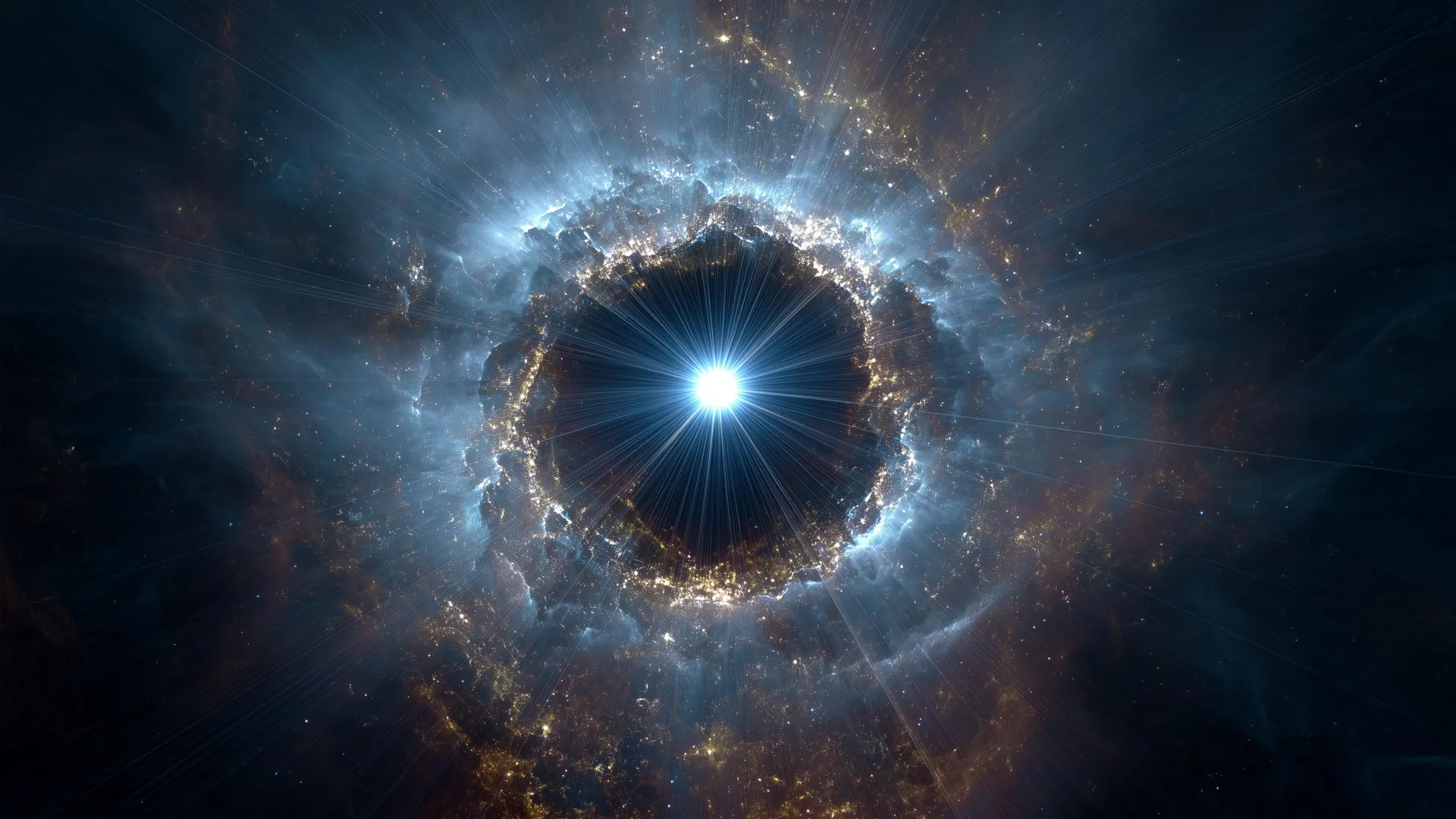
That faint cosmic hum you've been hearing? It might not be the universe's refrigerator. New research suggests the gravitational wave background detected by pulsar timing arrays could be the ghostly echo of supermassive black holes that formed more than 13 billion years ago - possibly from the collapse of hypothetical 'Dark Stars' powered by dark matter.
In a study published as a Letter in Physical Review D, Colgate University researchers Sohan Ghodla and Cosmin Ilie investigated whether supermassive black holes born in the early Universe could leave a lasting mark on the gravitational waves we detect today. The connection? The surprisingly massive black holes seen in the young Universe and the gravitational waves generated billions of years later when pairs of these behemoths spiral together.
The team found that one possible class of early black hole seeds - remnants of supermassive Dark Stars - could potentially dominate the Pulsar Timing Array (PTA) signal. As Ilie put it, 'Pulsar timing arrays are usually thought of as probes of supermassive black-hole binaries in the relatively recent Universe. What our work shows is that the signal may also contain information about how the ancestors of those black holes formed at cosmic dawn.'
For those not fluent in pulsar-speak: Pulsar Timing Arrays use rapidly spinning neutron stars as cosmic clocks. When gravitational waves pass through, they subtly alter the timing of radio pulses reaching Earth. By tracking many pulsars, teams have found evidence for a stochastic gravitational wave background at nanohertz frequencies - likely from supermassive black hole binaries, especially those with combined masses over a billion Suns.
But how did those black holes get so big so fast? That's where Dark Stars come in. These hypothetical primordial stars would be powered by dark matter heating rather than nuclear fusion, allowing them to grow to a million solar masses or more before collapsing into black holes. Ghodla and Ilie modeled how such seeds would evolve, merge, and produce gravitational waves.
Their conclusion? If Dark Star remnants exist at a number density of roughly 10^-3 Mpc^-3, their descendants could contribute a large, possibly dominant share of the PTA signal. In contrast, direct collapse black holes, with densities near 10^-6 Mpc^-3, would contribute far less.
The study also highlights a neat twist: PTA observations can limit how common these early seeds were. 'Produce too many of these massive seeds and you end up over-producing the PTA-detected signal. Produce too few, and you need other sources to efficiently assemble these supermassive black holes later,' said Ghodla. Seed densities around 10^-2 to 10^-1 Mpc^-3 would exceed observed limits, depending on halo masses.
This gives PTAs an unexpected ability to probe populations at redshifts greater than 10 - ancient objects whose descendants create the waves we see today. The calculations also confirm that binaries with total black hole masses above roughly 10^9 solar masses dominate the signal.
So, next time you hear that cosmic hum, remember: it might be the gravitational-wave imprint of the universe's first supermassive black holes, born from dark-matter-powered stars. Who knew the universe had such dramatic origins?
The Good Times
News in your inbox.
One sardonic roundup, delivered on your schedule. Free. Unsubscribe whenever your tolerance for wit runs out.
Already subscribed but we never reach your inbox? Check your spam folder and hit 'Not spam' (or 'Remove from spam') to bust us out of junk-mail purgatory. You'll be helping everyone else too.
Don't open any of our emails for a month and you'll be automatically removed from the mailing list.
Rewrite Article
Select parts to regenerate with a fresh AI pass. Translations will be updated automatically.
Generate AI Image
Creates a sardonic version of the article image using OpenAI.