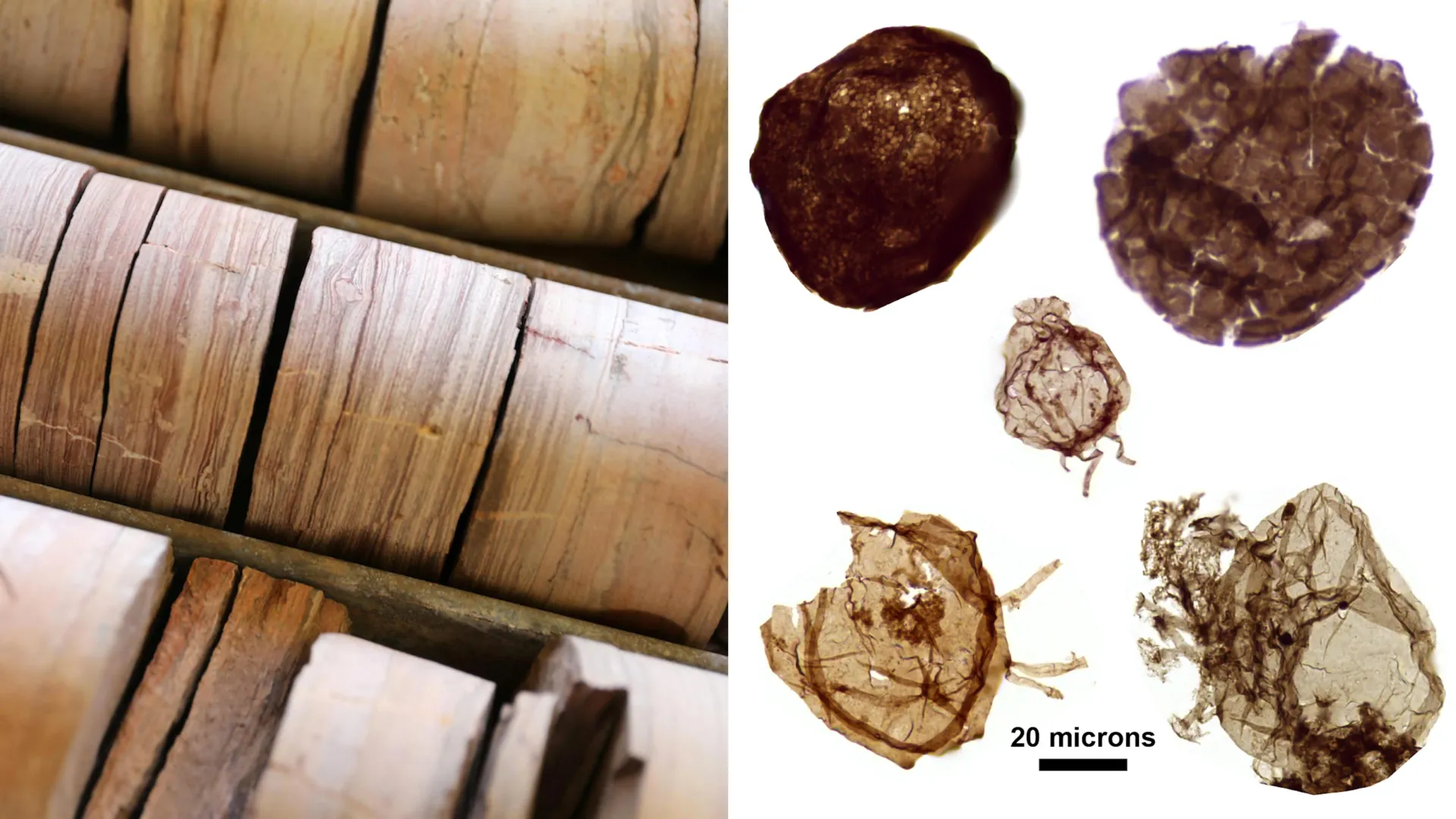
In an open-air warehouse in tropical Darwin, Australia, dozens of trays sit holding cylindrical rock cores, drilled hundreds of metres below the surface by mineral exploration companies decades ago. Those companies were mostly looking for minerals, not the secrets of existence, so they can be forgiven for not noticing the microscopic fossils of ancient organisms buried in the mudstone - sedimentary rock formed from hardened seafloor mud - of an inland sea that covered much of northern Australia over 1.5 billion years ago.
As a new study published in Nature shows, those neglected cores are central to a longstanding puzzle about the biggest evolutionary leap in Earth's history: the origin of eukaryotes.
All life on Earth falls into one of two categories, fundamentally different at the cellular level. Prokaryotes - bacteria and archaea - have simple cellular organization and are mostly single-celled. Eukaryotes, which include all animals, plants, algae and fungi, have far more complicated cells featuring a nucleus and specialized structures called organelles that perform specific jobs. The eukaryotic revolution transformed the planet, led to the rise of animals and, eventually, to us. Based on observations from the genes of living organisms, it is now widely agreed that the last common ancestor of all living eukaryotes resulted from the symbiotic union of at least two prokaryotic microbes: an archaeon and a bacterium.
The first evidence for eukaryotic life comes in the form of fossils of single-celled organisms showing a level of cellular complexity not seen among prokaryotes but common in eukaryotes. Eukaryote fossils can be found around the world in rocks dating back at least 1.5 billion years. The fossils of the Northern Territory, the oldest of which date back to 1.75 billion years ago, are the oldest currently known eukaryote fossils globally.
But the ancient world in which early eukaryotes evolved remains shrouded in mystery, and many fundamental aspects of their nature are unknown.
Many types of bacteria can live and grow without oxygen. But nearly all eukaryotes alive today use oxygen for survival, because aerobic respiration - breaking down food using oxygen - provides the vast amounts of energy that complex life demands. Yet the idea that oxygen has always been beneficial for all eukaryotes has come under fire in recent years, following surprising discoveries of enigmatic eukaryotes that can thrive without oxygen. There is also mounting evidence from the geological record that when eukaryotes were first evolving, oxygen was likely much scarcer, meaning oxygen-free marine habitats would have been the norm. Collectively, these observations have called into question the assumption that eukaryotes have depended on oxygen since their inception.
Genetic studies of living microbes belonging to groups considered closest to the ancestors of the first eukaryote can offer key insights into eukaryote ancestry. But only the fossil record can tell us about long-extinct lineages, and only geology can offer a window into the kind of world these organisms lived in.
For the new study, researchers crushed up samples of the mudstone cores stored in Darwin, then dissolved them. They identified more than 12,000 fossils by analysing the organic residue left behind under a microscope. They also studied the mudstones the fossils were preserved in to better understand what the environment was like when the sediments were deposited, offering insight about the habitats in which these eukaryotes lived. And by analysing the chemistry of these mudstones, they could determine whether oxygen was present in the ancient seawater.
The results show that eukaryote fossils were found in environments ranging from coastal mudflats to the open sea, but only in samples deposited in oxygenated settings. Samples from oxygen-free environments contained only simple, prokaryotic forms. This suggests that even the oldest known eukaryotes that lived on Earth 1.7 to 1.4 billion years ago were dependent on oxygen, lending support to a long-held hypothesis that oxygen played a key role in driving the evolution of early eukaryotes.
Resolving the drivers and context of the major evolutionary leap represented by early eukaryotes is one of the major outstanding questions in the life sciences. Ongoing studies of these enigmatic, ancient microfossils will no doubt tell us more about our own origins - and our place in the cosmos.
The Good Times
News in your inbox.
One sardonic roundup, delivered on your schedule. Free. Unsubscribe whenever your tolerance for wit runs out.
Already subscribed but we never reach your inbox? Check your spam folder and hit 'Not spam' (or 'Remove from spam') to bust us out of junk-mail purgatory. You'll be helping everyone else too.
Don't open any of our emails for a month and you'll be automatically removed from the mailing list.
Rewrite Article
Select parts to regenerate with a fresh AI pass. Translations will be updated automatically.
Generate AI Image
Creates a sardonic version of the article image using OpenAI.