
For decades, astronomers peering through Hubble have been trying to catch a glimpse of the Universe’s first stars flickering to life. The small galaxies that built the cosmos, however, were too faint to spot - even by the fanciest instruments. Now, astronomers finally have two things on their side: the Webb Space Telescope and a bit of cosmic luck.
In a recent paper in Nature, a team led by Kimihiko Nakajima at Kanazawa University, Japan, used the James Webb Space Telescope to observe an ultra-faint galaxy called LAP1-B as it existed roughly 800 million years after the Big Bang. It’s the most chemically primitive galaxy we’ve ever seen - which is saying something, given how many primitive things we’ve spotted.
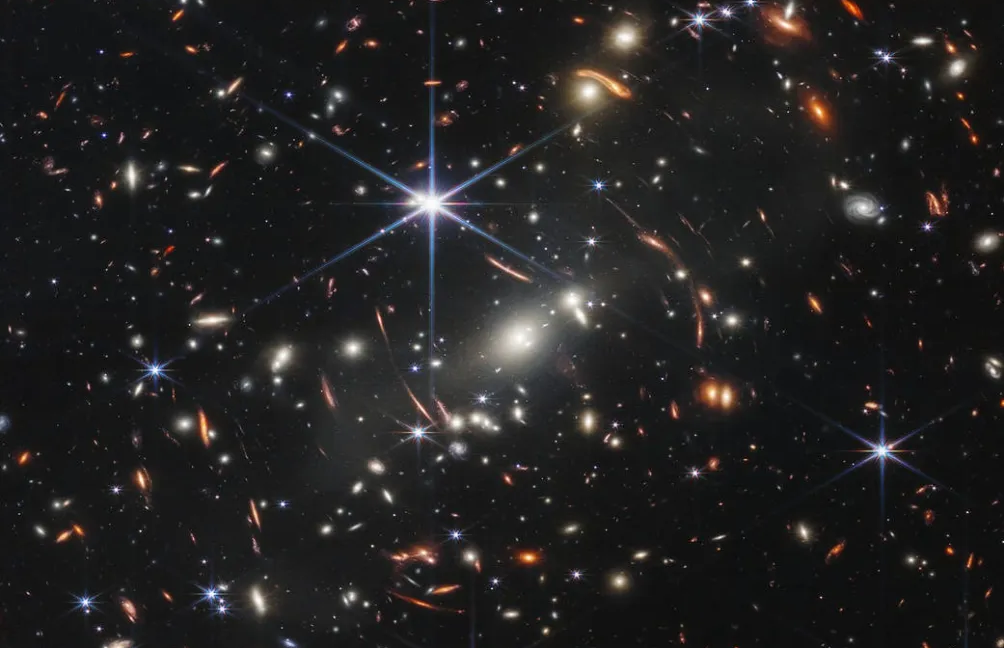
LAP1-B is 13 billion light-years away. Even JWST’s huge, gold-coated beryllium mirrors weren’t enough alone. The team spotted it thanks to a massive galaxy cluster called MACS J046, which warps spacetime between us and LAP1-B like a cosmic funhouse mirror. “The galaxy was strongly magnified through the gravitational lensing effect,” Nakajima said. Specifically, the warped spacetime boosted LAP1-B’s brightness by roughly 100-fold.
Even with that boost, LAP1-B is so dim that neither JWST nor Hubble could detect its stellar continuum - the steady background light of its stars. For Nakajima and colleagues, that was itself a clue. Knowing the distance and telescope sensitivity, they calculated the hard upper limit of LAP1-B’s stellar mass: 3,300 Suns. That’s a rounding error compared to the Milky Way’s roughly 100 billion solar masses.
Most of the light hitting JWST’s mirrors wasn’t from stars but from glowing gas. Examining that gas, the team realized LAP1-B is the closest thing to the first pristine galaxies we’ve observed. The glow comes from high-energy radiation from massive stars hitting surrounding interstellar gas clouds, making them fluoresce. Using JWST’s Near-Infrared Spectrograph, the researchers broke the light into a spectrum and searched for emission lines indicating chemical composition.
“We wanted to measure how much oxygen was present,” Nakajima said. The analysis revealed a profound shortage of elements heavier than hydrogen and helium. The gas-phase oxygen-to-hydrogen ratio stood at just 0.4 percent of what we find in our Sun. Another detail: triply ionized carbon - a state where a carbon atom loses half its six electrons. Stripping those electrons requires extreme-ultraviolet photons with energies exceeding 47.9 electronvolts. Standard stars, even massive ones near us, aren’t hot enough. The stars that could get that hot, the team suggests, were the very first ignited in the Universe - made exclusively of hydrogen and helium from the Big Bang, lacking heavy elements to cool as they formed. “Such stars should be formed from primordial gas,” Nakajima said.
Today’s stars, including our Sun, are Population I. Older ones in the galactic halo are Population II, with far lower heavy elements. Population III stars were the first - theorized as violent monsters with masses hundreds of times the Sun squeezed into small volumes, burning extremely hot and dying young in supernovae. Nakajima’s team likely found traces of those explosions in LAP1-B.
Despite being incredibly poor in heavy elements, LAP1-B has an unusually high carbon-to-oxygen ratio - higher than our Sun’s. The researchers think the answer lies in how those massive first-generation stars died. When a Population III star collapses, its core becomes a black hole, but the supernova isn’t energetic enough to blow the star apart. “Their bounding energy of gravity is stronger than in the usual massive stars,” Nakajima said. The collapse results in a faint supernova with significant fallback: heavier elements like oxygen get sucked past the event horizon, while lighter outer layers rich in carbon escape. LAP1-B’s chemical makeup looks like a fingerprint of gas from Population III supernovae.
One more clue: gas speed. By measuring Doppler broadening of emission lines, the team found gas swirling at roughly 58 kilometers per second - typical for dwarf galaxies. Using gravity, they calculated the mass needed to keep that gas from flying off: “10 million solar masses,” Nakajima said. Since stars account for less than 3,300 solar masses and gas adds a tiny bit more, the rest must be dark matter. LAP1-B is dominated by a massive dark matter halo - invisible scaffolding that pulled in primordial gas to form the first stars.
Uncertainties remain. The intense radiation producing triply ionized carbon could come from extremely massive Population II stars instead. Heavy elements, though extremely low, are still 10 times higher than in the most primitive stars observed today. Clearing this up will take more research, wrote Alexander Ji, an astronomer at the University of Chicago and author of Nature’s News & Views commentary. Still, Ji argued, LAP1-B offers “some of the best insights into the first stars and galaxies uncovered by JWST.”
What LAP1-B primarily is, Nakajima said, is a missing link in cosmic evolution. Several ancient clusters called Ultra-Faint Dwarf galaxies orbit the Milky Way - extremely low-mass, dark-matter-dominated, filled with carbon-enhanced, metal-poor stars. They’re dead cosmic fossils that stopped forming stars billions of years ago. Astronomers suspect these galaxies were killed during the Epoch of Reionization, when intense ultraviolet light from the first galaxies heated intergalactic gas, starving small galaxies of cold gas. LAP1-B looks like a fossil in the making, observed just before the reionization wave rolled through.
“This is a step forward toward understanding the primordial Universe,” Nakajima said. “The obvious next step is to find more metal-deficient galaxies, and this work is already underway.”