Tiny Gold Crystal Says 'No Thanks' to Absolute Zero, Brings Quantum Tech to Room Temperature
LSU physicists craft a gold metacrystal that sorts quantum light at room temperature, potentially ditching the cryogenic chill and paving the way for practical quantum tech.
Quantum materials have been the tech world's most promising and simultaneously most frustrating guests: they show up with incredible abilities, but only if you freeze them to near absolute zero. At room temperature, heat makes atoms vibrate like a caffeine-fueled crowd, wrecking the delicate quantum effects everyone's trying to control. This has meant massive cryogenic refrigeration systems - expensive, bulky, and about as practical for everyday devices as a personal snowplow.
But now, LSU physicists have crashed the party with the first room-temperature quantum material that can identify and transport distinct quantum states of light. The breakthrough, published in Nature, tackles the biggest obstacle in quantum materials research: the need for extreme cold.
Led by Associate Professor Omar S. Magaña-Loaiza, the team didn't just stumble upon a new material; they engineered it from scratch. Chenglong You, a former postdoc now at the University of Electronic Science and Technology of China, was thrilled when the weird design worked exactly as predicted: "One of the most exciting parts of this project was realizing that we could build a material that does something nature doesn't provide on its own. Seeing it work exactly as we predicted was incredibly rewarding."
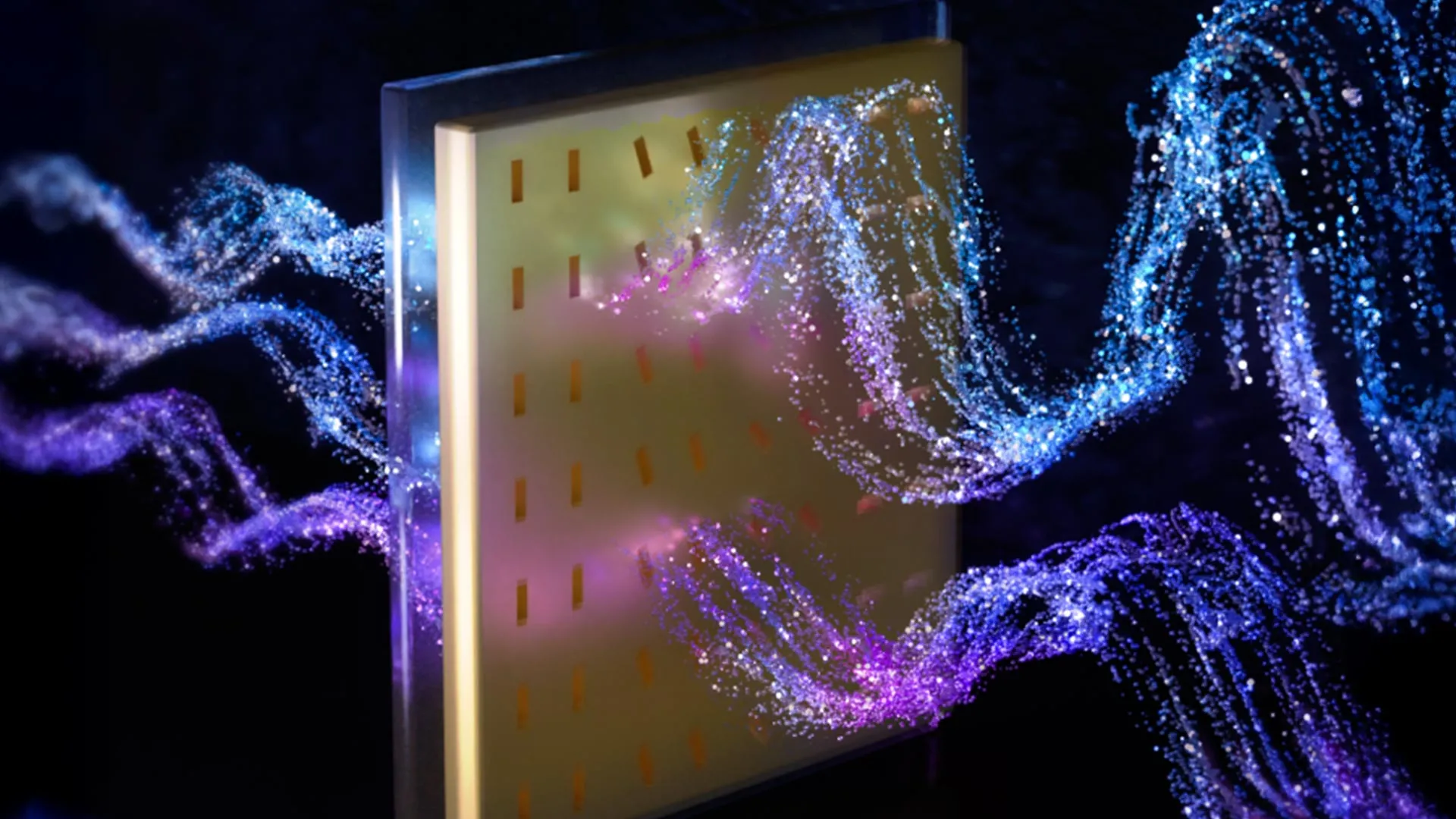
Here's the recipe: take a glass chip, slap a thin layer of gold on it, and use focused ion beams to carve hundreds of tiny slits. Each slit acts like an artificial atom, or 'meta-atom,' and together they form a crystal thinner than a human hair - nature never made anything like it. When light hits the chip, it interacts with these meta-atoms, and by tweaking their size, shape, and spacing, the team controls how the material responds to light. The result? Light manipulation never before achieved at room temperature.
Riley B. Dawkins, who just finished his Ph.D. and is heading to NIST as an NRC Postdoctoral Research Associate, explains: "By engineering the distribution of meta-atoms in the plasmonic metacrystal, we can systematically dictate which quantum statistics are allowed to pass through the structure. So, our crystal essentially acts as a statistical filter on quantum states."
The metacrystal doesn't just sit there; it sorts different quantum states of light. Sunlight, laser light, and fluorescent light all have different photon behaviors, and distinguishing them usually requires complex equipment, cryogenic detectors, and millions of measurements. This crystal does it on its own, directing different quantum states along separate routes while preserving their statistics - a trick called 'robust transport.' As Magaña-Loaiza puts it: "These quantum states carry information. Our crystal can distinguish them and move them from one point to another in a robust way without requiring cryogenic cooling. That's what opens the door to practical quantum technologies."
This is the first room-temperature quantum material inherently sensitive to quantum coherence in many-body systems - a big deal, since maintaining coherence is notoriously hard.
The team even coined a new term: 'quantum statistical plasmonic metacrystal.' They also discovered 'quantum statistical bands,' which work like the electronic band structures in semiconductors but govern light's quantum states. By rearranging meta-atoms, researchers can choose which states pass through unchanged. This design blueprint could spawn a whole family of quantum materials without needing to find them in nature.
Room-temperature operation makes this relevant beyond labs: quantum computers could shrink without giant cooling systems, quantum communication networks could become more practical, and sensors could get more sensitive. Plus, the material might boost solar cells by guiding light along stable pathways, preventing energy loss as heat. The team plans to test that next by integrating the metacrystal into solar cells.
The work was funded by the U.S. Department of Energy, Office of Basic Energy Sciences, Division of Materials Sciences and Engineering, under Award DE-SC0021069. Materials provided by Louisiana State University. Content may be edited for style and length.
The Good Times
News in your inbox.
One sardonic roundup, delivered on your schedule. Free. Unsubscribe whenever your tolerance for wit runs out.
Already subscribed but we never reach your inbox? Check your spam folder and hit 'Not spam' (or 'Remove from spam') to bust us out of junk-mail purgatory. You'll be helping everyone else too.
Don't open any of our emails for a month and you'll be automatically removed from the mailing list.
Rewrite Article
Select parts to regenerate with a fresh AI pass. Translations will be updated automatically.
Generate AI Image
Creates a sardonic version of the article image using OpenAI.