Tiny Black Holes May Be Secretly Exploding Stars Across the Milky Way
Primordial black holes might be secretly triggering white dwarf supernovae, potentially explaining galactic chemistry and giving dark matter something else to do.
An international research team has found that primordial black holes - those hypothetical remnants from the universe's earliest moments - might be triggering white dwarf stars to explode as Type Ia supernovae. Because that's exactly what the cosmos needed: more things exploding. The study, published in The Astrophysical Journal, also suggests these unusual explosions could help explain a puzzling chemical abundance pattern seen among stars in the Milky Way.
Primordial black holes (PBH) are thought to have formed during cosmic inflation, when the rapid expansion of the universe amplified tiny fluctuations in matter distribution. They've long been proposed as candidates for dark matter, the invisible stuff that supposedly makes up about 90% of all matter in the Universe by mass. Because, sure, why not add 'secretly exploding stars' to the list of things dark matter might be doing.
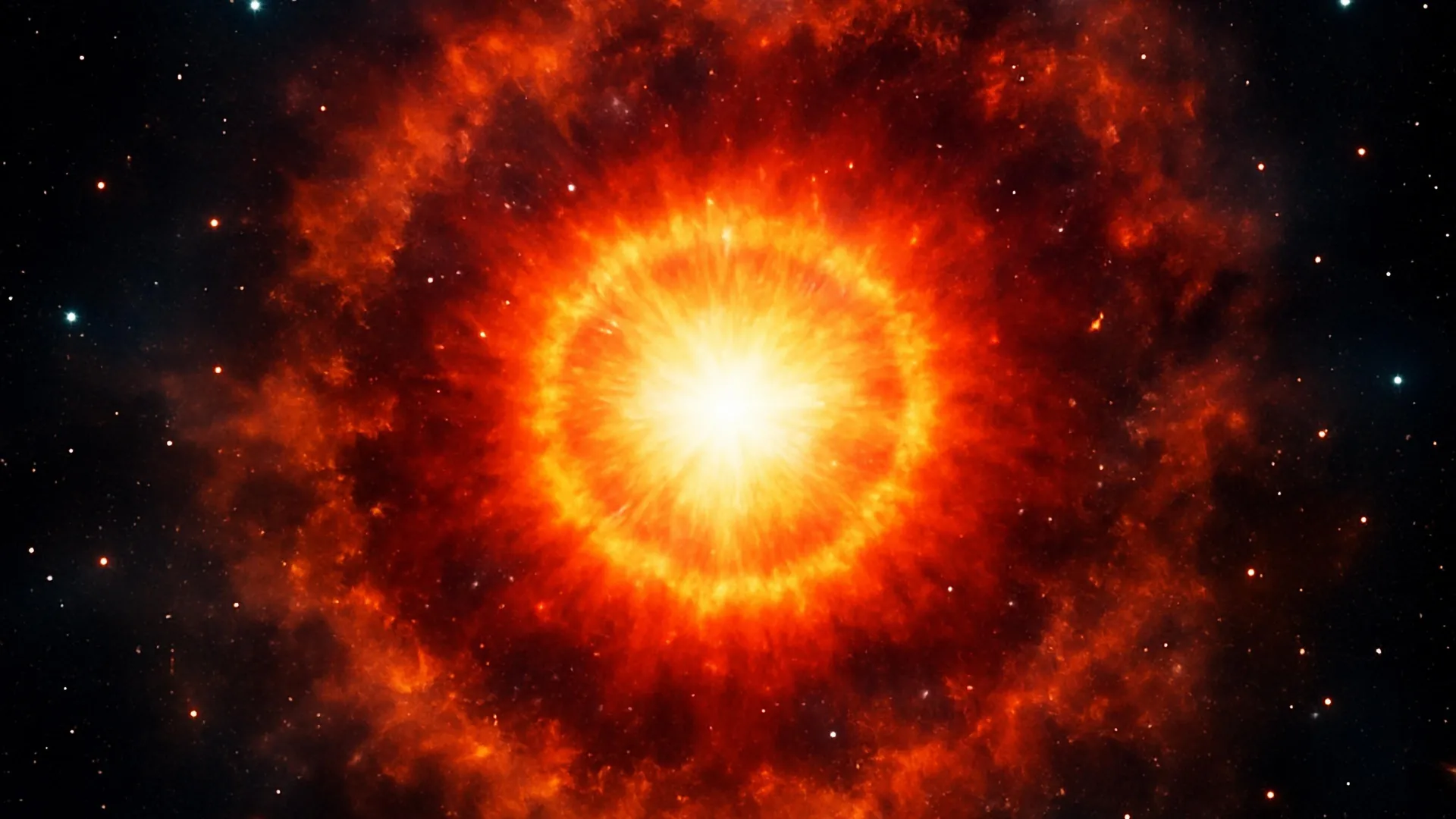
Here's the proposed mechanism: as primordial black holes travel through space, they might occasionally pass through a white dwarf - the dense stellar remnant left after a low-mass star runs out of fuel. The black hole's gravity would create powerful tidal forces inside the star, destabilizing it and causing it to explode as a Type Ia supernova (SNe Ia). Type Ia supernovae are extremely bright explosions, generally believed to occur when a white dwarf becomes unstable and undergoes a runaway thermonuclear reaction. But who needs the 'generally believed' when you can have 'possibly triggered by a tiny black hole'?
The research was led by Shing-Chi Leung, an assistant professor at SUNY Polytechnic Institute and a visiting associate scientist at The University of Tokyo Kavli Institute for the Physics and Mathematics of the Universe (Kavli IPMU). The team also included Kavli IPMU Visiting Senior Scientist Ken'ichi Nomoto and Kavli IPMU Senior Fellow Alexander Kusenko. They investigated the motion, brightness, and chemical properties of supernovae produced through this proposed PBH-triggered explosion channel.
In an earlier paper published in 2025, the team showed that PBH-triggered explosions could produce SNe Ia with properties closely resembling those generated by standard models. For the new study, they compared their models with several well-known supernova remnants (Tycho, Kepler, 3C 397), nearby supernovae (e.g., SN 2011fe, SN 2012cg), and the chemical abundances of Milky Way stars. Their results showed that PBH-triggered SNe Ia could reproduce several characteristics observed in these supernovae and their remnants.
The researchers examined radioactive isotopes such as Ni-56, Ni-57, and stable elements like Mn and Ni. These chemical signatures allowed them to estimate the masses and metallicities of the stars that produced the explosions. Metallicity - the amount of metal when the star is formed, which probes when the star was born in the cosmic age - provides clues about when a star formed and the chemical conditions at that point in the universe's history. (In astronomy, 'metals' are elements heavier than hydrogen and helium, because astronomers have their own definitions.)
The team also used supernova models to explore how this explosion mechanism could contribute to galactic chemical enrichment. Supernovae release newly formed elements into space, where they can later become part of new stars and planets. The analysis indicated that a non-zero fraction of PBH-triggered SN Ia may be needed to explain the chemical abundance trend observed in stars across the Milky Way. This suggests that primordial black holes may have influenced the chemical evolution of our galaxy through the stellar explosions they triggered.
'Our work suggests that some supernova that we observe in the sky could be a result of the PBHs. Therefore, even though we cannot directly observe these evasive entities, they leave many interesting clues in nature for us to probe their properties,' Leung said. The researchers plan to broaden their investigation by studying how PBH-triggered explosions might affect the overall population of conventional supernovae and the combined rates of these brief but powerful cosmic events.
Materials provided by Kavli Institute for the Physics and Mathematics of the Universe. Note: Content may be edited for style and length.
The Good Times
News in your inbox.
One sardonic roundup, delivered on your schedule. Free. Unsubscribe whenever your tolerance for wit runs out.
Already subscribed but we never reach your inbox? Check your spam folder and hit 'Not spam' (or 'Remove from spam') to bust us out of junk-mail purgatory. You'll be helping everyone else too.
Don't open any of our emails for a month and you'll be automatically removed from the mailing list.
Rewrite Article
Select parts to regenerate with a fresh AI pass. Translations will be updated automatically.
Generate AI Image
Creates a sardonic version of the article image using OpenAI.