Sunlight Does Quantum Entanglement Now, Because Lasers Are Apparently Too Mainstream
Researchers proved sunlight can create quantum entanglement, potentially replacing lasers with the most abundant light source in the solar system. Your quantum computer may soon run on solar power.
In a move that will surely delight environmentalists and confuse anyone who remembers physics class, researchers have demonstrated that plain old sunlight can generate quantum entanglement - a phenomenon previously thought to require the coherent, laser-focused effort of a well-tuned laser. Because why use a precise, energy-hogging laser when you can just... open the blinds?
The findings, published in Optica, show that sunlight can produce entanglement comparable to laser-based techniques, provided you account for the bandwidth differences. The work is a collaboration between Robert Boyd's group at the University of Ottawa and Hanieh Fattahi's team at the Max Planck Institute for the Science of Light (MPL) in Germany. Because apparently, international cooperation is also required to harness the power of the sun.
"Quantum entanglement is crucial for applications such as secure communication, ultra-precise sensing and high-performance computation," said Cheng Li, a recent graduate of the University of Ottawa and first author of the paper. "Our work shows that abundant natural light sources can be used for quantum entanglement, opening the possibility of more energy-efficient and accessible quantum technologies."
In other words, your future quantum computer might be powered by the same thing that gives you a sunburn. Li also noted that "this technology could one day enable satellites to create secure encryption keys using the sunlight already abundant in space, reducing the need for onboard lasers and much of the supporting hardware." Because why carry a laser into space when the sun is right there, doing its thing?
The team challenged the long-held assumption that quantum entanglement requires coherent light - the kind where waves are synchronized and predictable, like a laser. Earlier work from Boyd's team had already shown that an LED, an incoherent light source, could produce polarization-entangled photons. Now they've upgraded to sunlight, which is even more chaotic, spreading in all directions and sporting a full rainbow of colors.
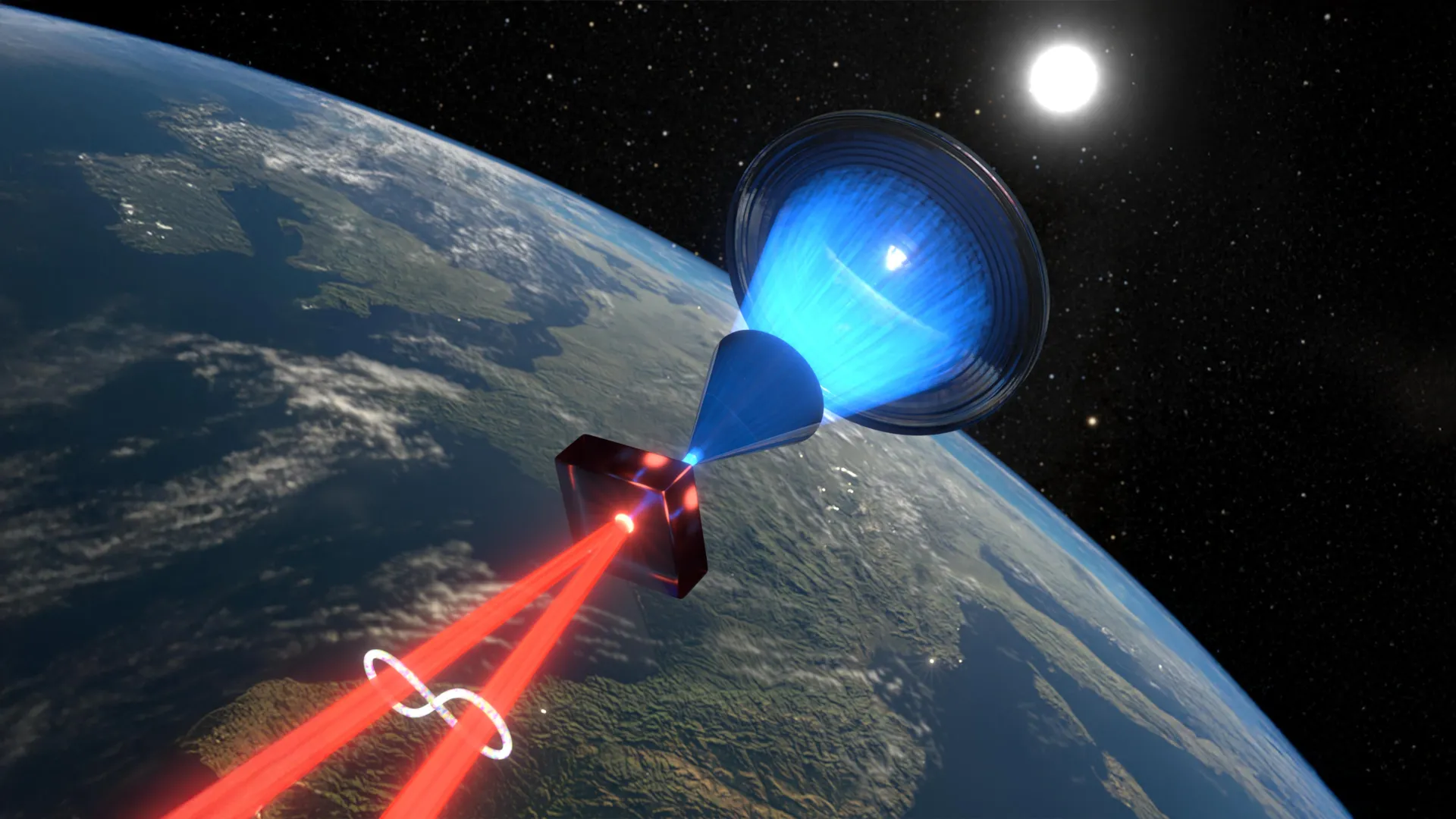
To wrangle this chaos, the researchers used spontaneous parametric down-conversion (SPDC), a process where a pump beam enters a nonlinear crystal and splits photons into entangled pairs. Instead of a laser pump, they used strongly polarized sunlight, which remained highly incoherent in space and time but oscillated in a consistent direction. "We designed our experimental setup so that differences introduced by the different colors and propagation directions didn't influence the photons' polarization," Li explained. "As our theory predicts, if the entanglement lives only in polarization, then it should only depend on the pump's orderliness in its oscillation direction and not on its direction or color."
But there was a catch: the nonlinear crystal is only about a millimeter across, so they needed to concentrate the sunlight. Fattahi's team at MPL built an all-glass solar concentrator that uses a Fresnel lens the size of a household window to funnel sunlight into an optical fiber about as wide as a human hair, then direct it onto the tiny crystal. Because nothing says "quantum optics" like a setup that resembles a giant magnifying glass.
Outdoor experiments at MPL confirmed the theory: quantum state tomography showed the sunlight-produced entanglement was about 94% similar to a perfectly entangled state, and the photons violated Bell's inequality, proving they were genuinely entangled and not just having a classical misunderstanding.
The team is now working on increasing brightness and improving entanglement quality, with hopes of taking the system outside the lab. They also suggest the approach could work with other nonlinear optical techniques like four-wave mixing, potentially opening new doors in quantum photonics.
Of course, the scientific community had its doubts. "Since the inception of this project, our idea has met with repeated doubt and pushback," Li said. "Some world-renowned researchers in the field even questioned whether it would be possible to detect any photons - not to mention entangled photons - from sunlight-driven nonlinear optical processes. However, we trusted our calculations, continued improving the experimental setup, and eventually showed that it was possible."
So next time you're at the beach, remember: the sun isn't just giving you a tan; it's also quietly doing quantum physics. And you thought it was just a big ball of gas.
The Good Times
News in your inbox.
One sardonic roundup, delivered on your schedule. Free. Unsubscribe whenever your tolerance for wit runs out.
Already subscribed but we never reach your inbox? Check your spam folder and hit 'Not spam' (or 'Remove from spam') to bust us out of junk-mail purgatory. You'll be helping everyone else too.
Don't open any of our emails for a month and you'll be automatically removed from the mailing list.
Rewrite Article
Select parts to regenerate with a fresh AI pass. Translations will be updated automatically.
Generate AI Image
Creates a sardonic version of the article image using OpenAI.