Stanford Physicists Create Fingertip-Sized Light Booster That Uses Surprisingly Little Juice
Stanford physicists built a fingertip-sized optical amplifier that boosts light signals 100x while sipping power - because apparently light needed a performance-enhancing drug.
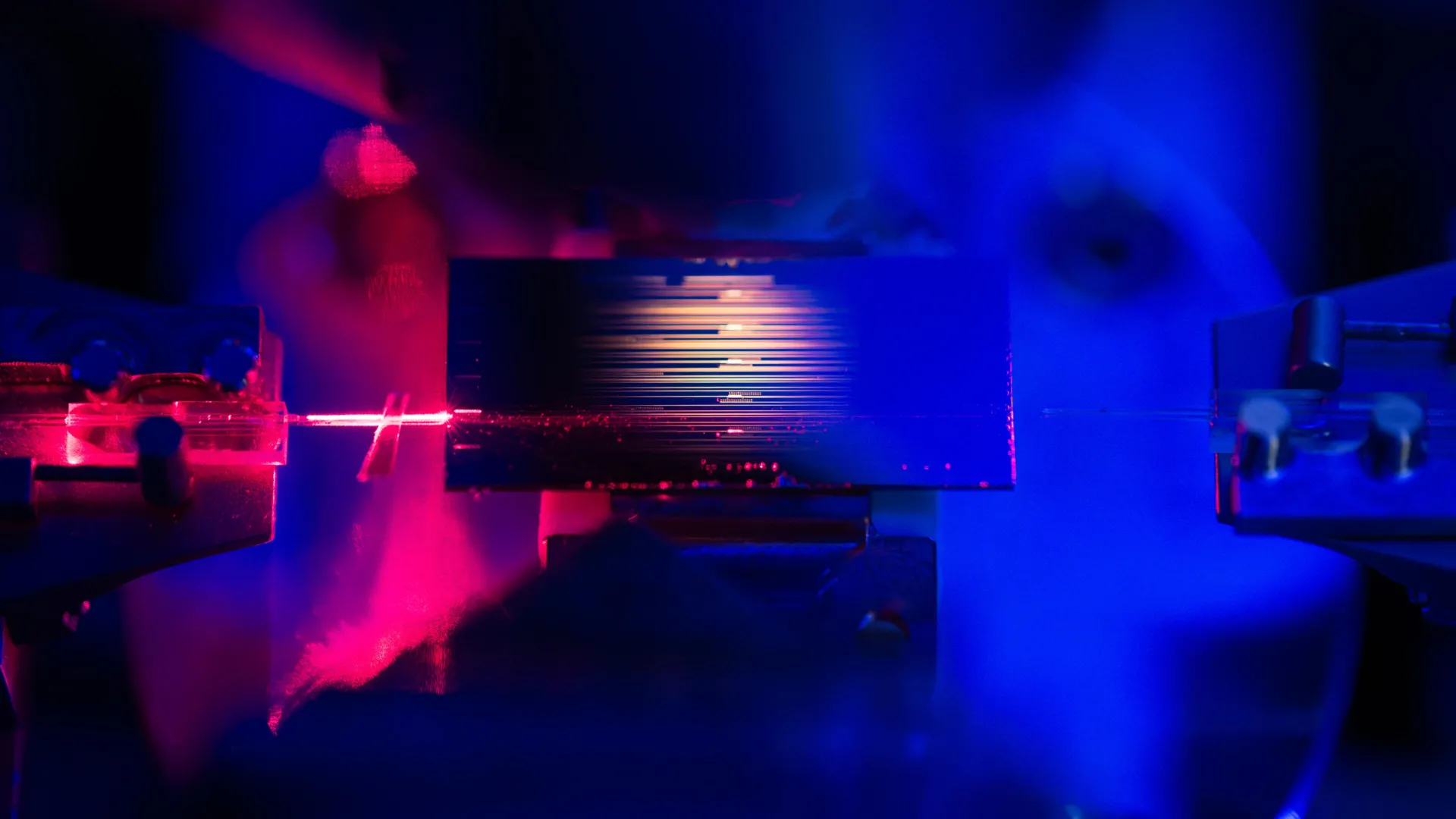
Light does a lot of heavy lifting in modern life - TVs, satellites, the fiber optic cables that let you read this sentence. Now physicists at Stanford have figured out how to give light a little extra oomph without burning through the power bill. They built an optical amplifier roughly the size of a fingertip that can strengthen light signals by about 100 times while consuming only a few hundred milliwatts.
For context, optical amplifiers work like audio amplifiers - except they boost light instead of your neighbor’s bass-heavy playlist. Traditional compact versions tend to guzzle power, making them about as efficient as a treadmill that only runs downhill. The new device, described in the journal Nature, sidesteps this by recycling much of the energy it needs to operate.
“We’ve demonstrated, for the first time, a truly versatile, low-power optical amplifier, one that can operate across the optical spectrum and is efficient enough that it can be integrated on a chip,” said Amir Safavi-Naeini, the study’s senior author and associate professor of physics at Stanford. Translation: we can now build much more complex optical systems than before, and they won’t need their own power plant.
The amplifier keeps noise to a minimum - no one wants a hissy signal - and works across a wider range of wavelengths than existing models, meaning it can carry more data with less interference. The secret sauce involves a resonant design that sends light back on itself, like a photon doing laps around a racetrack. The pump light loops around, gets more intense, and amplifies the target signal more efficiently.
“By recycling the energy of the pump that powers this amplifier, we made it more efficient, and this doesn’t come at a cost to its other properties,” said Devin Dean, co-first author and a doctoral student in Safavi-Naeini’s lab. Because the device is compact and energy-efficient, it could run on a battery and be stuffed into laptops, smartphones, or other small electronics.
“When you can do that, then the possibilities are really quite broad because they are so small that you can mass produce them and power them with batteries,” Dean said. Potential applications include data communications, biosensing, and making new light sources - basically anything that could use a stronger signal without a bigger plug.
The research was supported by the Defense Advanced Research Projects Agency, NTT Research, and the National Science Foundation. Co-authors also include Taewon Park, Martin Fejer, Hubert Stokowski, Sam Robison, Alexander Hwang, Luke Qi, and Jason Herrmann. Dean, Park, Safavi-Naeini, and Stokowski have filed a patent application covering methods for achieving quantum advantage in power-constrained photonic sensors.
Materials provided by Stanford University. Note: Content may be edited for style and length.
The Good Times
News in your inbox.
One sardonic roundup, delivered on your schedule. Free. Unsubscribe whenever your tolerance for wit runs out.
Already subscribed but we never reach your inbox? Check your spam folder and hit 'Not spam' (or 'Remove from spam') to bust us out of junk-mail purgatory. You'll be helping everyone else too.
Don't open any of our emails for a month and you'll be automatically removed from the mailing list.
Rewrite Article
Select parts to regenerate with a fresh AI pass. Translations will be updated automatically.
Generate AI Image
Creates a sardonic version of the article image using OpenAI.