Silly Sprinklers Solve Feynman's Reverse Sprinkler Puzzle, Scientists Confirm What Everyone Suspected: Physics Is Weird
NYU physicists used silly sprinklers to finally settle a century-old fluid dynamics puzzle, proving that even Feynman got it wrong - and that lawn ornaments have hidden depths.
Watering your lawn can be both pragmatic and fun with so-called “silly sprinklers,” those delightful plastic contraptions that spray water in amusing loops and spirals. But beneath their playful exterior lies a serious physics problem that has puzzled scientists for over a century. Researchers at New York University’s Courant Institute have now tackled the reverse sprinkler problem - popularized by physicist Richard Feynman - by experimenting with silly sprinklers they built themselves. Their findings, published in the Proceedings of the National Academy of Sciences, support a theory called momentum flux theory and debunk earlier hypotheses by both Ernst Mach and Feynman.
The reverse sprinkler problem dates back to a thought experiment in Ernst Mach’s 1883 textbook. Mach proposed that a sprinkler sucking water in would not rotate, as the forces on the nozzle would cancel out. Feynman, as a graduate student at Princeton in the 1940s, famously debated the issue and built an experiment in the cyclotron lab, observing only a slight tremor. But later experiments produced conflicting results: some showed steady reverse rotation, others only transient motion, and some unsteady changes in direction.
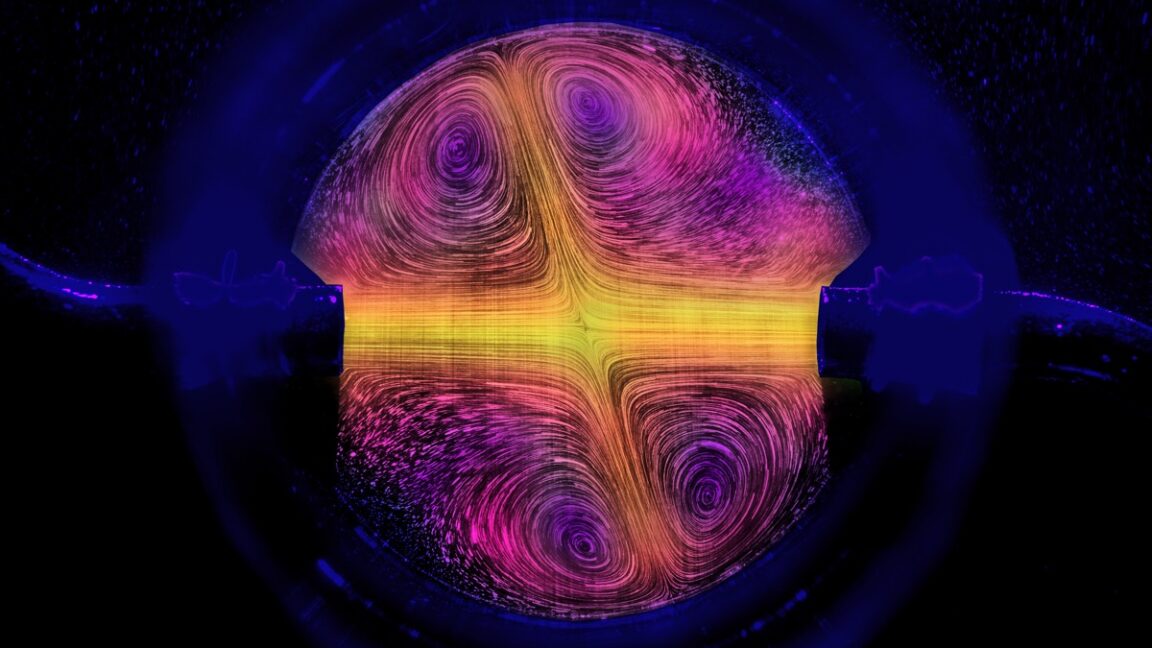
In 2024, NYU applied mathematician Leif Ristroph and his team built a custom sprinkler with ultra-low-friction bearings, immersed it in water, and used dyes and lasers to track flow. They found that the reverse sprinkler rotates 50 times slower than a regular one, but through similar mechanisms - like an “inside-out rocket” where internal jets collide and produce torque. Their mathematical model, momentum flux theory, matched experiments but only tested S-shaped arms.
Now, Ristroph et al. extend that work to silly sprinklers of various shapes, testing both forward and reverse modes. The results strongly support momentum flux theory and contradict Mach’s and Feynman’s ideas. They also showed that arm shape controls jet flow, offering guidelines for designing structures like turbines that convert fluid flows into energy. “Our findings provide a firmer understanding of how components respond to fluid flows - knowledge that can guide future engineering and technological advances,” said co-author Brennan Sprinkle of the Colorado School of Mines.
Ristroph’s lab has a history of tackling colorful puzzles: in 2018, they perfected the bubble recipe; in 2021, they studied Chinese “stone forests”; in 2021, they built a working Tesla valve; and in 2022, they analyzed paper airplane aerodynamics. Because sometimes the most profound physics comes from the silliest toys.
The Good Times
News in your inbox.
One sardonic roundup, delivered on your schedule. Free. Unsubscribe whenever your tolerance for wit runs out.
Already subscribed but we never reach your inbox? Check your spam folder and hit 'Not spam' (or 'Remove from spam') to bust us out of junk-mail purgatory. You'll be helping everyone else too.
Don't open any of our emails for a month and you'll be automatically removed from the mailing list.
Rewrite Article
Select parts to regenerate with a fresh AI pass. Translations will be updated automatically.
Generate AI Image
Creates a sardonic version of the article image using OpenAI.