
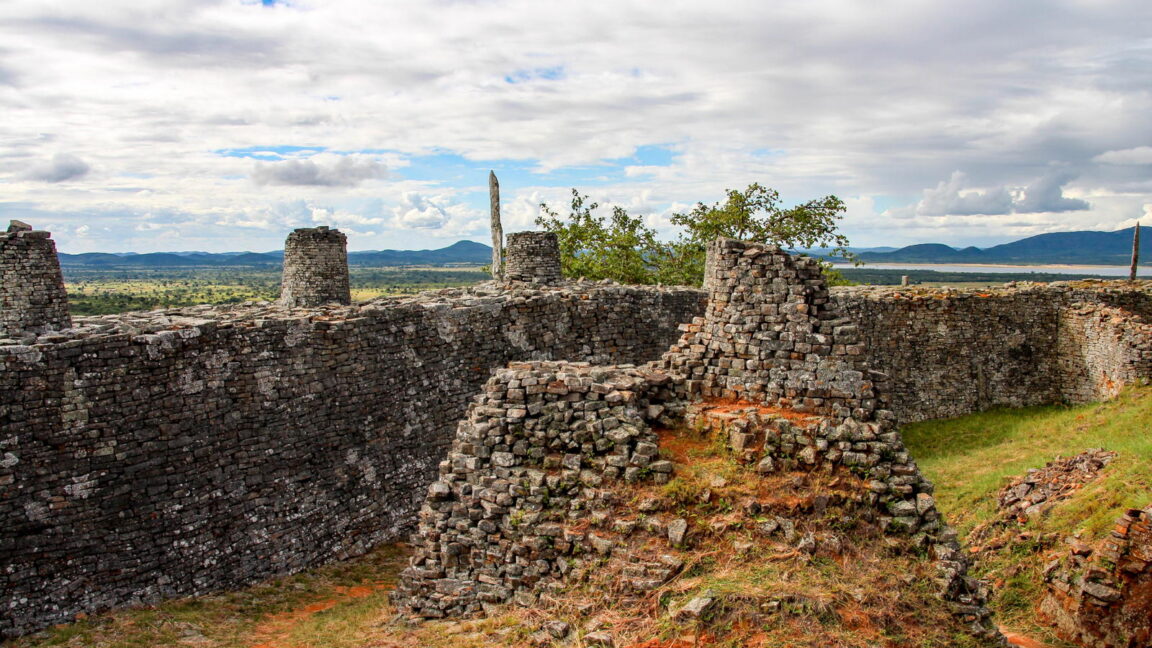
It turns out you can't just wake up one morning and decide to smelt iron. But the peoples of Great Zimbabwe - capital of a thriving southern African kingdom between 1000 and 1700 AD - were, by all accounts, annoyingly good at it. At sites near the city's stone ruins, clusters of iron-smelting furnaces survive as mounds of rubble; at Mashava, a village 25 miles northwest, fragments still bear the fingermarks of whoever smoothed the clay interiors long ago. Some furnaces were nearly an adult's arm span wide, with walls thick enough to contain the 2,100°F-plus heat required. And unlike lesser furnaces that demanded humans force air in with bellows, these were designed to suck air in and vent it through a chimney - no labor required. "The number and size of these furnaces, together with the use of natural-draft technology, indicate intensive and technologically sophisticated iron production," says archaeometallurgist Ezekiel Mtetwa of Chicago's Field Museum of Natural History, who has studied the furnaces for years.
So who masterminded all this? Research points to an adaptable, innovative group from western Africa: the Bantu speakers, who began gradually expanding across the continent's southern half starting 6,000 to 4,000 years ago. In doing so, they introduced a fundamentally new sedentary lifestyle - farming, livestock, pottery, metalworking - to regions previously dominated by hunter-gatherers. The migration transformed not just history and technology but language: today around 350 million Africans speak one of roughly 500 distinct Bantu tongues, from Zulu to Swahili. At least as many Africans - plus many African Americans and Afro-Latinos - carry Bantu ancestry in their DNA.
Reconstructing this expansion has been a tough puzzle, given sparse written records and limited research funding. But linguists, archaeologists, and geneticists have teamed up to unearth clues about the deep origins of Bantu-speaking peoples, their path across Africa, and their relationships with other cultures. "It completely reshaped the demography in sub-Saharan Africa, and we are really interested in trying to understand it," says population geneticist Sandra Beleza of the University of Leicester.
The first evidence came from noticing that Bantu languages are strikingly similar. So similar, in fact, that when Vasco da Gama sailed around Africa's southern tip in 1497, a Portuguese crew member who'd spent time in west-central Africa could reportedly communicate with locals in southeastern Africa. Nineteenth-century linguists dubbed the family Bantu - plural of muntu, "human being" in many Bantu tongues - and reasoned the languages stemmed from an ancestral people who migrated from western Africa, home to the greatest Bantu language diversity. Archaeologists soon found supporting evidence: similar-yet-diverse pottery styles across eastern and southern Africa, alongside first traces of village life, metal-making, domesticated animals, and western African crops, all within the last 2,000 years. Northern sites generally dated earlier than southern ones. "You can clearly see a north-to-south progression," says archaeological scientist Shadreck Chirikure of the University of Oxford.
By the 1990s, some scholars questioned whether languages and skills spread through migration at all - couldn't hunter-gatherers have simply passed along new technologies and habits? Genetic techniques helped settle that. A 2009 analysis of 2,432 Africans found Bantu speakers from western, central, and southern Africa much more closely related than geographic distance would suggest. Then in 2024, a team analyzed the genomes of 1,763 Africans and found the greatest genetic diversity among Bantu speakers in western Africa, declining with distance. "This is a typical signature of a population expanding from one place to another," explains coauthor Carina Schlebusch, a geneticist at Uppsala University.
But while linguistic and genetic data point to western Africa - particularly Cameroon's Grassfields region - as the Bantu homeland, conclusive archaeological proof is thin. At Shum Laka, the best-studied rock shelter in the Grassfields, pottery fragments appear dating from 7,000 to 6,000 years ago and become abundant by 5,000 to 4,000 years ago; bowls and jars first decorated with simple incisions and stamps, later bearing marks of carved or braided tools rolled over wet clay. A possible, yet inconclusive, trace of Bantu ancestors. South of Cameroon, archaeologist Alexandre Livingstone Smith of Belgium's Royal Museum for Central Africa traveled by boat along the Congo River between 2010 and 2023 as part of a team led by linguist Birgit Ricquier, finding pottery shards consistent with western styles dating back 2,300 to 2,000 years ago. "That would be the potential first Bantu settlers of the forest," Smith says.
What's unclear is when and how Bantu speakers acquired farming and metalworking skills - and whether they invented iron smelting themselves or learned it from neighboring iron-extracting cultures. Scientists have deduced the path they took east and south. Some argued the route split into two before entering the Congo rainforest; but evidence is mounting that the groups crossed the rainforest together and only split at its southern fringes roughly 2,500 to 3,500 years ago. Linguistic studies support this: a 2015 computational analysis of about 400 Bantu languages found much larger diversity and deeper splits among rainforest languages, suggesting ancestors spent a long time there. Languages farther east and south stem from a less diverse subset, explains coauthor Koen Bostoen of Ghent University. In 2023, Beleza and colleagues compared genomes of Bantu speakers from Angola, Mozambique, and Cameroon - and remarkably, the eastern African samples were more genetically similar to Angola, south of the rainforest, than to Cameroon, pointing to a recent common ancestor in the Angola region.
By the time Bantu peoples moved east and south, they were already a farming, iron-making, livestock-herding, pottery-making people - many ancient settlements contain evidence of this Bantu "package," Chirikure says. Their sedentary lifestyle and iron tools let them produce more food and grow in number, occupying new territories. Forests became farmland, and hunter-gatherer communities were affected: some likely crowded out and disappeared, others pushed to marginal regions - including rainforest hunter-gatherers and Khoisan peoples, who live in central and southern Africa to this day. Yet scientists are learning the relationships ran deep. The 2024 genetic analysis found some central African Bantu-speaking groups share about an eighth of their DNA with rainforest hunter-gatherers, and some southern African Bantu speakers share a similar amount with Khoisan groups.
Curiously, in the Khoisan case, mixing tended to arise from pairings of Bantu-speaking men with Khoisan women. A 2021 study found mitochondrial DNA - inherited only from mothers - had greater-than-expected Khoisan proportions, while Y chromosomes had much higher Bantu ancestry. Some experts speculate this could reflect Bantu men raiding Khoisan women or preferentially marrying them for cheaper bride prices. "Whenever there is a power difference… between two groups, it tends to melt down to this," says coauthor Ananyo Choudhury, a geneticist at the University of Witwatersrand. The pattern left marks on language too: the characteristic clicks of Khoisan languages appear in Zulu and Xhosa. Bostoen suspects the children of Khoisan-Bantu pairings were at first bilingual - eventually losing their mothers' languages but leaving a substrate behind.
Archaeologists are also studying relationships between Bantu farmers and neighbors. While there may have been conflicts over land, groups also cooperated and learned from one another, says Décio Muianga of Eduardo Mondlane University and the research institute Kaleidoscopio in Maputo, Mozambique. He's been excavating a rock shelter in Mozambique containing thousands of years' worth of stone tools, wild animal bones, and wild plant remains - telltale signs of hunter-gatherers living at t