Scientists Finally Find Map of Nose, Ending Years of Olfactory Disorientation
Harvard researchers mapped over a thousand smell receptors in mice, revealing orderly stripes instead of chaos - ending decades of olfactory guesswork and maybe fixing your lost sense of smell.
Smell shapes how we experience the world every day, helping us detect hazards, enrich flavors, and trigger memories - yet for all its importance, scientists have been wandering around blindfolded when it comes to understanding how it actually works. Until now.
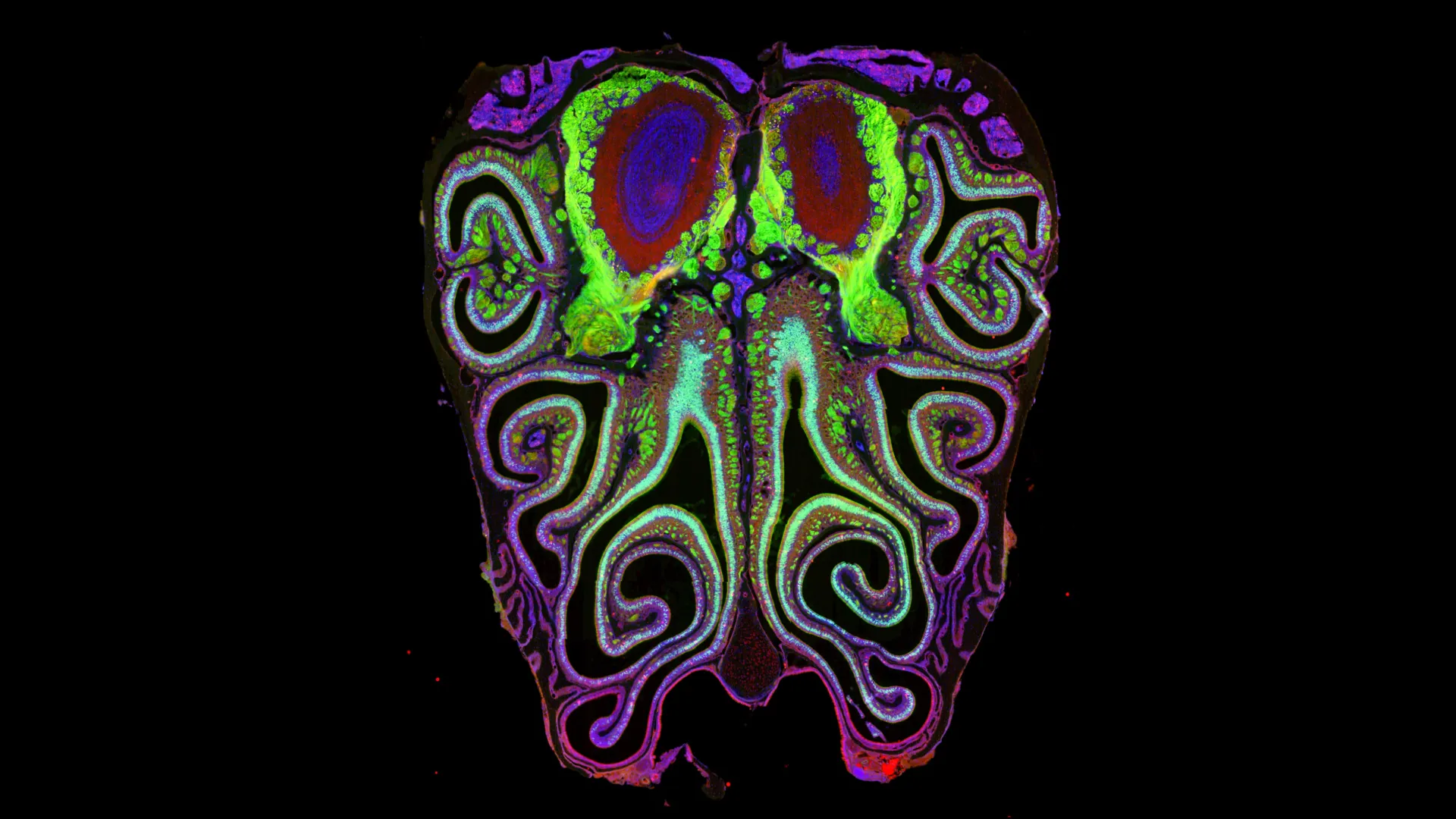
In a new study using mice, Sandeep (Robert) Datta, professor of neurobiology at Harvard Medical School, and his colleagues have built the first detailed map showing how more than a thousand types of smell receptors are arranged inside the nose. Spoiler: they’re not just tossed in there like confetti.
“Olfaction is super-mysterious,” Datta admitted, which is a polite way of saying it’s been the weird cousin of the senses - vision, hearing, and touch all have neat maps, but smell has been sulking in the corner. The researchers found that neurons carrying these receptors form horizontal bands, or stripes, running from the top of the nose to the bottom, grouped by receptor type. “Our results bring order to a system that was previously thought to lack order,” Datta said.
The team analyzed about 5.5 million neurons across more than 300 mice, combining single-cell sequencing with spatial transcriptomics to pinpoint where each neuron lives. “This is now arguably the most sequenced neural tissue ever,” Datta noted, proving that mice have better cellular GPS than most humans. The map also aligns with corresponding maps in the olfactory bulb of the brain, offering new insight into how scent information travels from nose to neural circuits.
Mice have about 20 million olfactory neurons, each expressing one of more than a thousand receptor types - compared with human color vision, which gets by on just three main receptor types. Smell, in other words, is overachieving. Researchers identified retinoic acid, a molecule that regulates gene activity, as a key factor guiding this precise arrangement. A gradient of retinoic acid helps each neuron activate the correct receptor depending on its position; when levels were altered, the entire receptor map shifted upward or downward. “We show that development can achieve this feat of organizing a thousand different smell receptors into an incredibly precise map,” Datta said.
A separate study led by Catherine Dulac at Harvard University, published in the same issue of Cell, found consistent results - because science loves a good corroboration.
Beyond satisfying basic curiosity, this discovery could help treat loss of smell, which currently has few effective treatments despite affecting safety, nutrition, and mental health. “Without understanding this map, we're doomed to fail in developing new treatments,” Datta warned. The team is now working to understand why the receptor stripes appear in their specific order and whether the same organization exists in humans, potentially guiding stem cell therapies or brain-computer interfaces to restore the sense of smell.
So next time you sniff a rose and feel a wave of nostalgia, remember: there’s a highly organized stripe party happening in your nose, and science finally has the guest list.
The Good Times
News in your inbox.
One sardonic roundup, delivered on your schedule. Free. Unsubscribe whenever your tolerance for wit runs out.
Already subscribed but we never reach your inbox? Check your spam folder and hit 'Not spam' (or 'Remove from spam') to bust us out of junk-mail purgatory. You'll be helping everyone else too.
Don't open any of our emails for a month and you'll be automatically removed from the mailing list.
Rewrite Article
Select parts to regenerate with a fresh AI pass. Translations will be updated automatically.
Generate AI Image
Creates a sardonic version of the article image using OpenAI.