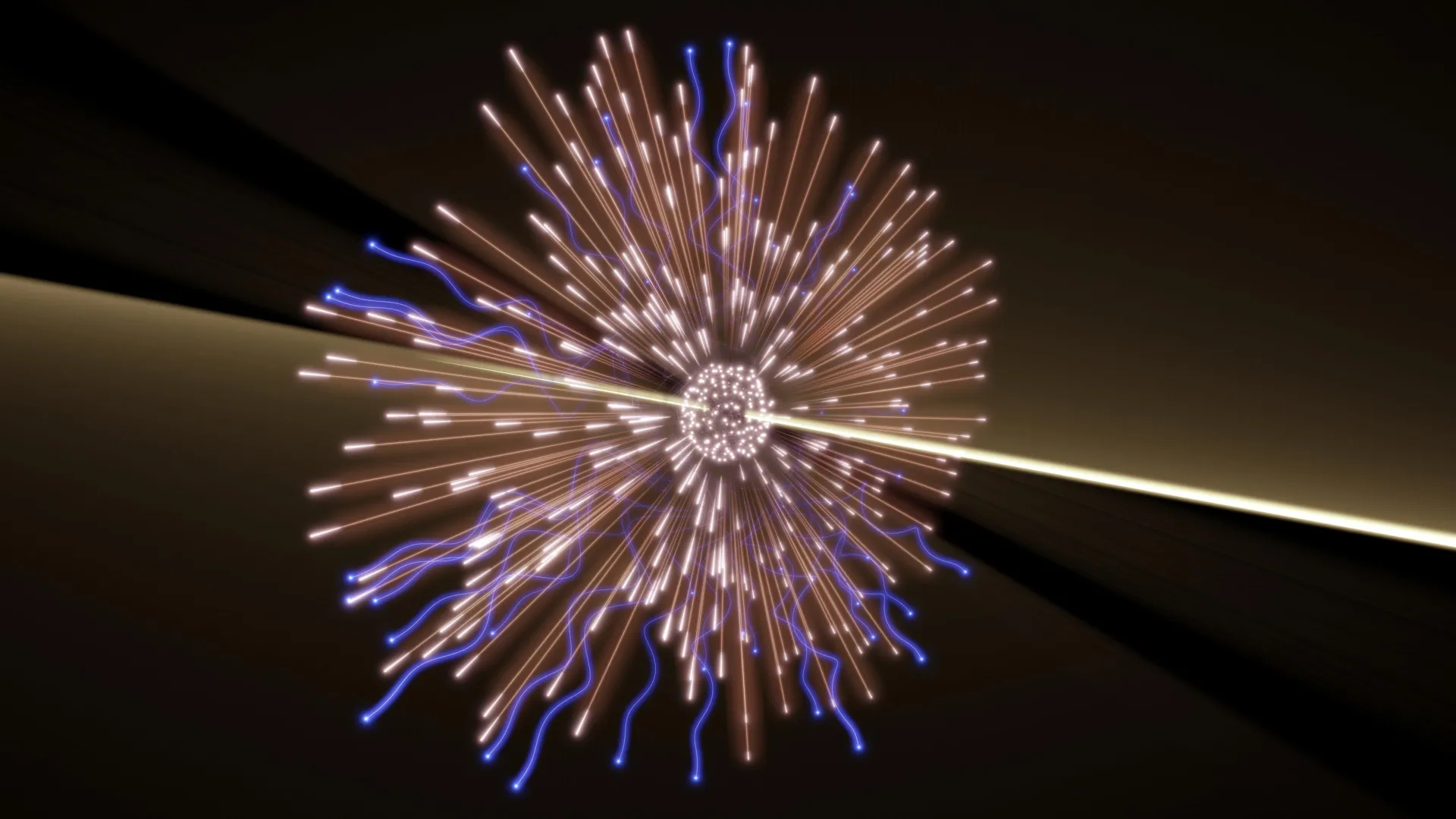
Even after you turn off a nuclear reactor, it doesn't just go quietly into that good night. Deep inside its core, long-lived radioactive fission products keep decaying for months or years, emitting a faint stream of antineutrinos - the Universe's most elusive particles, which pass through reactor shielding like a polite ghost through a wall.
Now, the Double Chooz collaboration has for the first time measured this lingering antineutrino emission, as reported in Physical Review Letters. Led by Anthony Onillon and Thierry Lasserre of the Max-Planck-Institut für Kernphysik (MPIK) in Heidelberg, Germany, the research reveals that antineutrino detectors can snoop on reactors even when they're off, potentially creating new opportunities for monitoring, safety, and safeguards.
The measurement took place at the Chooz nuclear power plant in northern France, where the Double Chooz detector sits underground about 400 meters from the facility's two reactor cores. The detector contains over 30 cubic meters of liquid scintillator, which flashes when an antineutrino interacts - a rare event, but with a characteristic double-light signature that distinguishes it from background noise.
Over 17.2 days of observations with both reactors fully shut down, the detector recorded around 100 antineutrino candidate events linked to residual radioactivity in the cores and nearby spent-fuel cooling pools. The signal matched detailed simulations accounting for the remaining nuclear fuel inventory and decay of long-lived fission products, providing the first direct experimental confirmation of predictions about shutdown emissions.
"Until now, reactor antineutrino experiments have mainly focused on operating reactors, where the antineutrino flux is much larger," notes Dr. Onillon. "Detecting the tiny residual signal after shutdown required exceptionally low backgrounds and careful analysis techniques developed by the Double Chooz collaboration over many years."
Other experiments, like JUNO-TAO, are already following suit, using reactor-off data to study spent-fuel antineutrinos. TAO is working to isolate the weak emission, but Double Chooz has now provided the first published benchmark for this ghostly glow.
The findings suggest antineutrino detectors could independently confirm reactor status and track spent-fuel inventories, even during maintenance or after shutdown. Double Chooz, originally built to study neutrino oscillations and measure the mixing angle θ13, has added yet another first to its résumé: catching the faint neutrino glow after a reactor goes dark. Because who doesn't love a good ghost story with a scientific twist?
The Good Times
News in your inbox.
One sardonic roundup, delivered on your schedule. Free. Unsubscribe whenever your tolerance for wit runs out.
Already subscribed but we never reach your inbox? Check your spam folder and hit 'Not spam' (or 'Remove from spam') to bust us out of junk-mail purgatory. You'll be helping everyone else too.
Don't open any of our emails for a month and you'll be automatically removed from the mailing list.
Rewrite Article
Select parts to regenerate with a fresh AI pass. Translations will be updated automatically.
Generate AI Image
Creates a sardonic version of the article image using OpenAI.