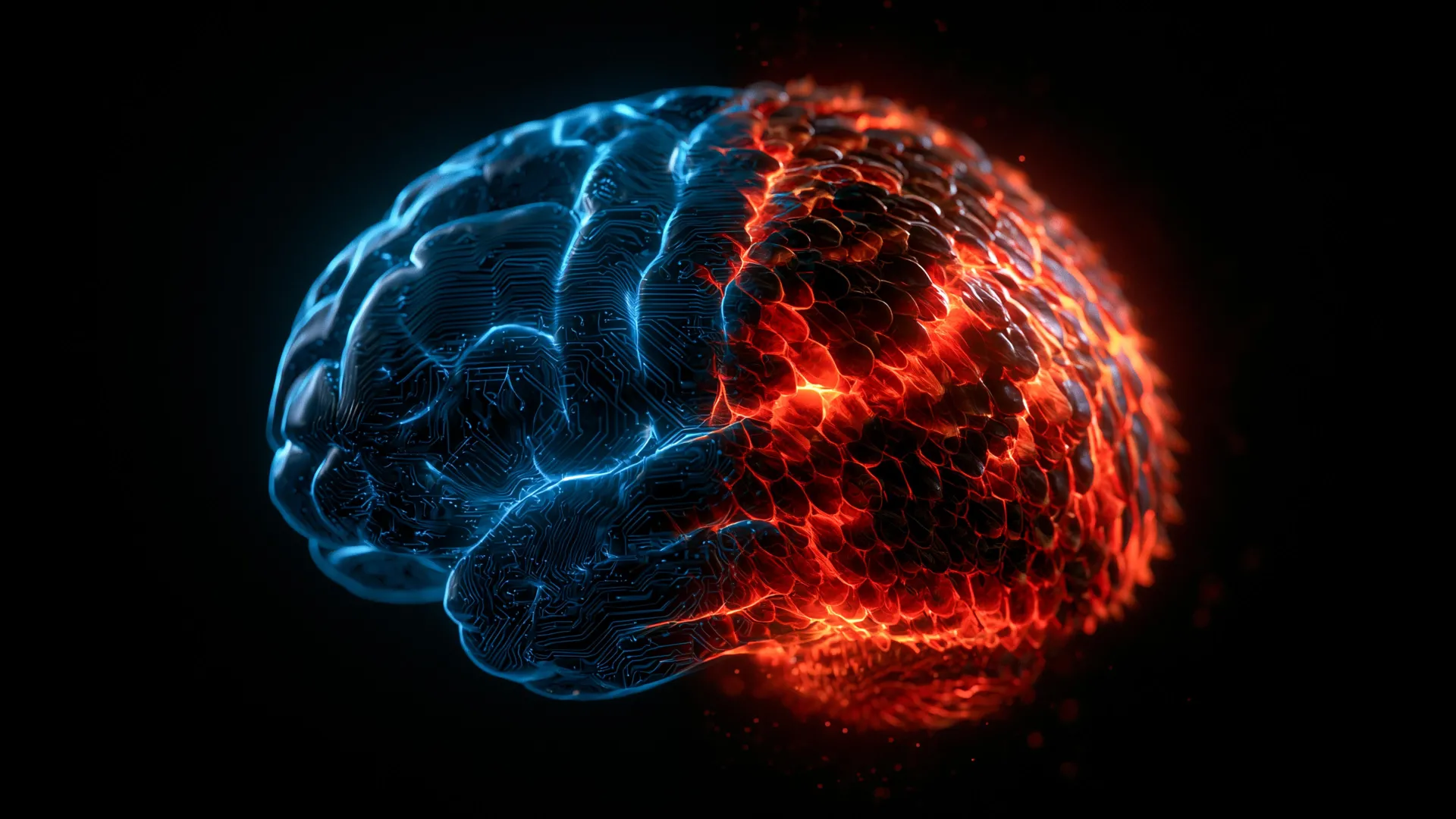
Scientists Debunk 70-Year-Old 'Lizard Brain' Myth, Suggest Evolution Is More Like a Tug-of-War
New research debunks the 70-year-old 'lizard brain' myth, revealing brain evolution as a tug-of-war between wiring strategies, with implications for AI.
For decades, pop culture has framed our decision-making as a cage match between the cool, rational "logical brain" and the impulsive, ancient "lizard brain." But according to new research, that's about as accurate as a fortune cookie's stock advice.
Nabil Imam, an assistant professor at Georgia Tech's School of Computational Science and Engineering and a faculty member with the Institute for Neuroscience, Neurotechnology, and Society (INNS), isn't buying the '50s-era layered-brain theory. "This is not how an evolutionary biologist would think about the problem," he said, gently setting fire to a beloved metaphor.
The study, published in Science Advances, suggests that brain evolution isn't about stacking new regions atop old ones like some neurological Jenga tower. Instead, it's about wiring - and a fierce competition for limited brain space.
Imam and his colleagues compared biological brains and artificial neural networks, finding that evolution might allocate brain space between two competing wiring strategies: spatial maps (like those in the neocortex, which process vision, sound, and touch) and distributed "barcode-style" networks (like in the limbic system, which handle smell, memory, and emotion). Both strategies are established before birth, making the brain less a blank slate and more a pre-furnished apartment.
The limbic system - often lazily lumped together as the "reptilian brain" - controls emotion, but it also contains regions for memory, smell, navigation, and emotional regulation. "Why do people group all these different regions into one big system?" Imam wondered. Good question, given that a '70s-era theory doesn't exactly hold water.
The researchers examined how the limbic system and neocortex vary together across 182 species. They found a clear pattern: when one part of the limbic system was relatively large, other limbic regions were too, while the neocortex shrank. This suggests coordinated expansion, not independent evolution.
To test what drives this, they used AI models. Networks with localized, spatial connections excelled at vision, sound, and touch, while distributed "barcode" networks were better for smell and memory. Then, they created a multimodal network where both systems competed for "real estate." When the simulated environment rewarded smell, the distributed system expanded and the neocortex shrank; when vision was favored, the opposite happened.
This trade-off explains real-world oddities: the nine-banded armadillo, a smell-dependent creature, boasts a large limbic system, while the vision-reliant squirrel monkey has a neocortex-heavy brain.
The implications extend beyond biology. If engineers can mimic this pre-wired architecture in AI, they might build systems that learn more like biological brains, requiring less data and energy. "Today's artificial neural networks are trained by vast amounts of data - it's about nurture," Imam said. "But the brain is not a blank slate... It is a mix of nature and nurture, and the nature is that pre-wired architecture."
This work, a collaboration with Cornell University and supported by the National Science Foundation, suggests that brain evolution is less about climbing a ladder of logic and more about shifting resources in a neural tug-of-war. And that's a metaphor we can get behind.
The Good Times
News in your inbox.
One sardonic roundup, delivered on your schedule. Free. Unsubscribe whenever your tolerance for wit runs out.
Already subscribed but we never reach your inbox? Check your spam folder and hit 'Not spam' (or 'Remove from spam') to bust us out of junk-mail purgatory. You'll be helping everyone else too.
Don't open any of our emails for a month and you'll be automatically removed from the mailing list.
Rewrite Article
Select parts to regenerate with a fresh AI pass. Translations will be updated automatically.
Generate AI Image
Creates a sardonic version of the article image using OpenAI.