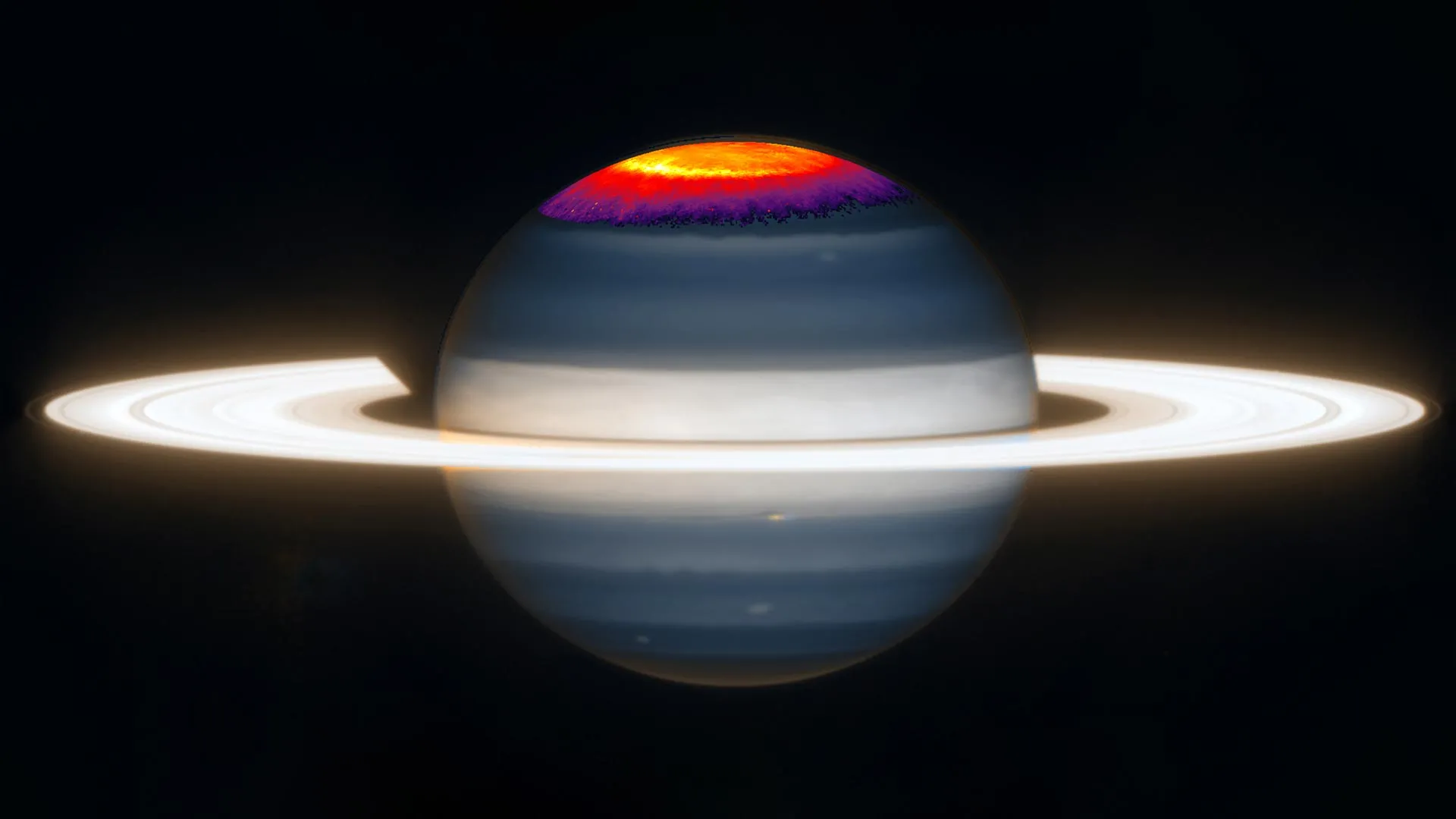
Saturn's Northern Lights Finally Explain Its Decades-Long Spin Mystery, Because of Course It's the Northern Lights
Saturn's spin mystery was a case of aurora-induced atmospheric trickery, solved by JWST's unprecedented infrared temperature maps - a classic planetary heat pump.
For years, Saturn appeared to be doing something impossible: changing its rotation rate, as if the giant planet were secretly training for the Olympic speed-skating trials. That puzzling result left scientists scratching their heads, presumably in zero gravity. Now, researchers using the James Webb Space Telescope (JWST) say they have finally solved the mystery, and the culprit is, naturally, a spectacular light show.
The new findings, published in the Journal of Geophysical Research: Space Physics, reveal that Saturn's aurora drives a powerful cycle involving heat, winds, and electrical currents that can make the planet appear to spin at different speeds depending on how you measure it. The puzzle dates back decades but gained renewed attention after NASA's Cassini spacecraft, in 2004, suggested Saturn's rotation rate was gradually changing - a result that was difficult to explain because planets do not simply alter their spin rates on short timescales, much like your aunt's opinion on pineapple pizza.
In 2021, a team led by Professor Tom Stallard of Northumbria University proposed a different explanation: Saturn's rotation was not actually changing. Instead, electrical signals linked to the planet's aurora were being affected by winds in Saturn's upper atmosphere, generating electrical currents that altered the auroral signal scientists were using to estimate the planet's rotation. While that study explained the misleading measurements, one major question remained: What was driving those atmospheric winds?
To investigate, Stallard and colleagues turned to the James Webb Space Telescope, observing Saturn's northern auroral region continuously for an entire Saturnian day. The team focused on infrared light emitted by a molecule known as trihydrogen cation, which forms in Saturn's upper atmosphere and serves as a natural temperature indicator. By analyzing its glow, they created the most detailed maps ever produced of temperatures and charged particle densities within Saturn's auroral region. The improvement in accuracy was dramatic: earlier measurements carried uncertainties of roughly 50 degrees Celsius, but JWST's observations were about ten times more precise, allowing scientists to identify localized patterns of heating and cooling for the first time.
The new data closely matched predictions from computer models developed more than a decade ago. However, the models only worked if the source of the atmospheric heating was located exactly where the strongest auroral particles enter Saturn's atmosphere. The results indicate that Saturn's aurora is doing far more than creating a dazzling light show - it is essentially a planetary heat pump. Energy deposited by the aurora heats specific regions of the atmosphere, generating winds, which then create electrical currents. Those currents help power the aurora itself, which continues heating the atmosphere and sustaining the entire cycle.
Lead researcher Professor Tom Stallard said: "What we are seeing is essentially a planetary heat pump. Saturn's aurora heats its atmosphere, the atmosphere drives winds, the winds produce currents that power the aurora, and so it goes on. The system feeds itself." He added that these new observations, made possible by JWST, finally provide the evidence needed to close the loop on a mystery that has puzzled scientists for decades.
The discovery may have significance far beyond a single planet. Researchers found evidence that Saturn's atmosphere and magnetosphere - the vast region of space shaped by the planet's magnetic field - are closely connected, with activity in the atmosphere influencing conditions in the magnetosphere while the magnetosphere feeds energy back into the atmosphere. This ongoing exchange could help explain why the process remains stable over long periods - and, according to the researchers, similar interactions may occur on other planets as well. "If a planet's atmospheric conditions can drive currents out into the surrounding space environment, then understanding what is happening in the stratospheres of other worlds may reveal interactions we have not yet even imagined," Stallard said.
The study, conducted by researchers from Northumbria University along with collaborators from Boston University, the University of Leicester, Aberystwyth University, the University of Reading, Imperial College London, Lancaster University, and Johns Hopkins University Applied Physics Laboratory, was funded by the Science and Technology Facilities Council (STFC). The James Webb Space Telescope, an international project led by NASA in partnership with ESA (European Space Agency) and CSA (Canadian Space Agency), continues to prove that it is the world's premier space science observatory - and apparently also the best aurora detective in the solar system.
The Good Times
News in your inbox.
One sardonic roundup, delivered on your schedule. Free. Unsubscribe whenever your tolerance for wit runs out.
Already subscribed but we never reach your inbox? Check your spam folder and hit 'Not spam' (or 'Remove from spam') to bust us out of junk-mail purgatory. You'll be helping everyone else too.
Don't open any of our emails for a month and you'll be automatically removed from the mailing list.
Rewrite Article
Select parts to regenerate with a fresh AI pass. Translations will be updated automatically.
Generate AI Image
Creates a sardonic version of the article image using OpenAI.