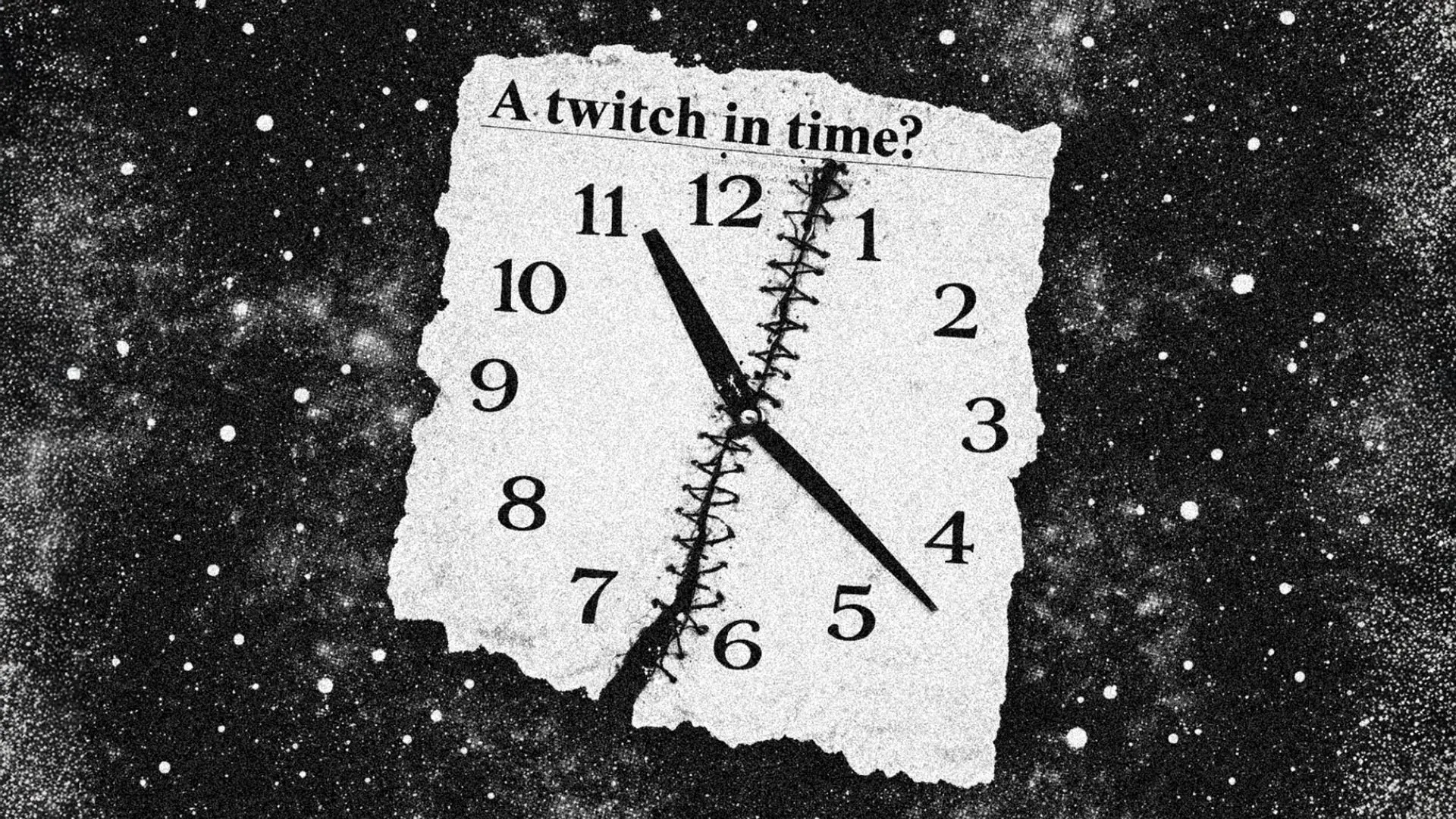
Quantum mechanics is already a headache, with particles that exist in multiple states at once and wavefunctions that collapse when you look at them too hard. Now, an international group of physicists has found that if you take certain alternative explanations seriously, time itself gets a little fuzzy.
With funding from the Foundational Questions Institute (FQxI), researchers led by Nicola Bortolotti of the Enrico Fermi Museum and Research Centre (CREF) in Rome examined two leading quantum collapse models: the Diósi-Penrose model and Continuous Spontaneous Localization. Their work, published in Physical Review Research, shows that if these models are correct, time would have a built-in uncertainty - a fundamental limit on how precisely any clock can measure it.
"What we did was to take seriously the idea that collapse models may be linked to gravity," said Bortolotti. "And then we asked a very concrete question: What does this imply for time itself?"
The team, which also included Catalina Curceanu, Kristian Piscicchia, Lajos Diósi, and Simone Manti, established a quantitative relationship between the Continuous Spontaneous Localization model and spacetime fluctuations caused by gravity. The result: a tiny wobble in the fabric of time, far too small to affect even the most advanced atomic clocks.
"The uncertainty is many orders of magnitude below anything we can currently measure, so it has no practical consequences for everyday timekeeping," said Curceanu. "Our results explicitly show that modern timekeeping technologies are entirely unaffected," added Piscicchia.
The research builds on decades of attempts to reconcile quantum mechanics with general relativity, which treat time in fundamentally different ways. In quantum mechanics, time is an external parameter; in relativity, it stretches and bends. The new study suggests that collapse models could point to a deeper link between quantum behavior, gravity, and time.
Curceanu praised the rare support for such foundational research. "There are not many foundations in the world which are supporting research on these types of fundamental questions about the universe, space, time, and matter," she said. "Our work shows that even radical ideas about quantum mechanics can be tested against precise physical measurements, and that, reassuringly, timekeeping remains one of the most stable pillars of modern physics."
The work was partially supported through FQxI's Consciousness in the Physical World program.
The Good Times
News in your inbox.
One sardonic roundup, delivered on your schedule. Free. Unsubscribe whenever your tolerance for wit runs out.
Already subscribed but we never reach your inbox? Check your spam folder and hit 'Not spam' (or 'Remove from spam') to bust us out of junk-mail purgatory. You'll be helping everyone else too.
Don't open any of our emails for a month and you'll be automatically removed from the mailing list.
Rewrite Article
Select parts to regenerate with a fresh AI pass. Translations will be updated automatically.
Generate AI Image
Creates a sardonic version of the article image using OpenAI.