
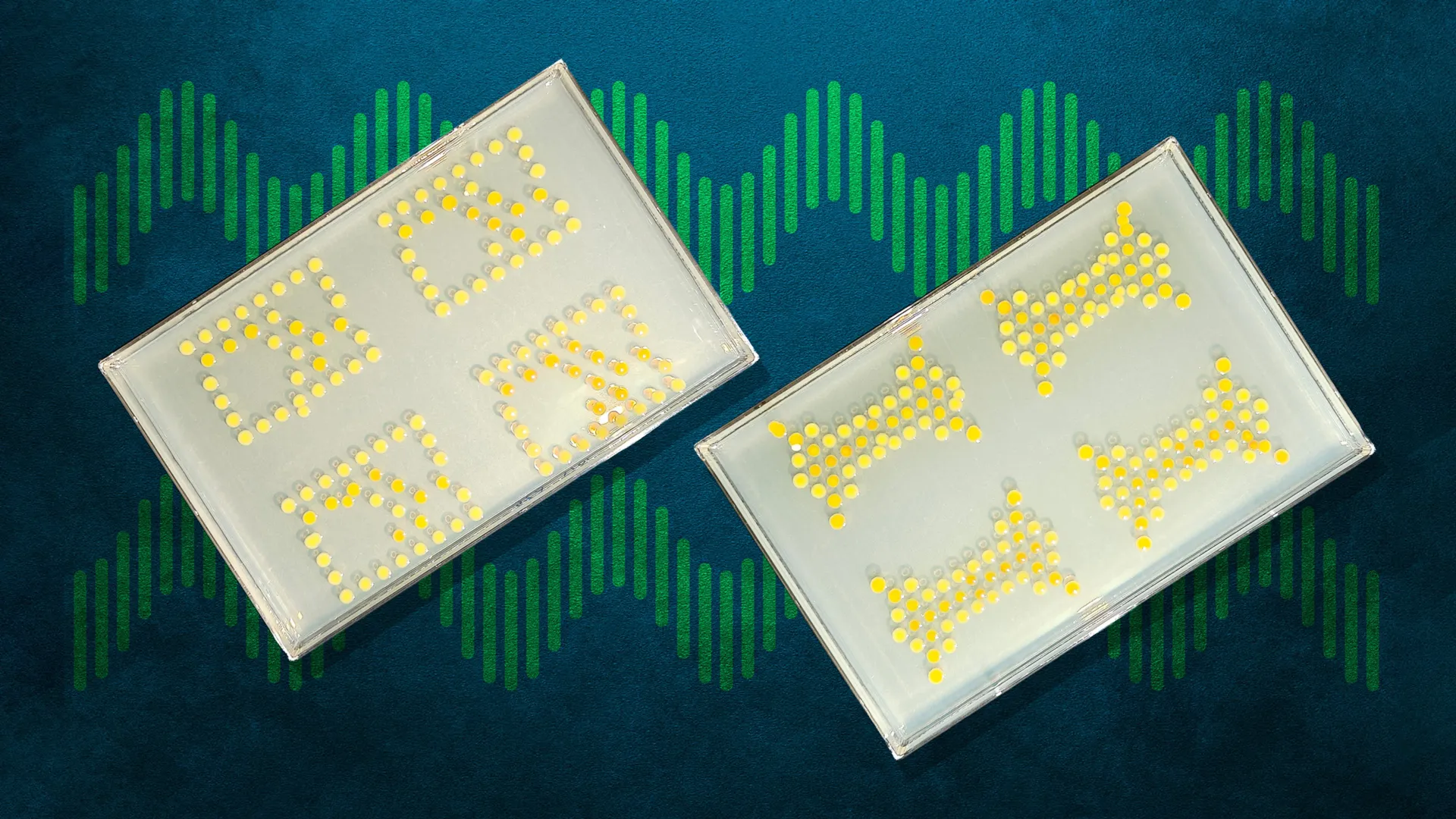
In a move that blurs the line between biology and your motherboard, MIT researchers have engineered bacteria to function as living transistors, creating biological 'circuit boards' that can be printed onto a Petri dish. Because if there's one thing we need, it's more circuitry - just this time, it's organic.
In conventional electronics, transistors act as switches controlling electrical current. In the MIT system, engineered bacterial cells do something similar, but instead of electrons, they regulate the movement of small signaling molecules. These molecules then carry information to other components in the biological circuit, essentially creating a tiny, squishy computer network.
The researchers constructed two types of bacterial transistors and three additional bacterial strains that act as relays between them. Together, these five strains form a modular toolkit that can be arranged to build nearly any kind of circuit. In their new study, they demonstrated circuits capable of adding two or three inputs and directing a single input to a chosen destination. Because who doesn't need a bacterial calculator?
'We've built some initial computer architecture components that are commonly used, but any operation can be built with these five strains,' says Hamid Doosthosseini PhD '25, an MIT postdoc and lead author of the study. Translation: The future of computing might smell faintly of agar.
One potential application is placing these living circuits on plant leaves or roots, where they could process environmental information and help plants detect and respond to stresses like drought or pest attacks. Finally, a use for bacteria that doesn't involve antibiotics or spoiled food.
Christopher Voigt, head of MIT's Department of Biological Engineering, is the senior author, and the paper was recently published in Nature Chemical Biology. Former MIT postdoc Haorong Chen also contributed, presumably by naming a few strains.
Synthetic biology circuits typically involve engineering cells to produce proteins and transcription factors that interact. These systems can be programmed to detect molecules and produce responses. However, their complexity is limited because each operation requires distinct transcription factors to avoid signal interference. There's a practical ceiling on how complicated a circuit can get inside a single cell - packing too many in overwhelms the protein production machinery. The MIT team sidestepped this by using individual cells as modular components, not trying to cram an entire circuit into one bacterium.
For their components, they used Pantoea agglomerans, a bacterium that commonly grows on plant surfaces. They engineered two versions of bacterial transistors that respond to a molecule called OC 6 - one switches on when it encounters the molecule, the other switches off. Each transistor also senses a second target molecule, OC 12. Depending on whether OC 12 is present and the transistor's activation state, the cell produces an output molecule called OHC 14. It's like a molecular game of telephone, but with chemistry.
The team also engineered three strains of Pantoea agglomerans to act as relays, converting the OHC 14 signal into another output that serves as input for the next transistor. This allows individual components to be 'wired' together, much like parts on an electronic circuit board. They even built a bidirectional switch using two transistors that detect OC 12, routing information through different relays based on a separate switch input.
To assemble circuits, they printed bacterial colonies onto agar plates, spacing each colony about 5 millimeters from its neighbor. This ensures chemical signals reach only the next colony, keeping information flowing in one direction. No word on whether they used a tiny soldering iron.
The researchers showed that the same bacterial transistor could perform multiple logic operations depending on its position, including 'multi-input,' 'or,' and 'imply' gates. By connecting multiple transistors, they created systems that could add two signals, process several signals simultaneously, or act as a demultiplexer - receiving one signal and routing it to one of several destinations based on a control signal. Their largest circuit contained 24 interconnected bacterial colonies and could add two inputs. Take that, abacus.
'This work shows that we can get toward more complicated functions by linking up simpler functions in individual cells,' Voigt says. 'Computationally, there's nothing that your iPhone can do that these circuits couldn't do.' True, but your iPhone doesn't take eight hours to calculate 2+2. Each bacterial calculation takes about eight hours - far slower than any electronic computer. But for biological applications, that pace is acceptable. As Voigt notes, 'We're not trying to replace computers, but rather put computational control into biology. If you have bacteria on the root of a plant, or the plant itself is doing the computing, running a simple calculation overnight is fast enough relative to a growth season.'
One possible application is agriculture: place these circuits on plant roots to detect stress and trigger responses like producing a fungicide. Because if there's one thing plants need, it's more bacterial bureaucracy.
The research was funded partly by the U.S. Defense Advanced Research Projects Agency (DARPA) and the U.S. Intelligence Advanced Research Projects Activity (IARPA). Because of course the military-industrial complex is interested in bacterial computers.
Materials provided by Massachusetts Institute of Technology, original written by Anne Trafton. Content may be edited for style and length - unlike our sarcasm, which is unedited.