MIT Physicists Watch Electrons Rebuild Themselves Like Tiny Ice Cubes in a Quantum Material
MIT physicists zap a quantum material with lasers and discover that electrons rebuild themselves like ice crystals, which might one day help replace silicon (but probably not your freezer).
MIT physicists have been poking at a quantum material with lasers, and what they found is that electrons can reorganize themselves in two very different ways - one smooth like evaporating water, the other lumpy like freezing ice. The study, published in Nature Physics, sheds light on how multiple electronic phases can coexist in the same material, which could one day help us build better quantum devices and, you know, maybe replace silicon.
"People believe the cornerstone of replacing silicon lies in quantum materials that have multiple coexisting phases," says co-author Alfred Zong PhD '20, now an assistant professor at Stanford University. "Our experiment provides a very neat way to study these multiple phases."
The researchers, led by Nuh Gedik, the Donner Professor of Physics at MIT, investigated erbium tritelluride, a rare-earth material with some serious electronic attitude. At ordinary conditions, electrons are spread out evenly, but cool it down and they start forming a wave-shaped arrangement called a charge density wave (CDW). Cool it even more, and a second wave appears perpendicular to the first, creating an atomic-scale checkerboard that would make any chess grandmaster jealous.
The team managed to separate the two phases and watch how each one forms. The first phase, the 'dominant' one, appears gradually across the material, like water turning to vapor. The second, 'subdominant' phase, however, starts in isolated pockets and expands outward, just like ice crystals forming in your drink. This difference is key: the first is a textbook second-order transition, while the second is a first-order transition, and that's a surprise.
"The mechanism responsible for the emergence of this second phase has long been debated, and our approach provides a powerful new way to uncover the hidden physics behind phase transitions in quantum materials," Gedik says.
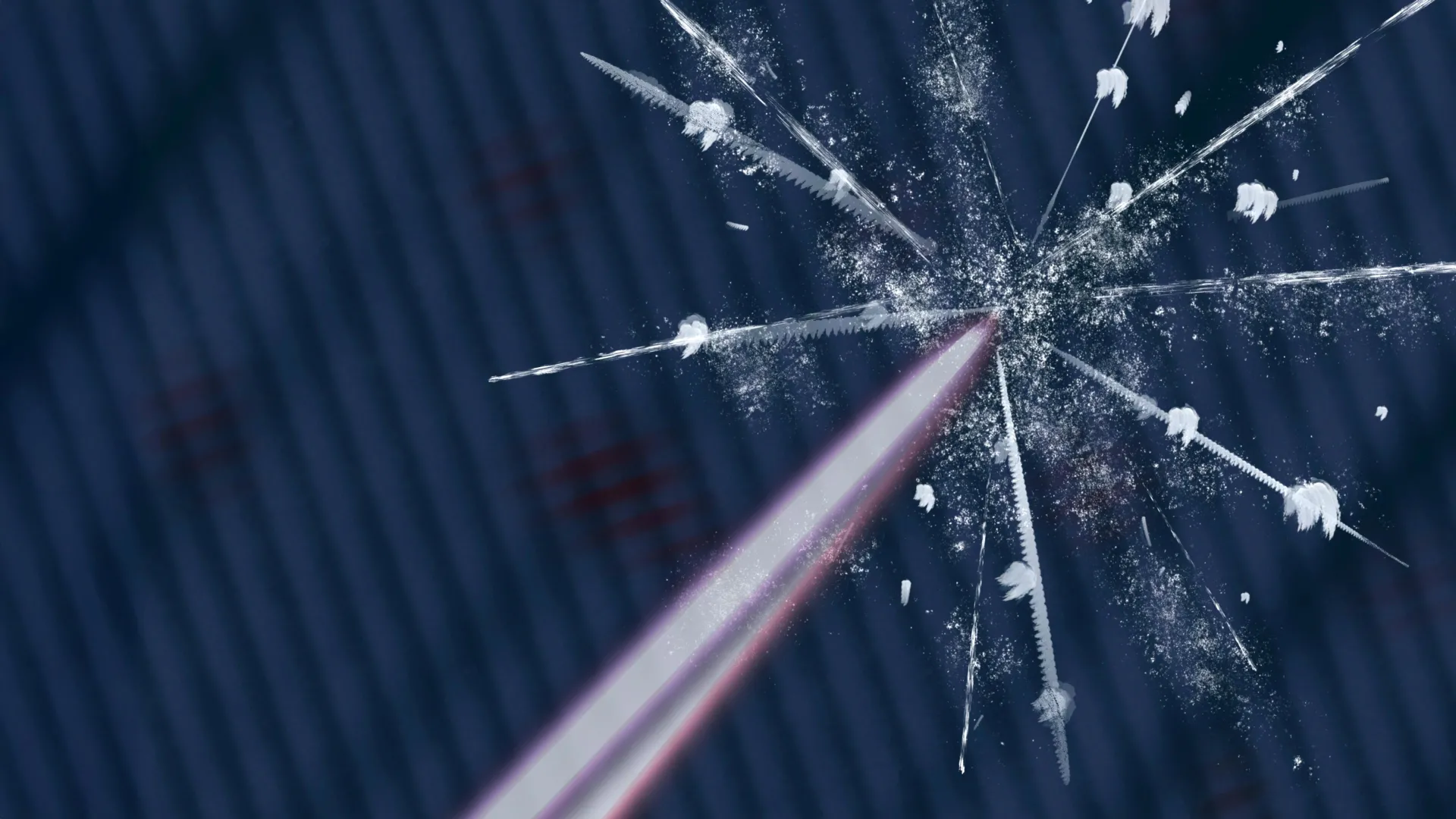
The experiment was a classic 'shake and listen' routine. The team cooled atomically thin samples of erbium tritelluride to about -230 degrees Celsius, then zapped them with two laser pulses. The first pulse 'shook' the system, breaking apart the electronic checkerboard, and the second pulse took snapshots of how the electrons recovered over time. The dominant wave bounced back smoothly no matter how hard they hit it, but the subdominant wave grew from scattered seeds, like ice crystals forming in supercooled water.
This behavior wasn't expected, and it finally identifies the long-debated mechanism behind the second CDW phase. And while erbium tritelluride is cool in its own right, the real prize is understanding more complex materials like high-temperature superconductors, where multiple phases (magnetism, superconductivity, CDWs) all coexist and interact.
"In systems that are much more complex, like high-temperature superconductors, you see that there are multiple phases - magnetism, superconductivity, charge density waves, and they all exist together," Gedik says. "One of the theories is that the way they interact with each other is key for their exotic properties. The lessons we learn here can be applied to much more complex materials."
The research was supported by the U.S. Department of Energy, the U.S. National Science Foundation, and the Gordon and Betty Moore Foundation's EPiQS Initiative grant. Materials provided by Massachusetts Institute of Technology. Original written by Jennifer Chu. Note: Content may be edited for style and length.
The Good Times
News in your inbox.
One sardonic roundup, delivered on your schedule. Free. Unsubscribe whenever your tolerance for wit runs out.
Already subscribed but we never reach your inbox? Check your spam folder and hit 'Not spam' (or 'Remove from spam') to bust us out of junk-mail purgatory. You'll be helping everyone else too.
Don't open any of our emails for a month and you'll be automatically removed from the mailing list.
Rewrite Article
Select parts to regenerate with a fresh AI pass. Translations will be updated automatically.
Generate AI Image
Creates a sardonic version of the article image using OpenAI.