
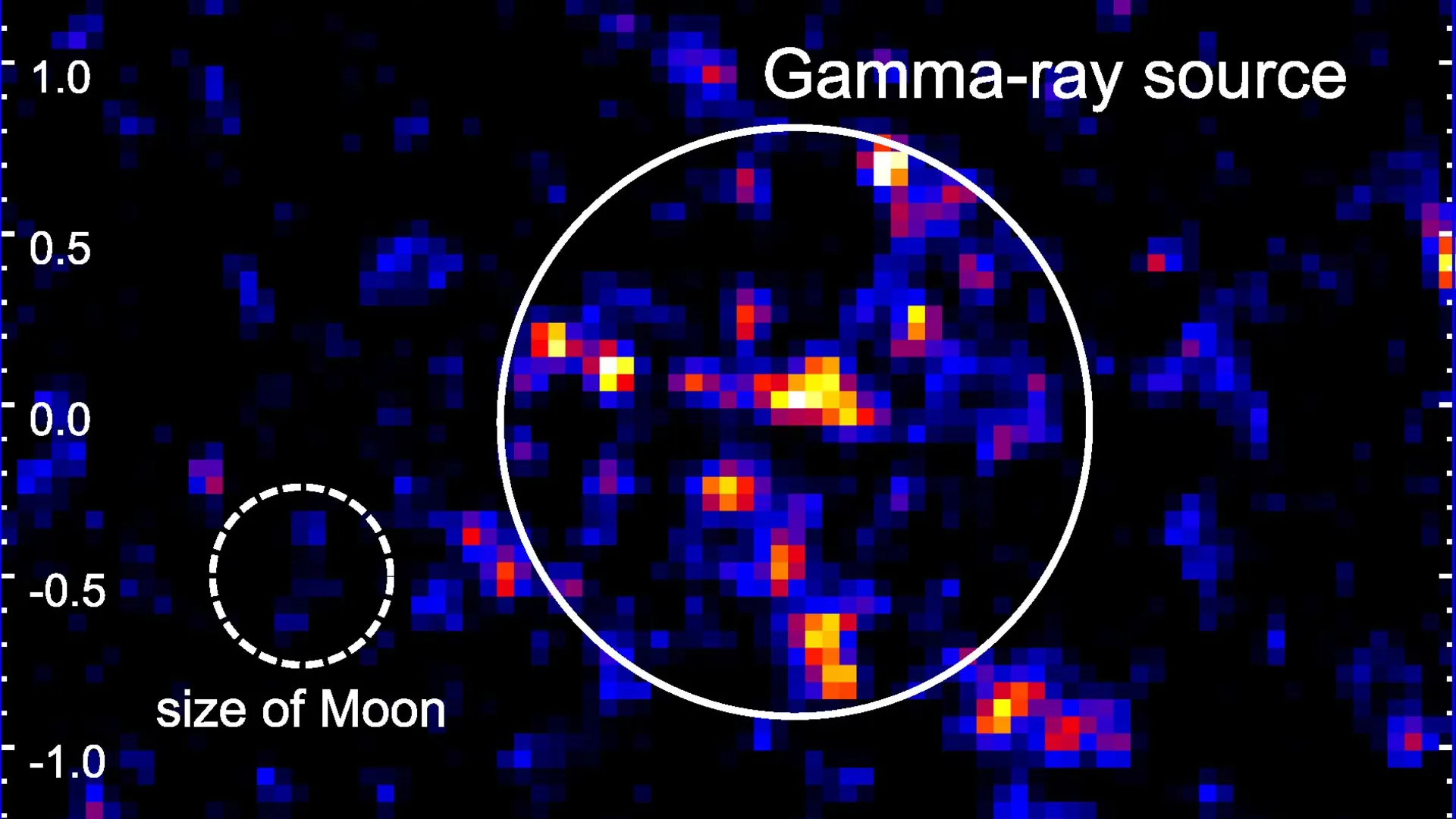
Scientists have finally nailed down a source in the Milky Way that hurls protons to some of the most eye-watering energies in our galaxy. The discovery could help us understand cosmic rays - those hyper-fast particles zipping between stars and generally causing a ruckus throughout the galaxy.
Cosmic rays are mostly protons, with a smattering of electrons. Some of them pack more punch than anything our puny human-built accelerators can manage. The Large Hadron Collider on the Swiss-French border can get protons close to light speed, but nature's own accelerators apparently have us beat.
An international team led by Hiroshima University confirmed the galactic accelerator by combining observations from three major observatories on Earth and in space. The results were published in The Astrophysical Journal on July 16, 2026.
"This immense energy makes cosmic rays important in astronomy and astrophysics," said Tsunefumi Mizuno, associate professor at Hiroshima University's Hiroshima Astrophysical Science Center and the study's first and corresponding author.
Cosmic ray energies are measured in electron volts - the energy an electron gains when its electrical potential increases by one volt. The top-tier galactic cosmic rays can reach and exceed one quadrillion (10^15) electron volts, or a peta electron volt (PeV). Finding a cosmic-ray proton accelerator above that PeV level - a proton PeVatron - is one of the hottest tickets in modern astrophysics. And they found one: an object previously known as LHAASO J1912+1014u.
A proton PeVatron is a natural cosmic accelerator that pushes protons past the PeV threshold. Spotting these things is tricky because scientists must separate proton signals from those of hyper-energetic electrons.
The Tibet AS gamma experiment (a Japan-China joint effort since 1990) and China's Large High Altitude Air Shower Observatory (LHAASO) had detected dozens of gamma-ray sources above 0.1 PeV. One of them was LHAASO J1912+1014u. Gamma rays are the most energetic form of electromagnetic radiation, often produced when cosmic-ray particles collide with their surroundings, and their energies are typically about one-tenth of the cosmic rays that created them. So sources producing gamma rays below the PeV range are prime PeVatron candidates. Earlier research suggested LHAASO J1912+1014u might be a pulsar wind nebula or some other debris from a massive star's explosion.
"However, data from Tibet AS gamma and LHAASO experiments alone cannot clearly identify proton PeVatrons because PeV cosmic ray electrons can also produce the lower energy gamma-rays," Mizuno said. The limited image resolution meant researchers couldn't tell if protons or electrons were behind the gamma rays.
Enter the cavalry: the Fermi Large Area Telescope (Fermi-LAT, a NASA-led mission with Hiroshima University's help), the FOREST Unbiased Galactic plane Imaging survey with the Nobeyama 45-m telescope (FUGIN, led by Japan), and NASA's Chandra X-ray Observatory. LHAASO J1912+1014u was discovered in 2024 in the constellation Aquila near Altair, one of the Summer Triangle's famous stars. It was initially tagged as a supernova remnant, but that idea got shaky after emissions above 100 TeV appeared.
"With data from multiple experiments, we have studied LHAASO J1912+1014u in detail," Mizuno said. The observatories covered a broad swath of the electromagnetic spectrum, from radio to gamma rays, letting the team build a detailed multiwavelength model.
Fermi-LAT measured gamma rays near a giga-electron-volt (GeV, a billion electron volts). Chandra supplied X-ray observations at lower energies, and FUGIN provided radio data at even lower energies. Combined with tera-electron-volt (TeV) observations from LHAASO and others, the picture strongly pointed to LHAASO J1912+1014u being a proton PeVatron - and eliminated other explanations.
Three key findings clinched it. First, the gamma-ray signal extended smoothly from over 100 trillion electron volts down to 400 million electron volts. Mizuno noted that wide range made electron acceleration unlikely. Second, the GeV gamma-ray distribution matched the interstellar gas pattern mapped by FUGIN - exactly what you'd expect if high-energy protons crashed into surrounding gas to make gamma rays. Third, Chandra saw only very weak diffuse X-ray emission; an electron-dominated source would typically shine brighter in X-rays, so the faintness backed the proton story.
"This research is achieved by team effort. There is an old Japanese saying: 'One arrow is easy to break, but three arrows bundled together are not,'" Mizuno said, referencing the three datasets - Fermi-LAT GeV gamma-ray data, FUGIN radio data, and Chandra X-ray data - bundled through detailed multiwavelength modeling to reveal LHAASO J1912+1014u as a cosmic-ray proton PeVatron.
The study didn't just identify the source; it also examined the characteristics of the accelerated particles, which could hint at what kind of object powers the process. Mizuno said there are dozens of other possible proton PeVatrons in the Milky Way, and the team plans to study those candidates to see how many can be confirmed and what cosmic objects produce them.
Co-authors include Naoto Nakahara at Hiroshima University; Hidetoshi Sano & Takeru Murase at Gifu University; Tomohiko Oka at Julius-Maximilians-Universität Würzburg; and Hiromasa Suzuki at Miyazaki University.
The Fermi LAT Collaboration acknowledges generous ongoing support from NASA and the Department of Energy (DOE) in the US; the Commissariat à l'Energie Atomique and the Centre National de la Recherche Scientifique / Institut National de Physique Nucléaire et de Physique des Particules in France; the Agenzia Spaziale Italiana and the Istituto Nazionale di Fisica Nucleare in Italy; the Ministry of Education, Culture, Sports, Science and Technology (MEXT), High Energy Accelerator Research Organization (KEK) and Japan Aerospace Exploration Agency (JAXA) in Japan; and the K. A. Wallenberg Foundation, the Swedish Research Council and the Swedish National Space Board in Sweden. Additional support for science analysis from the Istituto Nazionale di Astrofisica in Italy and the Centre National d'Études Spatiales in France is gratefully acknowledged.
This work was performed in part under US DOE Contract DE-AC02-76SF00515 and supported by a University Research Support Grant from the National Astronomical Observatory of Japan (NAOJ); the Japan Society for the Promotion of Science (JSPS) KAKENHI (23K25882, 23H04895, 22H00152, 24H00246, 24K17093).
Materials provided by Hiroshima University. Note: Content may be edited for style and length.