Google's Quantum Computer Learns to Fix Its Own Attitude Problem While You Wait
Google's quantum computer learns to recalibrate itself during calculations using error-correction data and reinforcement learning, boosting error detection by 20%.
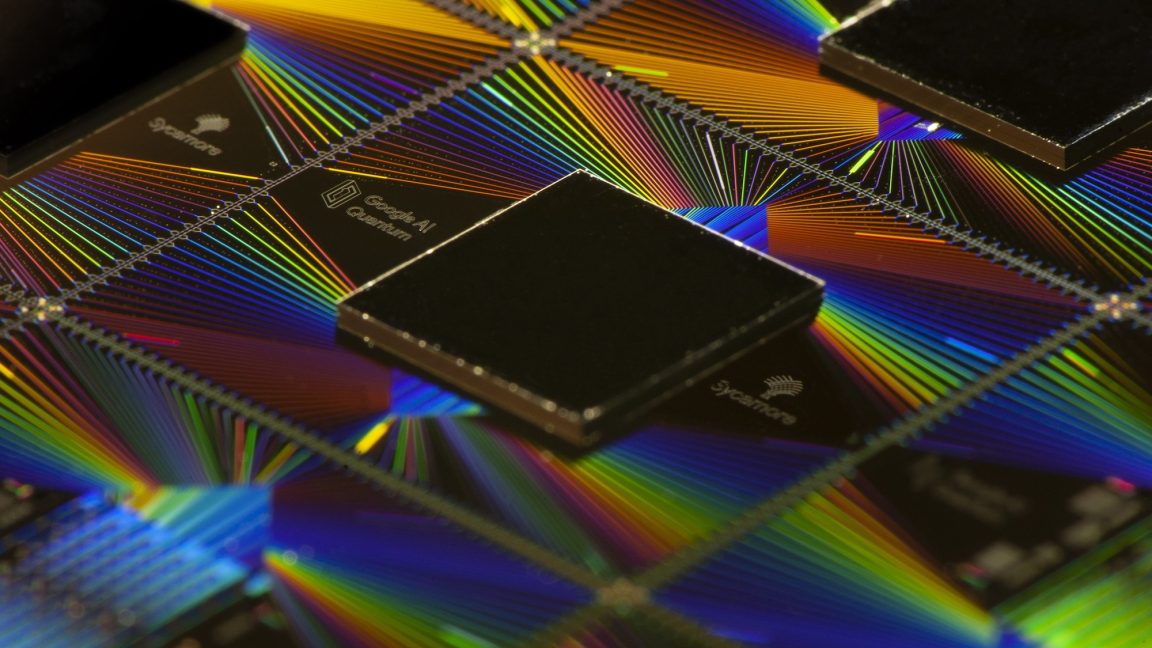
Quantum computing has plenty of big-ticket problems - like, can we even build enough qubits that don't explode? - but there's also a more mundane issue: calibration. Superconducting qubits, the kind Google and others use, are like snowflakes with attitude: each one has subtle variations, and the microwave pulses that control them can drift as hardware heats up. Normally, you stop everything to recalibrate, which is fine for short calculations but a non-starter for the marathon algorithms that could crack encryption or cure cancer.
Google's solution? Use the error-correction data that's already being collected to spot calibration drift, then apply reinforcement learning to tweak roughly 1,000 control parameters on the fly. In their paper, they describe deliberately applying small perturbations to all control parameters during a computation, like a chef tasting soup while it's still simmering. The system then infers which adjustments minimize errors, all while managing the logical qubit's error correction.
The team tested this on two logical qubits using different error-correction schemes (a surface code and a color code) and found that the active reinforcement learning boosted error detection by 20 percent. There's a catch: the system only works if drift stays small - big wobbles confuse it. But by constantly re-evaluating, the trade-off between exploration (trying suboptimal settings) and exploitation (sticking with what works) actually pays off, as long as drift is slow enough. Simulations showed it working for a system with roughly 40,000 parameters.
This isn't for today's toy quantum computers, which barely have time to drift. But if we ever build machines that run algorithms longer than a coffee break, this technique might keep them from going off the rails. The paper appears in Nature, 2026.
The Good Times
News in your inbox.
One sardonic roundup, delivered on your schedule. Free. Unsubscribe whenever your tolerance for wit runs out.
Already subscribed but we never reach your inbox? Check your spam folder and hit 'Not spam' (or 'Remove from spam') to bust us out of junk-mail purgatory. You'll be helping everyone else too.
Don't open any of our emails for a month and you'll be automatically removed from the mailing list.
Rewrite Article
Select parts to regenerate with a fresh AI pass. Translations will be updated automatically.
Generate AI Image
Creates a sardonic version of the article image using OpenAI.