German Scientists Use Two Fancy Lasers to Watch Metal Turn Into Plasma in Less Time Than It Takes to Say 'Trillionth of a Second'
German researchers used two lasers to watch a copper wire turn into plasma in trillionths of a second, because apparently that's what happens when you point a star's worth of energy at something.
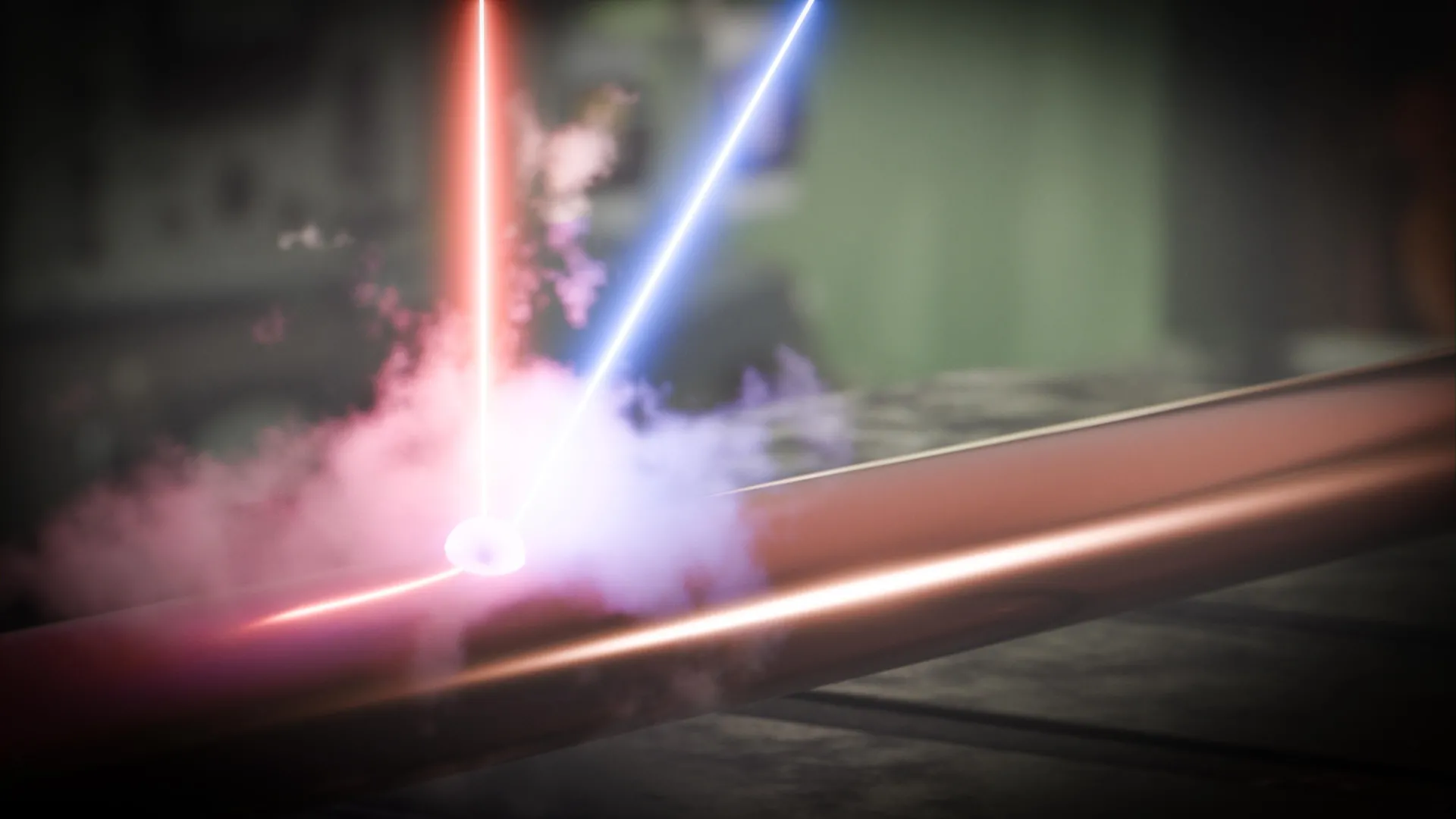
When you zap a piece of copper wire with a laser roughly as powerful as a small star, things get hot. Very hot. And fast. Very fast. Researchers at Helmholtz-Zentrum Dresden-Rossendorf (HZDR) have now captured this process with unprecedented detail, as reported in Nature Communications. They combined an X-ray free-electron laser with the high-intensity optical laser ReLaX at the European XFEL in Schenefeld near Hamburg, creating a sort of high-tech surveillance system for plasma formation. The work offers new insight into how high-energy lasers interact with matter under extreme conditions and, more practically, introduces a promising method for improving diagnostics in laser fusion research.
Ionization, the process of stripping electrons from atoms, unfolds within picoseconds - that's a few trillionths of a second. To capture such rapid changes, you need even shorter laser pulses. Dr. Lingen Huang, head of experimentation at HZDR's Division of High-Energy Density, explains that the two lasers used have pulse durations of just 25 and 30 femtoseconds - also trillionths of a second. With these ultrashort pulses, researchers could observe plasma formation almost in real time, like a slow-motion replay of a cosmic explosion, except the explosion happens on a copper wire one-seventh the thickness of a human hair.
The experiment begins with an intense burst of light striking that very thin copper wire. The energy delivered is about 250 trillion megawatts per square centimeter over a tiny area for an extremely brief moment - conditions usually found only near neutron stars or during gamma-ray bursts. The copper wire instantly vaporizes, producing plasma with temperatures of several million degrees. Copper atoms lose multiple electrons and become highly ionized. Researchers then use a second laser pulse, generated by the European XFEL, to examine the plasma. This pulse emits an intense flash of hard X-rays. By recording how these X-rays interact with the plasma, scientists capture a sequence of snapshots, similar to frames in a movie. This pump-probe approach allows them to follow the plasma's evolution step by step.
The X-ray pulses are carefully tuned to interact with Cu²²⁺ ions - copper atoms that have lost 22 electrons. The photon energy of 8.2 kiloelectronvolts matches a specific electronic transition in these ions, a process known as resonant absorption. After absorbing the X-rays, the ions emit their own distinctive X-ray radiation. 'In our pump-probe experiment, we exactly measure the temporal development of this stimulated X-ray emission,' says Huang. 'Because it shows us how many Cu22+ ions are present in the plasma at any given time.' The measurements reveal a clear sequence: right after the laser hits the wire, Cu22+ ions begin to form, peaking at about two and a half picoseconds, then steadily declining as recombination begins. Within roughly ten picoseconds, these highly charged ions disappear completely. 'No one has ever looked at this type of ionization so precisely before,' says Prof. Tom Cowan, former director of the Institute of Radiation Physics at HZDR.
Computer simulations helped researchers understand what drives this behavior. The initial laser pulse strips only a few electrons from the copper atoms. These electrons carry high energy and move through the material like a wave, knocking additional electrons free from neighboring atoms. 'They are so energy rich that they spread out like a wave and knock ever more electrons out of neighboring copper atoms,' explains Cowan. Over time, these electrons lose energy and are gradually recaptured by the ions, returning the atoms to a neutral state. 'This experiment demonstrates how powerful our lasers are and paves the way for future laser fusion facilities,' concludes Dr. Ulf Zastrau, responsible for the HED-HIBEF experiment station at the European XFEL. Laser fusion, after all, is also based on extremely hot plasmas heated by lasers and the resulting electron waves. 'Thanks to our new concrete findings, we can now focus on continuing to refine our simulations of these processes,' explains Zastrau, because accurate simulations are essential for designing efficient and reliable laser fusion reactors in the future. So, in short: scientists watched a tiny wire become a star-like plasma in trillionths of a second, and now they want to use that knowledge to build a fusion reactor. No pressure.
The Good Times
News in your inbox.
One sardonic roundup, delivered on your schedule. Free. Unsubscribe whenever your tolerance for wit runs out.
Already subscribed but we never reach your inbox? Check your spam folder and hit 'Not spam' (or 'Remove from spam') to bust us out of junk-mail purgatory. You'll be helping everyone else too.
Don't open any of our emails for a month and you'll be automatically removed from the mailing list.
Rewrite Article
Select parts to regenerate with a fresh AI pass. Translations will be updated automatically.
Generate AI Image
Creates a sardonic version of the article image using OpenAI.