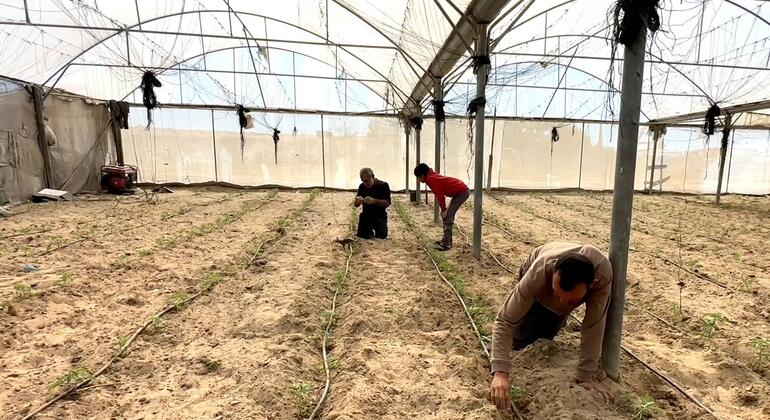
The UN is helping Gaza farmers rebuild their smallholdings in areas trashed by the Hamas-Israel war - a task that's essentially gardening in a war zone. Take Taysir Dahdouh, whose farm in the Zeytun neighbourhood, east of Gaza City, is a little smaller than a football pitch. His greenhouses once grew cucumbers and tomatoes; now they're rubble. He needs tools, seeds, fertilizer and water to start again, which is a bit like asking for a hose while your house is on fire.
Alessandro Mrakic, Head of the Gaza Office for the UN Development Programme (UNDP), told UN News that families who'd fled heavy bombing had moved multiple times before returning. UNDP provided 200 relief housing units, and behind him, he said, people are already producing eggplants, tomatoes, and molokhia - because nothing says resilience like growing vegetables in a war zone.
The UN's Food and Agriculture Organization (FAO) scaled up its cash assistance to help about 1,500 Palestinian farmers cultivate land during the 2026 planting season, enough to produce fresh vegetables for over 100,000 people. But FAO warned that farmers are "squeezed into rapidly shrinking space" thanks to ongoing Israeli military activity, and it's calling for access to land, sea, and production inputs like seeds, fertilizers, irrigation equipment, and fishing gear. Because you can't farm if you're being shot at.
Meanwhile, Deputy Special Coordinator Ramiz Alakbarov welcomed nearly $58 million in new commitments from eight Member States to the UN Horizon Fund, and politely asked for more money. The World Food Programme (WFP) noted that displaced Gazans risk losing access to basic services, but despite obstacles, WFP and partners reached over 250,000 people across 36 distribution sites in the first 12 days of this month. Humanitarian partners also distributed more than 5,440 educational kits to support around 217,600 children during summer learning activities - because even in a war zone, kids need homework.
Over in the West Bank, a high-level OCHA delegation visited Deir Nidham village, meeting Palestinian families affected by settler violence and settlement expansion. Settler attacks accounted for about 55% of all Palestinian injuries in the West Bank so far during 2026 - a statistic that's hard to spin as anything but grim. UN Spokesperson Stéphane Dujarric said the Secretary-General is "deeply alarmed" that Israeli authorities granted city status to Givat Ze'ev settlement, though he noted that designation doesn't change its illegal status under international law. All Israeli settlements in the occupied West Bank, including East Jerusalem, are illegal under international law, Dujarric reiterated, recalling the International Court of Justice's advisory opinion of July 2024. Settlements remain a major obstacle to a two-State solution, and the Secretary-General renewed his call on Israel to halt all settlement expansion. Because apparently, the message needs repeating.
The Good Times
News in your inbox.
One sardonic roundup, delivered on your schedule. Free. Unsubscribe whenever your tolerance for wit runs out.
Already subscribed but we never reach your inbox? Check your spam folder and hit 'Not spam' (or 'Remove from spam') to bust us out of junk-mail purgatory. You'll be helping everyone else too.
Don't open any of our emails for a month and you'll be automatically removed from the mailing list.
Rewrite Article
Select parts to regenerate with a fresh AI pass. Translations will be updated automatically.
Generate AI Image
Creates a sardonic version of the article image using OpenAI.