Frozen Fiber Makes Light and Sound 1,000x More Cozy Than Ever
Because freezing optical fibers apparently makes light and sound interact 1,000x more strongly - so forget lasers, cryogenics is the new computing frontier.
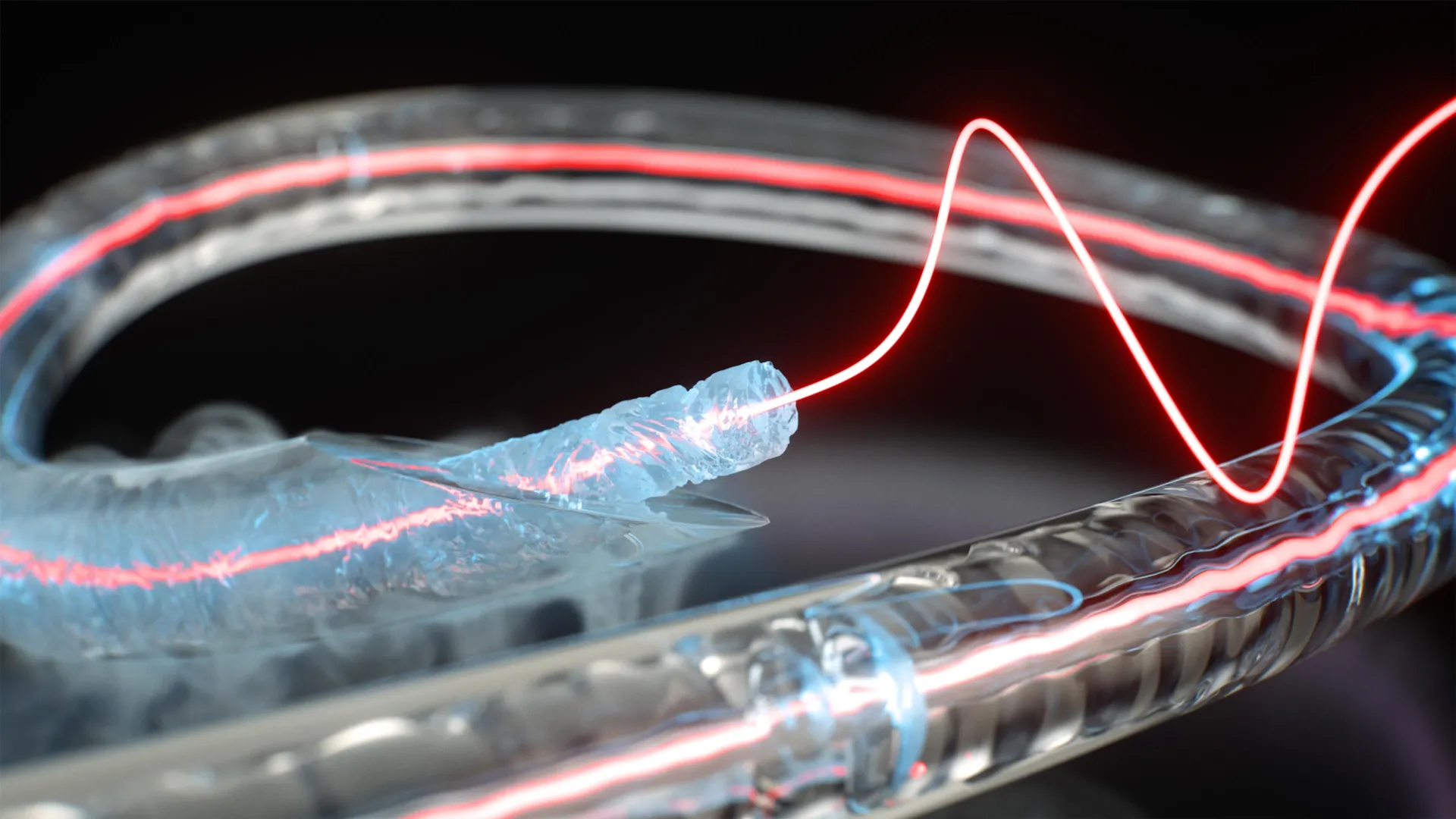
We all know that freezing stuff changes its properties - water turns to ice, lava becomes rock, and apparently, optical fibers become the ultimate party venue for light and sound. Researchers from the Max Planck Institute for the Science of Light (MPL), Leibniz University Hannover (LUH), and the Leibniz Institute for Photonic Technologies (IPHT) have taken liquid core optical fibers (LiCOF) and given them the deep freeze treatment, cooling the liquid inside with nitrogen at -196 °C. Surprisingly, the frozen core still guides light - and both liquid and frozen sections also guide hypersonic sound waves.
The result is a phenomenon called Brillouin-Mandelstam scattering, but with a twist: the interaction between light and sound becomes more than 1000 times stronger than in standard optical fibers. This dramatic boost allowed the team to demonstrate an optoacoustic memory, which could be a key component for photonic neuromorphic computing. The idea is to use the speed difference between light and sound to store information temporarily: a fast light wave transfers its data to slower sound waves, holds it there, then converts it back. Thanks to the frozen fiber's efficiency, this could slash the energy requirements of future photonic computing systems.
According to Simon Seiderer, one of the lead authors, the frozen section retains its light-guiding ability, and both sections guide sound waves. The work builds on previous LiCOF research by Prof. Markus Schmidt and Prof. Mario Chemnitz from IPHT Jena. By adding freezing, the team achieved much greater nonlinear effects. Prof. Dr. Birgit Stiller, who leads the project, calls it 'an entirely new physical platform' with extreme nonlinearities that's easy to handle. Beyond neuromorphic computing, this could open doors for quantum information processing, microwave photonics, and high-precision sensing. So next time you're freezing your dinner, remember: you might be creating a cutting-edge photonic device.
The Good Times
News in your inbox.
One sardonic roundup, delivered on your schedule. Free. Unsubscribe whenever your tolerance for wit runs out.
Already subscribed but we never reach your inbox? Check your spam folder and hit 'Not spam' (or 'Remove from spam') to bust us out of junk-mail purgatory. You'll be helping everyone else too.
Don't open any of our emails for a month and you'll be automatically removed from the mailing list.
Rewrite Article
Select parts to regenerate with a fresh AI pass. Translations will be updated automatically.
Generate AI Image
Creates a sardonic version of the article image using OpenAI.