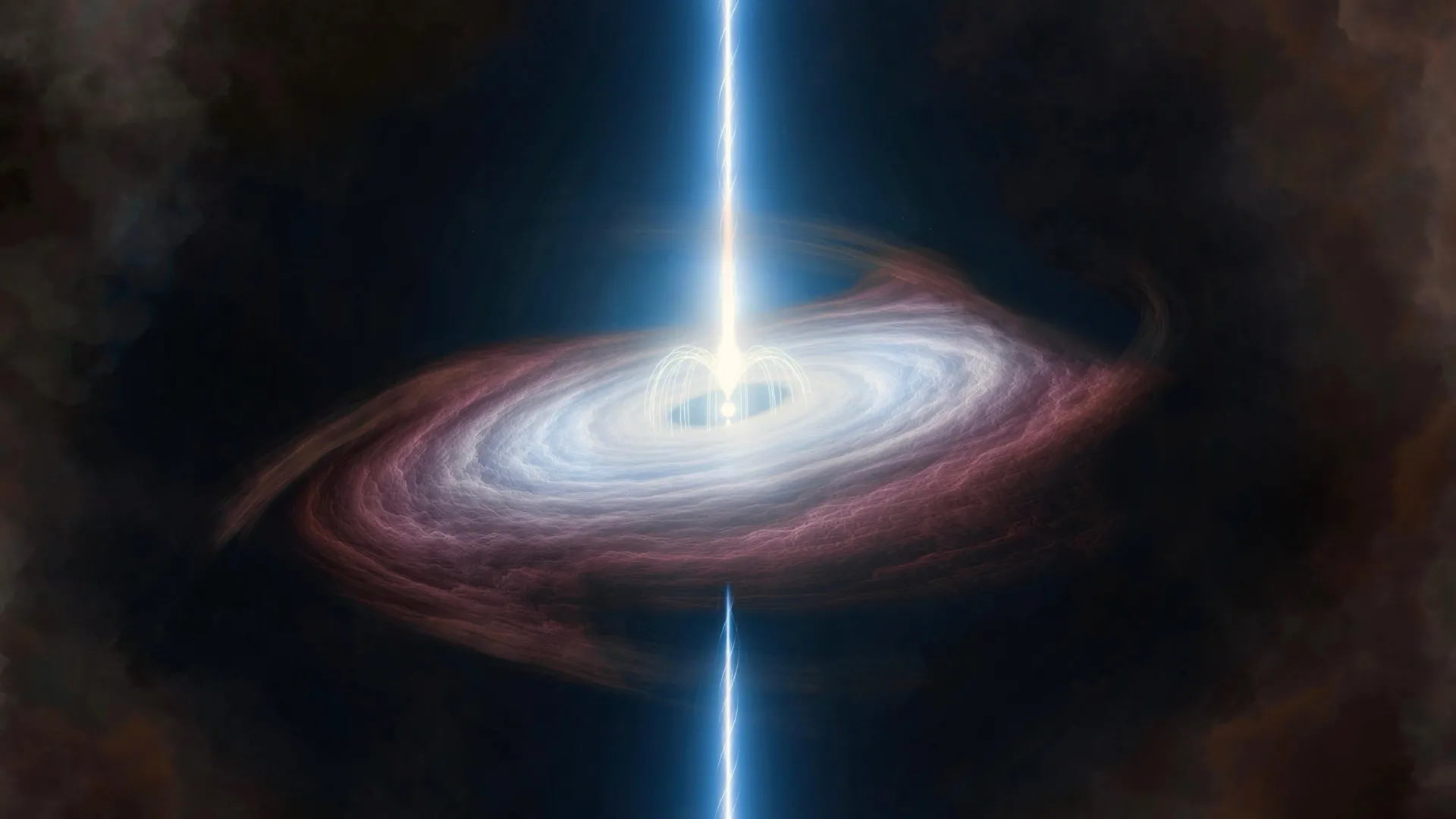
Astronomers have, for the first time, witnessed the birth of a magnetar - an extremely magnetic, rapidly spinning neutron star - confirming that these exotic objects can power some of the brightest stellar explosions ever seen. The discovery also validates a theory first proposed 16 years ago by a UC Berkeley physicist and reveals a distinctive "chirp" in the light of certain exploding stars that can only be explained using Einstein's general relativity. The research was published in the journal Nature.
Superluminous supernovae are among the most spectacular explosions in the universe, shining 10 or more times brighter than ordinary supernovae. Since astronomers first identified them in the early 2000s, they have struggled to explain why these explosions remain intensely bright long after a massive star's iron core collapses and blasts its outer layers into space. Back in 2010, UC Berkeley theoretical astrophysicist Dan Kasen proposed that the answer was a newborn magnetar. His theory argued that when an enormous star reaches the end of its life, its core can collapse into an incredibly dense neutron star instead of becoming a black hole. If that original star possessed a powerful magnetic field, the collapse would dramatically amplify it, producing a magnetar with a magnetic field 100 to 1,000 times stronger than that of a typical pulsar. Although both pulsars and magnetars measure only about 10 miles across, young magnetars can spin more than 1,000 times every second.
Graduate student Joseph Farah of UC Santa Barbara and Las Cumbres Observatory (LCO) found the strongest evidence yet for this theory after studying a supernova discovered in 2024, known as SN 2024afav. Farah and his colleagues concluded that unusual bumps in the supernova's light curve provide direct evidence that a magnetar formed during the explosion. "What's really exciting is that this is definitive evidence for a magnetar forming as the result of a superluminous supernova core collapse," said Alex Filippenko, a UC Berkeley distinguished professor of astronomy and coauthor of the study. Kasen said researchers had long suspected a hidden magnetar was powering these extraordinary explosions. "For years the magnetar idea has felt almost like a theorist's magic trick - hiding a powerful engine behind layers of supernova debris," he said. "The chirp in this supernova signal is like that engine pulling back the curtain and revealing that it's really there."
After SN 2024afav was discovered in December 2024, Las Cumbres Observatory monitored the explosion for more than 200 days. The supernova occurred roughly one billion light-years from Earth. Farah and UCSB astronomer Andy Howell noticed something unusual: after the supernova reached peak brightness about 50 days after the explosion, its brightness rose and fell repeatedly, creating four distinct bumps in the light curve. Farah compared the pattern to the rising pitch of a bird's chirp. Farah's model suggests that some of the material blasted outward by the explosion later fell back toward the newborn magnetar, forming an accretion disk. Because this disk was likely tilted relative to the magnetar's spin, Einstein's theory predicts that the rapidly spinning neutron star would drag the surrounding fabric of space-time with it, producing a phenomenon called Lense-Thirring precession. This effect causes the tilted disk to wobble, and as the wobbling disk periodically blocks and reflects light from the magnetar, the system behaves like a flashing cosmic lighthouse. Over time, the disk spirals inward, causing the wobble to speed up, producing the distinctive "chirp." "We tested several ideas, including purely Newtonian effects and precession driven by the magnetar's magnetic fields, but only Lense-Thirring precession matched the timing perfectly," Farah said. "It is the first time general relativity has been needed to describe the mechanics of a supernova."
The team also estimated that the neutron star spins once every 4.2 milliseconds and possesses a magnetic field roughly 300 trillion times stronger than Earth's, both defining characteristics of a magnetar. "I think Joseph has found the smoking gun," Howell said. "He's tied the bumps into the magnetar model and explained everything with the best-tested theory in astrophysics - general relativity. It is incredibly elegant." The researchers caution that magnetars may not explain every superluminous supernova; some may instead brighten when the explosion's shock wave crashes into surrounding material. But Farah expects astronomers to discover many more "chirping" supernovae once the Vera C. Rubin Observatory begins its unprecedented survey of the night sky. "This is the most exciting thing I have ever had the privilege to be a part of," Farah said. "It's the universe telling us out loud and in our face that we don't fully understand it yet, and challenging us to explain it."
The Good Times
News in your inbox.
One sardonic roundup, delivered on your schedule. Free. Unsubscribe whenever your tolerance for wit runs out.
Already subscribed but we never reach your inbox? Check your spam folder and hit 'Not spam' (or 'Remove from spam') to bust us out of junk-mail purgatory. You'll be helping everyone else too.
Don't open any of our emails for a month and you'll be automatically removed from the mailing list.
Rewrite Article
Select parts to regenerate with a fresh AI pass. Translations will be updated automatically.
Generate AI Image
Creates a sardonic version of the article image using OpenAI.