
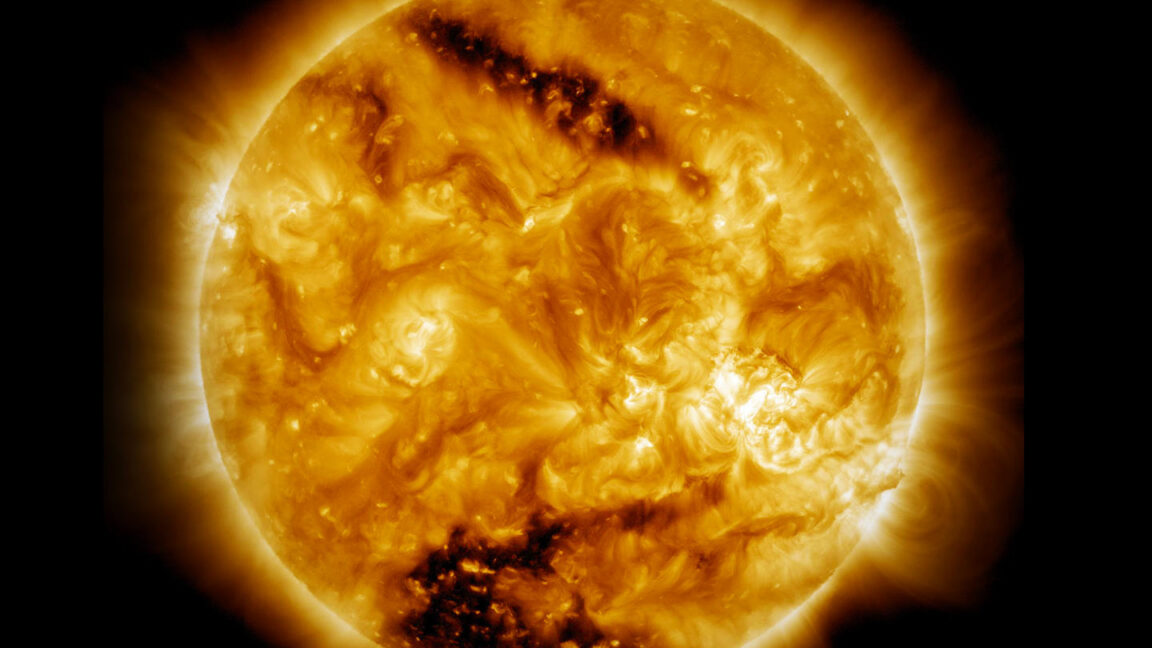
Here's a physics party trick: slide two fluids past each other at different speeds, and the boundary between them will buckle, curl, and roll into neat little vortexes. It's called the Kelvin-Helmholtz instability, a phenomenon explained back in the late 1860s, and it's why wind ripples water and clouds shear into those wavy rows. For decades, scientists suspected the Sun's plasma did the same thing, but nobody could prove it. Now, a team led by David Kuridze and Friedrich Wöger of the National Solar Observatory has not only confirmed it - they say these vortexes are everywhere on the solar surface. And that might change how we think about heat, mass, and magnetic energy moving through the Sun's atmosphere.
The reason these plasma whirlpools stayed hidden for so long is embarrassingly simple: they're tiny. Smaller than what any telescope with a mirror under 2 meters can resolve. For most of solar physics history, that ruled out every telescope on Earth. Enter the Daniel K. Inouye Solar Telescope, a 4-meter behemoth in Hawaii and the largest solar telescope on the planet, which began operations in November 2021.
On April 14, 2025, Kuridze's team pointed it at an active region near the solar disk's center, recording images at 416 nanometers with a diagnostic camera built by the National Solar Observatory and the Max Planck Institute for Solar System Research. Their goal was modest: "achieve diffraction-limited performance," Kuridze said. They weren't hunting vortexes - they just wanted to push the telescope's resolution. The shorter the wavelength, the finer the detail, so they picked 416 nanometers, "towards the smaller portion of the visible spectrum."
What they got was a bonus beyond a cool test drive. The camera snapped 740 frames per second with 100-microsecond exposures. Two thousand frames were combined using multi-frame blind deconvolution to remove atmospheric blurring, producing a movie with a frame every two seconds and a resolution of about 19 kilometers - the theoretical limit for a 4-meter mirror at that wavelength.
"As a byproduct we got these amazing observations, which allowed us to see something which has never been seen before," Kuridze said. At 416 nanometers, the solar surface shows granules - convection cells carrying heat from the interior - interlaced with intense magnetic field bundles. In lower-resolution images, the boundaries between these magnetic regions and the surrounding granulation look smooth and blurry. In the DKIST data, they're a mess of vortex-like structures and fine dark striations.
The team identified 47 vortex-bearing interfaces, with adjacent curls spaced 60 to 100 kilometers apart. Individual vortexes measured 25 to 170 kilometers in diameter, and the smallest ones were right at the 19-kilometer resolution limit - so we don't know how small they go. They could double in size in under a minute and propagated along the interfaces at 0.67 to 3 kilometers per second.
If you were hovering over one of these boundaries, Kuridze says, the view depends on timing. First comes the linear phase: "more relaxed, very well organized, regular and beautiful," with rolling, cloud-like structures. Then the non-linear phase hits: "very chaotic turbulence."
Why do curls form at these interfaces? It's all about the magnetic field's direction. Magnetic field lines act like elastic threads through the plasma, resisting bending. When they lie along the flow, they suppress the instability. When they run across it, they do nothing. In the strong magnetic regions DKIST observed, the field points straight up while the granular flows move sideways - the threads are strung the wrong way, so vortexes grow unhindered.
But seeing something nobody's seen before isn't enough. "Everything looked like it should be Kelvin-Helmholtz, but of course this is not enough," Kuridze said. So they ran computer simulations of a photosphere patch about 6 megameters on a side with 3.2-kilometer grid spacing, seeded with actual magnetic field maps. They synthesized what DKIST would see, computed 500 spectral points, applied the real filter's transmission profile, and blurred to match the telescope's resolution. The synthetic images matched the vortexes' appearance, growth, distribution, and speeds - confirming the observations are likely real.
This discovery has implications. Strong magnetic fields normally hold plasma still - that's what sunspots are. Finding an instability that spins vortexes along every magnetic element's edge means a stirring mechanism where none was expected. Magnetized and unmagnetized gas can blend, cool material from convection cell edges can leak into magnetic regions, altering heat movement below the visible surface. Our current models don't account for this.
Then there's the corona, the Sun's million-degree outer atmosphere, heated partly by field lines being shuffled at their anchor points until they braid and snap. We'd never observed the shuffling mechanism. "You have these twisting motions everywhere at the surface of the magnetic element, and this twisting motion is nothing else than braiding of the magnetic fields," Kuridze said.
But it's all based on a three-minute observation - a snapshot, not a survey. And the simulations have limits. "One thing we just don't know is how small these Kelvin-Helmholtz patterns get on the Sun," Kuridze said. The smallest ones we can resolve are near the resolution limit, so there could be smaller ones hiding. Running finer simulations hasn't worked yet: "some extra physics needs to be involved, and we are not sure exactly how things work in computational simulations when you need to reach those resolutions."
Also, DKIST provided high-resolution visual images, which are a decent proxy for magnetic field location and strength, but not direct measurements. Plasma velocities come from simulations, not the telescope, and the magnetic field driving everything hasn't been measured directly at this scale.
The team thinks longer observations will resolve the uncertainties. "If you want to quantify how the magnetic field is evolving in time, what sort of dissipation you have, how much energy is released, how much energy budget there is for eruptions and flares - you need much longer observations, and you need magnetic maps," Kuridze said. "This is the next challenge and the next milestone."
The study appears in Nature, 2026, DOI: 10.1038/s41586-026-10871-3.