Stanford Researchers Figure Out How to Run Quantum Computing Without Freezing the Planet First
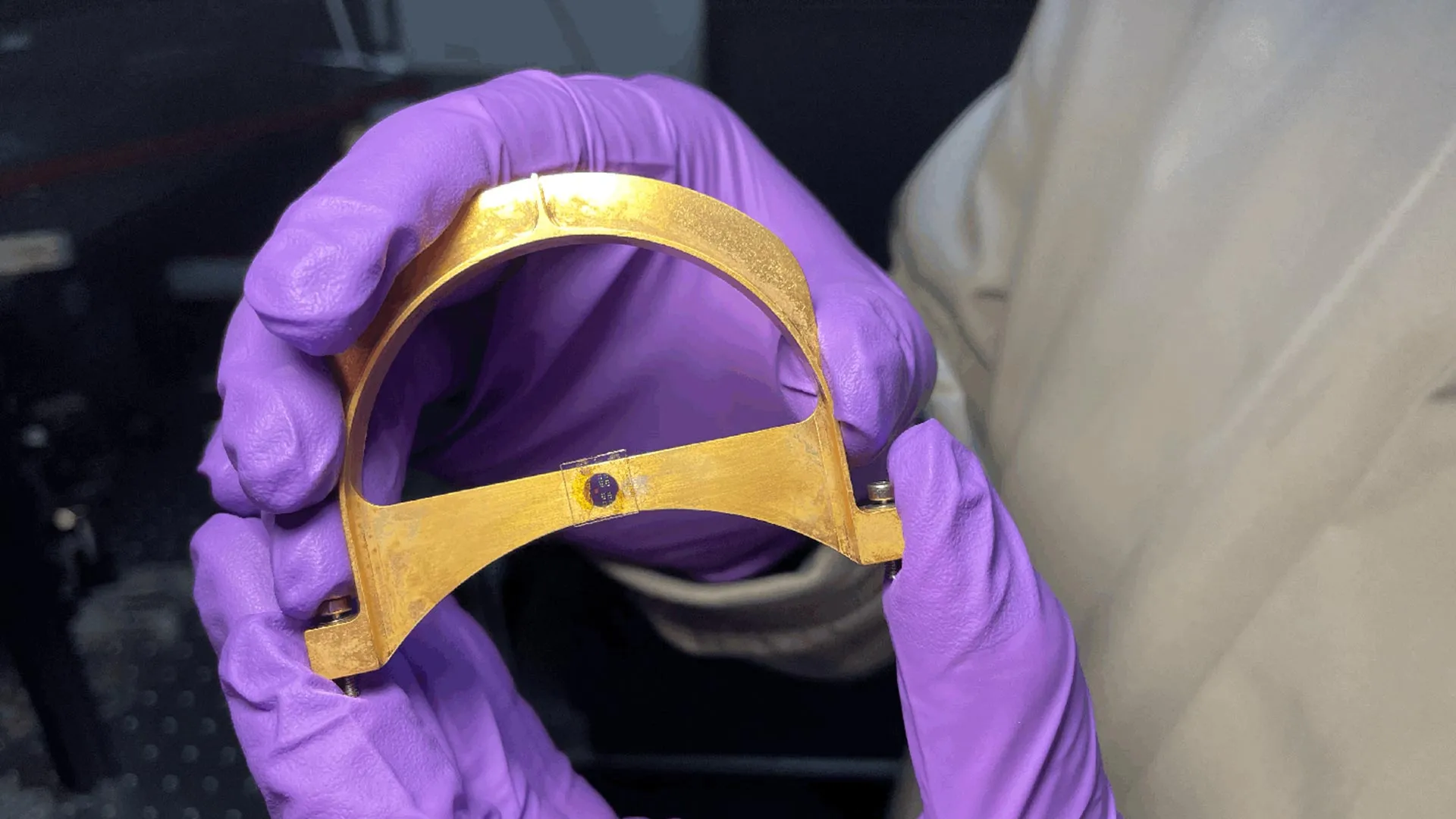
Stanford researchers built a room-temperature quantum device using twisted light and molybdenum diselenide, proving that quantum computing might not require dressing like you're going to Mars.
Quantum computers, as anyone who has ever priced one out knows, are a pain. They require temperatures near absolute zero (-459°F), which is roughly the temperature of deep space and, coincidentally, the temperature of most people's patience with the technology. But researchers at Stanford University have developed a nanoscale optical device that works at room temperature by linking the quantum properties of light and electrons. This could lead to smaller, cheaper quantum technologies that can actually transmit information across long distances without requiring a cryogenic facility.
The device enables entanglement between photons (light particles) and electrons, a fundamental requirement for quantum communication. Jennifer Dionne, a professor of materials science and engineering at Stanford and senior author of the study published in Nature Communications, notes that the material isn't new, but the way they're using it is. "It provides a very versatile, stable spin connection between electrons and photons that is the theoretical basis of quantum communication," she says. "Typically, however, the electrons lose their spin too quickly to be useful." So they fixed that.
The contraption combines a thin patterned layer of molybdenum diselenide (MoSe2) with a nanopatterned silicon substrate. Molybdenum diselenide is part of a family called transition metal dichalcogenides (TMDCs), which are prized for their optical and quantum properties. The silicon nanostructures generate what the researchers call "twisted light." Feng Pan, a postdoctoral scholar and first author of the paper, explains: "The photons spin in a corkscrew fashion, but more importantly, we can use these spinning photons to impart spin on electrons that are the heart of quantum computing." So it's basically a very small, very precise light-twister.
The patterned nanostructures are about the size of visible light wavelengths - invisible to the naked eye, but crucial for manipulating photons into spinning up or down. This twisted light can become entangled with electron spins, creating qubits, the building blocks of quantum information. In conventional computing, it's zeros and ones; in quantum, qubits exploit quantum effects to do things differently. The big hurdle has been decoherence - the loss of quantum information - which usually requires extreme cooling to prevent. This device sidesteps that by operating at room temperature, making it relatively inexpensive and practical.
If further developed, the technology could boost secure communications, advanced sensing, high-performance computing, and artificial intelligence. The team picked TMDC materials for their unusual quantum characteristics, collaborating with Stanford researchers Fang Liu and Tony Heinz, who specialize in these materials. "It all comes down to this material and our Silicon chip," Pan says. "Together, they efficiently confine and enhance the twisting of light to create a strong coupling of spin between photons and electrons. This stabilizes the quantum state that makes quantum communication possible."
The researchers are continuing to improve the device, exploring additional TMDC materials and combinations for better performance. They're also investigating whether these systems might unlock new quantum capabilities not currently possible at room temperature. A longer-term goal is integrating such devices into larger quantum networks, requiring improvements in light sources, modulators, detectors, and interconnects. Ultimately, they hope quantum components can be miniaturized for everyday electronics. "If we can do that, maybe someday we could do quantum computing in a cell phone," Pan says with a smile. "But that's a 10-plus-year plan." So don't hold your breath, but maybe start planning for a much cooler phone.
The Good Times
News in your inbox.
One sardonic roundup, delivered on your schedule. Free. Unsubscribe whenever your tolerance for wit runs out.
Already subscribed but we never reach your inbox? Check your spam folder and hit 'Not spam' (or 'Remove from spam') to bust us out of junk-mail purgatory. You'll be helping everyone else too.
Don't open any of our emails for a month and you'll be automatically removed from the mailing list.
Rewrite Article
Select parts to regenerate with a fresh AI pass. Translations will be updated automatically.
Generate AI Image
Creates a sardonic version of the article image using OpenAI.