Scientists Suggest Life May Have Begun When Things Got Icy and Stuck Together
New research suggests life may have started not in a warm pond but in a freezing-thawing cycle that made primitive bubbles fuse and hold DNA better - turns out, ice can be a matchmaker.
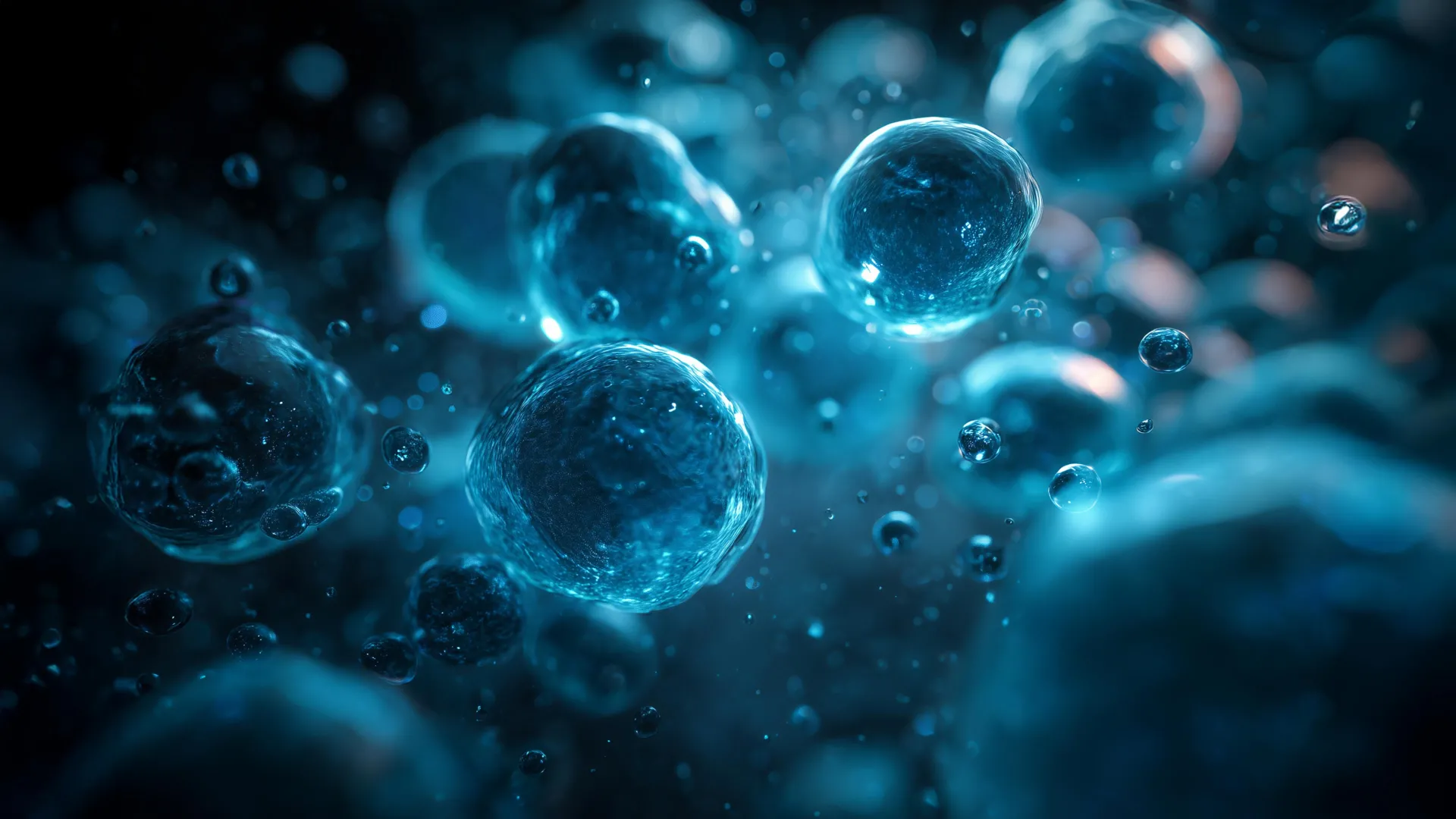
Modern cells are the overachievers of the biological world - internal scaffolding, tightly controlled chemical processes, and a genetic instruction manual for everything. But the earliest cell-like structures? They were basically greasy bubbles with delusions of grandeur. Understanding how those simple protocells evolved into the complex cellular machines we see today has been a central headache in origin-of-life research.
A recent study from the Earth-Life Science Institute (ELSI) at Institute of Science Tokyo decided to stop guessing and start freezing. Instead of proposing one grand theory, they built model protocells - large unilamellar vesicles (LUVs) - using three types of phospholipids: POPC (1-palmitoyl-2-oleoyl-glycero-3-phosphocholine; 16:0-18:1 PC), PLPC (1-palmitoyl-2-linoleoyl-sn-glycero-3-phosphocholine; 16:0-18:2 PC), and DOPC (1,2-di-oleoyl-sn-glycero-3-phosphocholine; 18:1 (D9-cis) PC). "We used phosphatidylcholine (PC) as membrane components, owing to their chemical structural continuity with modern cells, potential availability under prebiotic conditions, and retaining ability of essential contents," said Tatsuya Shinoda, a doctoral student at ELSI and lead author. Subtle differences in double bonds made some membranes rigid (POPC) and others floppy (PLPC and DOPC).
Then came the freeze/thaw cycles (F/T) - mimicking ancient Earth's temperature mood swings. After three cycles, POPC-rich vesicles just huddled together without merging. But PLPC and DOPC vesicles fused into larger compartments. The more PLPC, the more fusion. "Under the stresses of ice crystal formation, membranes can become destabilized or fragmented, requiring structural reorganization upon thawing," explained Natsumi Noda, researcher at ELSI. Translation: floppy membranes are better at merging when things get icy - and fusion is how scattered organic molecules got mixed, potentially jump-starting chemistry toward life.
The team also tested DNA retention. PLPC vesicles trapped and held onto DNA better than POPC vesicles, even before freezing. After repeated cycles, they still clung to more DNA. This suggests icy environments - not just drying pools or hydrothermal vents - could have been a cradle for life. Freeze/thaw cycles concentrate molecules and encourage fusion, though fluid membranes risk leakage. Balance is everything.
"A recursive selection of F/T-induced grown vesicles across successive generations may be realized by integrating fission mechanisms such as osmotic pressure or mechanical shear," noted Tomoaki Matsuura, Professor at ELSI and principal investigator. In plain English: simple freezing and thawing might have nudged basic bubbles toward the first cells capable of Darwinian evolution. So next time you scrape ice off your windshield, remember - you might be witnessing the origin story of all life.
The Good Times
News in your inbox.
One sardonic roundup, delivered on your schedule. Free. Unsubscribe whenever your tolerance for wit runs out.
Already subscribed but we never reach your inbox? Check your spam folder and hit 'Not spam' (or 'Remove from spam') to bust us out of junk-mail purgatory. You'll be helping everyone else too.
Don't open any of our emails for a month and you'll be automatically removed from the mailing list.
Rewrite Article
Select parts to regenerate with a fresh AI pass. Translations will be updated automatically.
Generate AI Image
Creates a sardonic version of the article image using OpenAI.