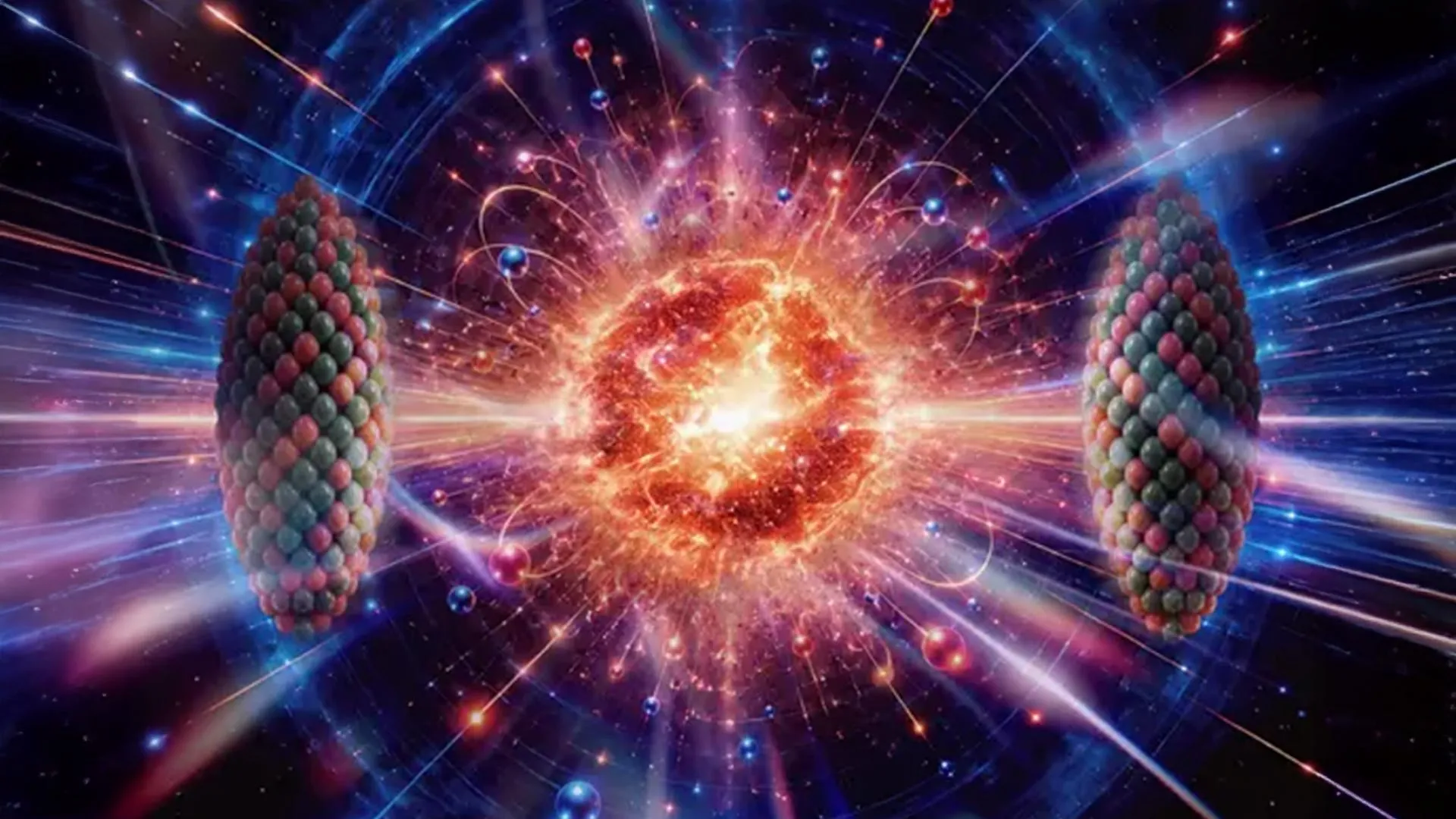
When atomic nuclei smash into each other at nearly the speed of light, they briefly create quark-gluon plasma, an absurdly hot state of matter where quarks and gluons roam free. This stuff behaves like an almost perfect fluid and lets scientists peek at conditions similar to those right after the Big Bang. Researchers have spent plenty of time staring at the plasma's dramatic swirling and its powerful electromagnetic fields, but its acceleration? Barely a glance. That's a shame, because acceleration is what makes the fireball expand so quickly - in hydrodynamics, it's just as fundamental as vorticity, much like electric and magnetic fields are both essential to electromagnetism.
A team led by Fudan University physicists Yu-Gang Ma and Xu-Guang Huang decided to map how acceleration forms and changes inside this plasma. They combined two popular particle transport models, AMPT and UrQMD, with a Gaussian smearing method. This trick turns individual particle distributions into continuous energy, momentum, and velocity fields, letting them treat the plasma as a fluid in motion. They then tracked acceleration across collision energies from 3.5 GeV all the way up to 2.76 TeV.
"Acceleration is not merely a kinematic detail -- it may act as a thermodynamic control parameter of QCD matter," said Professor Huang, presumably while adjusting his glasses.
The simulations showed that peak proper acceleration can hit several hundred MeV at both low and high collision energies. The strongest transverse acceleration always points outward and lurks near the fireball's outer edge. Why? Because pressure drops fast there while enthalpy density stays low. According to the relativistic Euler equation, those two factors reinforce each other and crank up the acceleration. So the edge is basically an acceleration hotspot, which sounds like a great place to avoid.
But the plasma doesn't behave the same at all energies. At lower energies, nuclear stopping initially slows things down, producing deceleration of up to about 500 MeV. At ultrarelativistic energies, the nuclei zip through each other so quickly that they yank the new plasma into brief, intense acceleration pulses. And because the strongest acceleration stays along the boundary, it doesn't matter much whether the nuclei hit head-on or at an angle - the effect is similar. So much for dramatic collisions.
Acceleration might do more than just move the plasma around. Through the Unruh effect, an accelerating observer would see empty space as a warm bath. An acceleration of several hundred MeV could resemble temperatures near the QCD transition temperature. That means acceleration could add a new "acceleration axis" to the phase structure of QCD matter, potentially affecting both the chiral transition and the quark confinement transition. It might also generate transport effects and influence particle spin alignment, which would complement vorticity effects and might help explain weird spin behavior seen at RHIC and the LHC.
The researchers plan to include more realistic hydrodynamic evolution in their calculations next. They also hope to find experimental signals - like patterns in hyperon spin polarization - that could reveal acceleration's fingerprints. By connecting non-inertial quantum effects with measurable particle behavior, this work opens a fresh path for studying matter governed by the strong interaction.
"Just as temperature and density define the phase diagram of matter, acceleration may open a new axis of that diagram," said Professor Huang. "By mapping this hidden dimension of the quark-gluon plasma, we hope to turn non-inertial quantum effects into signatures that experiments can actually measure." In other words, they're turning a theoretical curiosity into something you can actually see at a collider, which is way cooler than it sounds.
The Good Times
News in your inbox.
One sardonic roundup, delivered on your schedule. Free. Unsubscribe whenever your tolerance for wit runs out.
Already subscribed but we never reach your inbox? Check your spam folder and hit 'Not spam' (or 'Remove from spam') to bust us out of junk-mail purgatory. You'll be helping everyone else too.
Don't open any of our emails for a month and you'll be automatically removed from the mailing list.
Rewrite Article
Select parts to regenerate with a fresh AI pass. Translations will be updated automatically.
Generate AI Image
Creates a sardonic version of the article image using OpenAI.