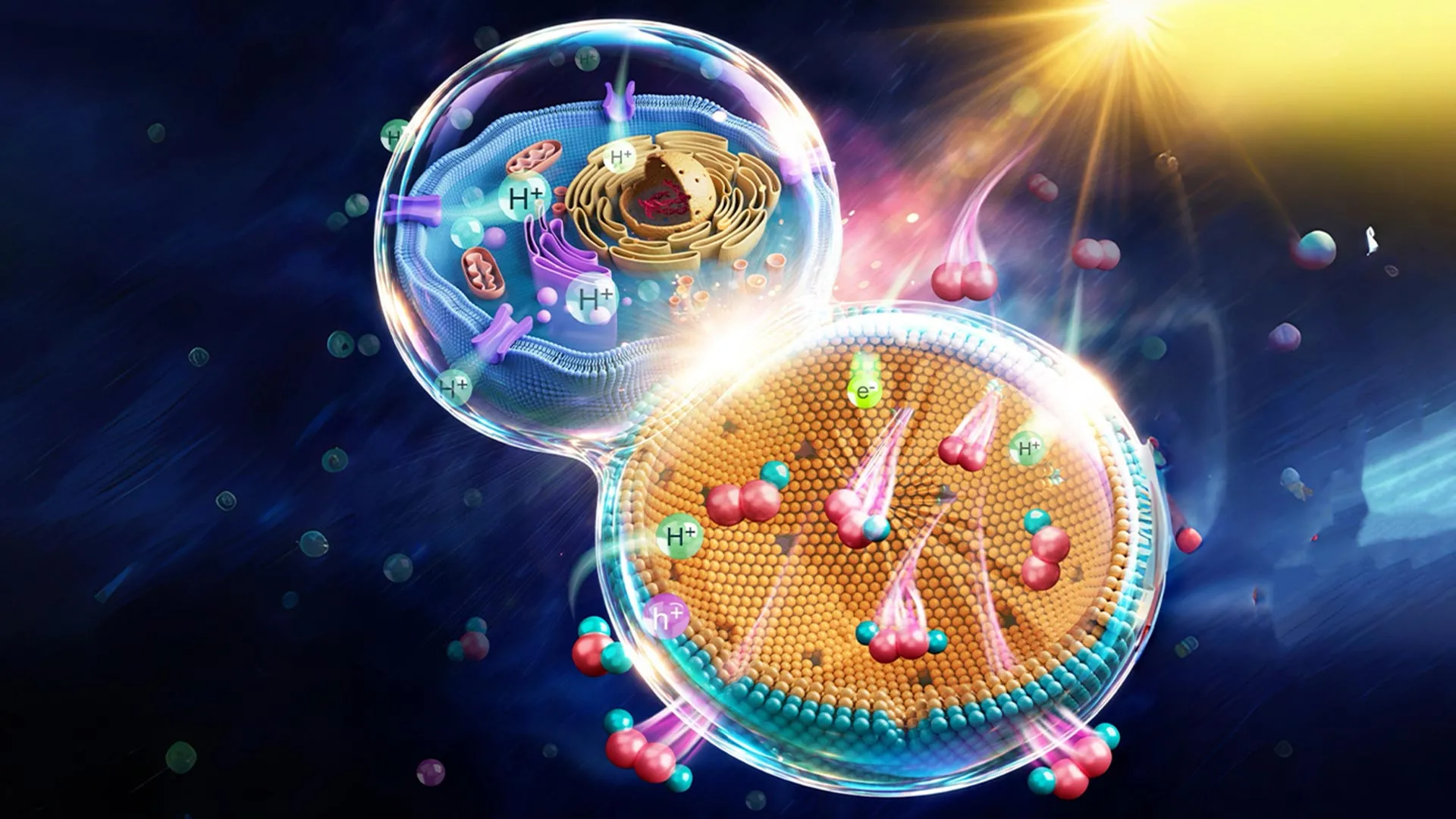
Scientists Build Tiny Cell-Inspired Reactor That Makes Hydrogen Peroxide From Sunlight, Because Why Not
Scientists built a tiny cell-inspired nanoreactor that turns sunlight into hydrogen peroxide, because nature's design was just too efficient to leave alone.
In a move that will surely delight both chemists and people who enjoy metaphors about tiny factories, researchers have constructed a hollow CdS@polydopamine nanoreactor that mimics two key features of living cells. The design, published in the Journal of the American Chemical Society, offers a fresh way to reproduce the highly organized chemical functions of cells inside synthetic nanomaterials. Lead researcher Prof. LI Can from the Dalian Institute of Chemical Physics (DICP) of the Chinese Academy of Sciences (CAS), along with Prof. Jian Liu's team at Inner Mongolia University, are the masterminds behind this microscopic marvel.
Cells are basically the original overachievers: they perform complex biochemical reactions with exceptional efficiency and precision by compartmentalizing components in tightly controlled spaces. Scientists, never ones to let biology show them up, are now applying these principles to engineered nanomaterials. This field, called nanocell engineering, aims to create cell-like structures with specialized surfaces and internal pores or cavities. These synthetic systems, often dubbed nanoreactors, are essentially the lovechild of cell biology and nanotechnology.
The new nanoreactor sports two biomimetic features. First, it has a dynamic catechol/o-benzoquinone redox pair in its polydopamine shell, which acts as a proton relay rather than a proton pump. This pair speeds up proton-coupled electron transfer (PCET), a process where protons and electrons move in lockstep. Second, it boasts a compartmentalized structure: a nanoscale hollow cavity surrounded by a porous shell, creating a confined environment that traps photons and lets reactants accumulate. It's like a tiny, sun-powered chemistry lab with its own waiting room.
These features help balance the reaction speeds of oxygen reduction and water oxidation, two half-reactions that need to work in harmony for hydrogen peroxide production. Under visible light in an aqueous solution, the nanoreactor achieved an H2O2 photosynthesis rate of 3.24 mmol gcat.-1 h-1 and a solar-to-chemical conversion efficiency of 1.2%. To figure out how it all works, the researchers used in situ spectroscopy, photochemical analysis, finite element simulations, and theoretical calculations. They also embedded the nanoreactors in a sodium alginate hydrogel matrix, creating solid, recyclable photocatalysts that can continuously synthesize H2O2 under natural sunlight while maintaining stable performance.
"Our study provides a new strategy for engineering biomimetic nanoreactors that increasingly replicate the sophisticated functions of living cells, opening new opportunities in artificial photosynthesis, energy catalysis, and synthetic chemistry," said Prof. Li. So, next time you see a plant doing its photosynthesis thing, just remember: we're one step closer to doing it in a test tube, but with more polydopamine.
The Good Times
News in your inbox.
One sardonic roundup, delivered on your schedule. Free. Unsubscribe whenever your tolerance for wit runs out.
Already subscribed but we never reach your inbox? Check your spam folder and hit 'Not spam' (or 'Remove from spam') to bust us out of junk-mail purgatory. You'll be helping everyone else too.
Don't open any of our emails for a month and you'll be automatically removed from the mailing list.
Rewrite Article
Select parts to regenerate with a fresh AI pass. Translations will be updated automatically.
Generate AI Image
Creates a sardonic version of the article image using OpenAI.