Quantum Bath Puts Entanglement on Autopilot, Because Who Has Time for Active Control?
Physicists finally prove a 20-year-old theory by making qubits entangle themselves via a 'quantum bath' of correlated photons - no active control, just passive-aggressive quantum vibes.
In a development that will either revolutionize quantum computing or give physicists a new excuse to avoid doing anything manually, researchers at the Institute of Science and Technology Austria (ISTA) have demonstrated a method to entangle qubits using a 'quantum bath' - no active control, no repeated measurements, just a stream of correlated photons doing all the heavy lifting. Published in Physical Review X, the experiment finally proves a prediction made over 20 years ago, marking the first time anyone has gotten entangled states to assemble themselves.
Entanglement, the quantum phenomenon that lets particles share correlations defying classical logic, is crucial for building larger quantum computers and networks. Previously, scientists had to either send a single actively controlled photon between qubits or match photons from each qubit - a method that earned the 2022 Nobel Prize in Physics but still relies on post-selection and doesn't always work.
Enter Alejandro Andrés-Juanes and Johannes Fink at ISTA, who, with international collaborators, decided to let the environment do the work. Their 'quantum bath' - a shared source of correlated light particles - automatically synchronizes distant qubits, stabilizing entanglement even beyond the qubits' own lifetime. 'In our method, the quantum bath is the source of entanglement,' says Fink. 'It creates a new ground state through a continuous stream of correlated photons.' The result: entangled states that stay available for quantum processing whenever needed, rather than fleeting moments.
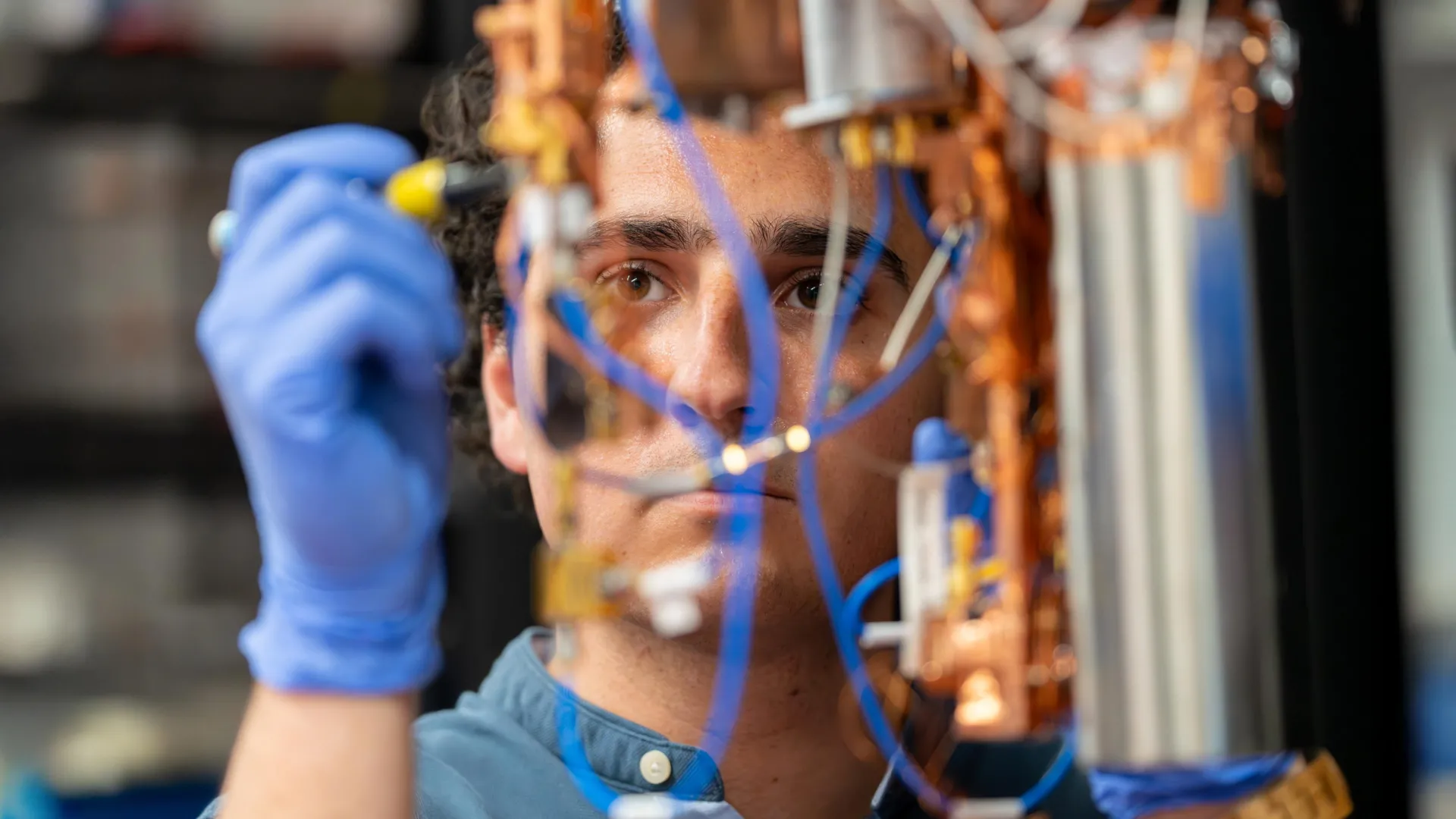
The team used microwave photons to couple the qubits to the photon source, capitalizing on their low energy and existing superconducting-qubit technology. To confirm the qubits were actually synchronized, they employed quantum tomography, taking measurements lasting just 20-80 nanoseconds (a nanosecond being one billionth of a second) to reconstruct the quantum states.
This proof-of-concept prototype is 'a relatively simple method that could be scaled up to synchronize multiple distant qubits,' says Andrés-Juanes. But it's not yet efficient - currently transferring only about 10% of the bath's available entanglement. The researchers suspect the 20-year gap between theory and experiment is due to the original idealized conditions being a bit too perfect for real-world labs. Still, the prototype offers new opportunities for quantum-optics experiments and could help push quantum processors toward fault-tolerant operation. Because honestly, who wouldn't want entanglement on autopilot?
The Good Times
News in your inbox.
One sardonic roundup, delivered on your schedule. Free. Unsubscribe whenever your tolerance for wit runs out.
Already subscribed but we never reach your inbox? Check your spam folder and hit 'Not spam' (or 'Remove from spam') to bust us out of junk-mail purgatory. You'll be helping everyone else too.
Don't open any of our emails for a month and you'll be automatically removed from the mailing list.
Rewrite Article
Select parts to regenerate with a fresh AI pass. Translations will be updated automatically.
Generate AI Image
Creates a sardonic version of the article image using OpenAI.