Physicists May Have Finally Caught the Elusive Glueball, and It Only Took 10 Billion Particle Collisions
BES III physicists have found the strongest evidence yet for glueballs, the elusive particles made of pure gluons - turns out you can build something out of nothing but glue, and it only took 10 billion collisions to see it.
Physicists at the Beijing Spectrometer III (BES III) experiment have unearthed what they call the strongest evidence yet for the existence of glueballs - those mythical particles made entirely of gluons that quantum theory insists should exist but has been rather coy about showing up. The findings appeared in a preprint on arXiv last month and were presented at the International Conference on High Energy Physics (ICHEP) last week.
Let's rewind to the basics: everything you see is made of quarks, held together by gluons, which are the carriers of the strong nuclear force. These glue-ons (yes, that's really where the name comes from) bind quarks into protons and neutrons, which form the cores of atoms. The Higgs boson, discovered in 2012 after decades of searching, was hailed as the final piece of the Standard Model, but there are still missing bits - glueballs being a rather glaring one. They are a direct prediction of quantum chromodynamics (QCD), the theory of the strong force, and there should even be several varieties.
As Matthew Francis explained for Ars back in 2015, glueballs are part of why matter has mass. Like the Higgs, they're linked to mass, but in a different way: most of the mass of protons and neutrons doesn't come from quarks but from the energy of the gluons binding them together, thanks to E=mc². Gluons also stick to each other, not just to quarks, so theoretically you can build a particle out of pure gluons - no quarks needed. That's the glueball.
The hunt has focused on the J/ψ particle, a meson with a charm quark and a charm antiquark, discovered in 1974. When J/ψ particles decay, they produce a bunch of gluons and hadrons, making them a prime hunting ground for glueball signatures. For a particle to qualify as a glueball candidate, it needs zero spin, no electric charge, and odd parity, among other things.
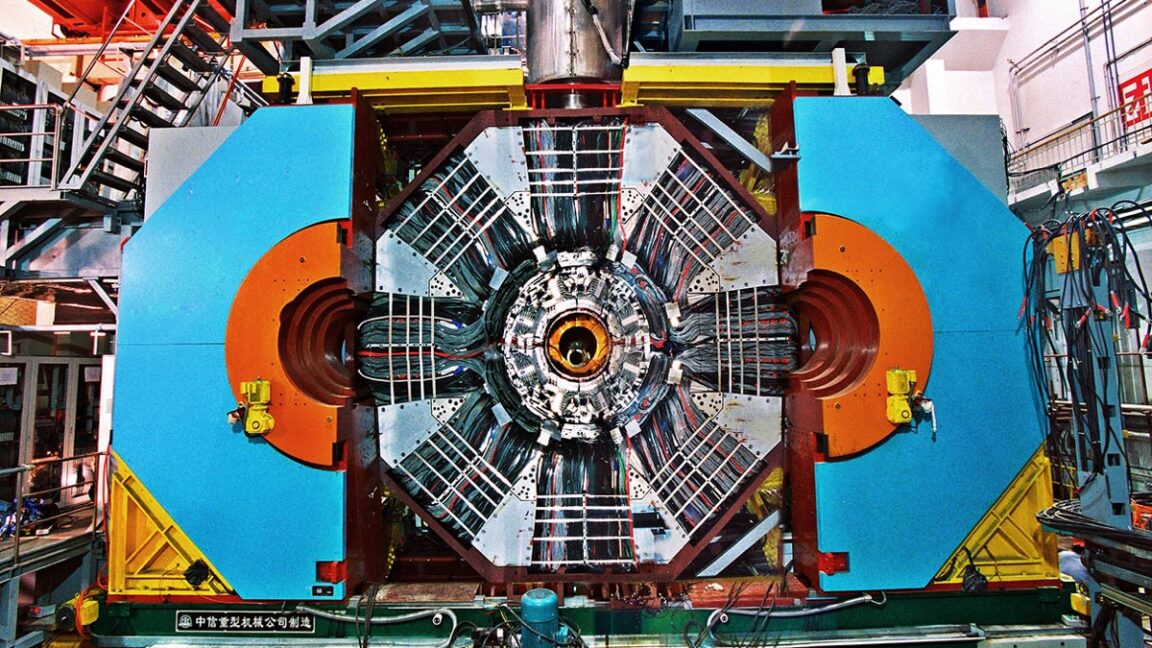
Enter BES III, an electron-positron collider designed specifically for this hunt. It started collecting data in 2008 and within a year had recorded over 226 million events. One of the strongest candidates for the lightest glueball is the X(2370) particle, discovered there in 2011, with a mass initially measured at 2.370 GeV/C², slightly below the predicted 2.395 GeV/C² from lattice QCD.
By 2024, BES III had racked up over 10 billion J/ψ events, making it possible to spot rare events and exotic states like XYZ mesons and tetraquarks, and to measure X(2370) with unprecedented accuracy. The team got a predicted mass of 2.395 GeV/C² - a nice match to theory - and spin and parity consistent with QCD. Still, that wasn't quite enough to declare a discovery.
But now, the latest results look at several previously unreported decay modes of X(2370). The analysis shows it's a "flavor singlet," meaning it isn't tied to any specific quark flavor (up, down, or strange) - a vital clue that it's made predominantly of gluons, about 90% according to the collaboration. That matches the three primary predicted properties for a glueball, which the BES III team calls a complete chain of evidence.
"It's an experimental triumph," said Colin Morningstar, a particle physicist at Carnegie Mellon University who wasn't involved, to Science. "It's the strongest evidence yet that particles dominated by a glueball component can exist in nature."
Next up: independent verification, perhaps at the proposed Super Tau-Charm Facility (STCF) in China or the Electron-Ion Collider under construction at Brookhaven National Laboratory in the US. But BES III is currently the only machine devoted exclusively to hunting gluons, so confirmation might take a while. The paper is on arXiv, 2026, DOI: 10.48550/arXiv.2607.20366.
The Good Times
News in your inbox.
One sardonic roundup, delivered on your schedule. Free. Unsubscribe whenever your tolerance for wit runs out.
Already subscribed but we never reach your inbox? Check your spam folder and hit 'Not spam' (or 'Remove from spam') to bust us out of junk-mail purgatory. You'll be helping everyone else too.
Don't open any of our emails for a month and you'll be automatically removed from the mailing list.
Rewrite Article
Select parts to regenerate with a fresh AI pass. Translations will be updated automatically.
Generate AI Image
Creates a sardonic version of the article image using OpenAI.