
For decades, physicists have been painstakingly organizing their ever-growing collection of subatomic particles, only to have some new arrivals refuse to sit neatly in the designated boxes. Researchers at the U.S. Department of Energy's Thomas Jefferson National Accelerator Facility have now found evidence for two unexpected structures that might help sort out some of the chaos.
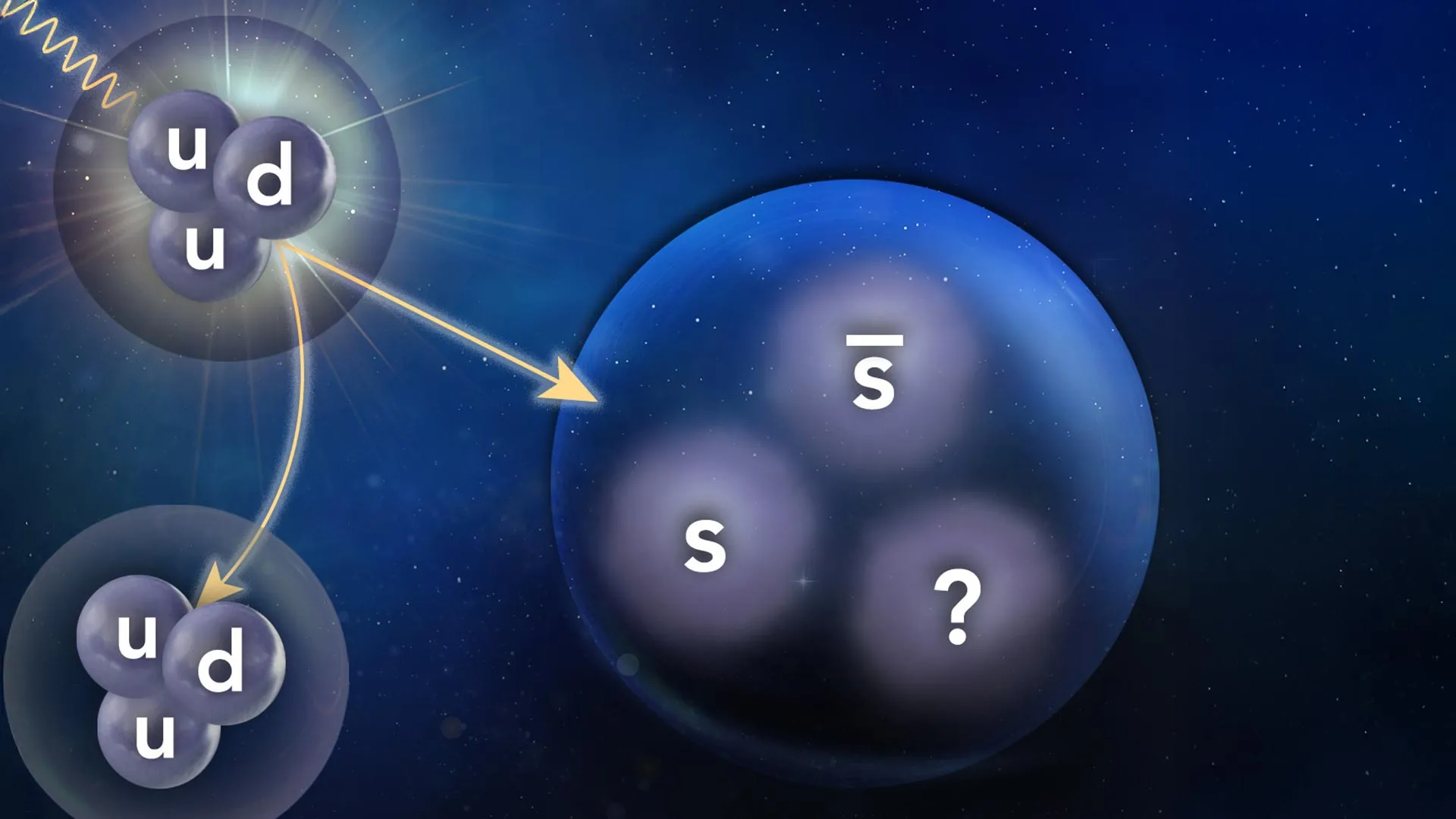
The signals could shed light on XYZ states - a puzzling group of objects that don't fit the conventional picture of particles made of quarks, matter's fundamental building blocks. For the first time, Jefferson Lab researchers detected two such signals when a beam of high-energy photons smacked into a proton target.
The findings come from the Gluonic Excitations (GlueX) Collaboration in Experimental Hall D at Jefferson Lab and were recently published in Physical Review Letters. The results could help scientists understand how one of nature's fundamental forces contributes to forming matter.
"We went searching for a confirmed XYZ candidate with a photon beam but instead found two other structures," said Malte Albrecht, a staff scientist at Jefferson Lab. "It's new information." Translation: they aimed for one exotic particle and accidentally discovered two more, which is either a huge win or a cosmic prank.
Since the 1950s, high-energy collision experiments have been unearthing a veritable zoo of subatomic particles called hadrons, which are composite particles made of two or more quarks held together by the strong nuclear force. Familiar examples include protons and neutrons, each containing three quarks (though those were known long before). Among the newcomers were short-lived particles called mesons, typically a quark paired with its antimatter counterpart, the antiquark.
In 1964, physicists introduced the quark model to impose order on these bound states. The earliest version had three quark "flavors": up, down, and strange. Up and down quarks, for instance, form protons and neutrons; up, down, and strange are the three lightest quark types. Then, in 1974, the heavier charm quark showed up and threw a wrench in the works - but also helped build the framework that became the Standard Model, the broad theory describing elementary particles and fundamental forces, while expanding the known spectrum of hadronic structures.
As accelerators got more powerful and detectors more sensitive, researchers began seeing subtler processes. After 2000, experiments started revealing hadrons with quantum properties that didn't fit the original quark model. The discoveries piled up so fast that physicists slapped the label XYZ states on many of these poorly understood particles.
"We are in a new era here, similar to 70-odd years ago," said Frank Nerling, a Jefferson Lab collaborator from Germany's GSI Helmholtz Centre for Heavy Ion Research and Goethe University Frankfurt. "First, a zoo of hadrons was discovered. Now, we're facing a zoo of so-called exotic states."
Hadrons containing a charm quark and its anticharm partner occupy a mass region called charmonium; particles with strange and anti-strange quarks populate strangeonium. Many XYZ states have been spotted in these sectors. In 2006, researchers on the BaBar experiment at the DOE's SLAC National Accelerator Laboratory reported a possible strangeonium state with a mass of about 2.16 billion electron volts (2.16 GeV), designating it Y(2175). BaBar created Y(2175) by colliding electrons and positrons (e+e- annihilation). Y(2175) showed quantum behavior that may be tough to explain as a plain quark-antiquark pair - it might be a hybrid state involving two strange quarks and excited gluons (the strong-force carriers), a four-quark tetraquark, or a molecule-like combo of other composite particles.
Later electron-positron collider experiments (BES in China, Belle in Japan) confirmed Y(2175), but until now it hadn't been seen via any process other than e+e- annihilation. "The challenge is that you have many measurements around the world in very different experiments that have to find consensus about what they are seeing," said Klaus Goetzen, another GSI physicist at Jefferson Lab. "It's more complicated than it sounds, because there are states that are close by in mass and might or might not be the same thing."
The GlueX Collaboration set out to find Y(2175) via photoproduction, where a photon beam hits protons in a fixed target. Y(2175) didn't show up - instead, researchers found something unexpected at nearby masses. GlueX was built specifically to hunt for hybrid mesons, exotic particles where excited gluons might directly contribute to the internal structure. Quantum chromodynamics (QCD), the theory of the strong force, predicts such states should exist.
"Excited gluonic fields are what could be in these mesons where you have more than just the quark-antiquark pair," said Justin Stevens, a William & Mary physics professor and GlueX spokesperson. "That's one of the investigations, to try to understand whether there is a gluonic contribution to the structure we see."
GlueX uses the Continuous Electron Beam Accelerator Facility (CEBAF), a DOE Office of Science user facility supporting research by over 1,700 physicists. An ultrathin diamond wafer converts CEBAF's electrons into a beam of high-energy photons with parallel spins. Millions of photons strike protons in a liquid hydrogen target every second, and a large-acceptance spectrometer records the particle spray.
"No other experiment has a facility with a photon beam of this intensity at the energy we have available," Albrecht said. "This truly is a unique setup."
The experiment generates enough data to fill an average laptop's hard drive in minutes. Researchers sifted through it for Y(2175), which had never been confirmed via photoproduction. Instead, they found two structures at nearby masses, hinting at similarly unusual origins. One appeared at roughly 2.24 GeV, dubbed Y(2240); the other at around 1.82 GeV, called X(1830).
"One of the interesting things about this result is that we didn't observe Y(2175) at the place we were searching," Albrecht said. "We found something new using a completely different physics process, and that's really intriguing. But now that these have been observed, that doesn't mean we're done."
GlueX detected Y(2240) with a confidence level of about 99.9994%, known as five sigma (5σ) significance - the odds of it being a fluke are less than one in a million. X(1830) was weaker but still notable, hitting 3σ significance (about 99.7% confidence). With these measurements locked in, theorists can start crafting new predictions about what these structures might be and what experiments could tell them apart.
"The next step is to figure out which exotic quark configurations nature might have realized here," Nerling said. "Theorists may come to further conclusions and identify measurements that could help pin down the real nature of these particular states."
The study also sets an upper limit on how likely Y(2175) is to be produced via photoproduction, helping design and interpret future experiments. For GlueX, these two unexpected signals could mark the start of a broader exploration of exotic hadrons with high-energy photon beams.
"It really opens the door for a whole new set of hadron spectroscopy measurements we can make with GlueX," Stevens said. "We've got much more data to sort through, so this is just the beginning of the story."