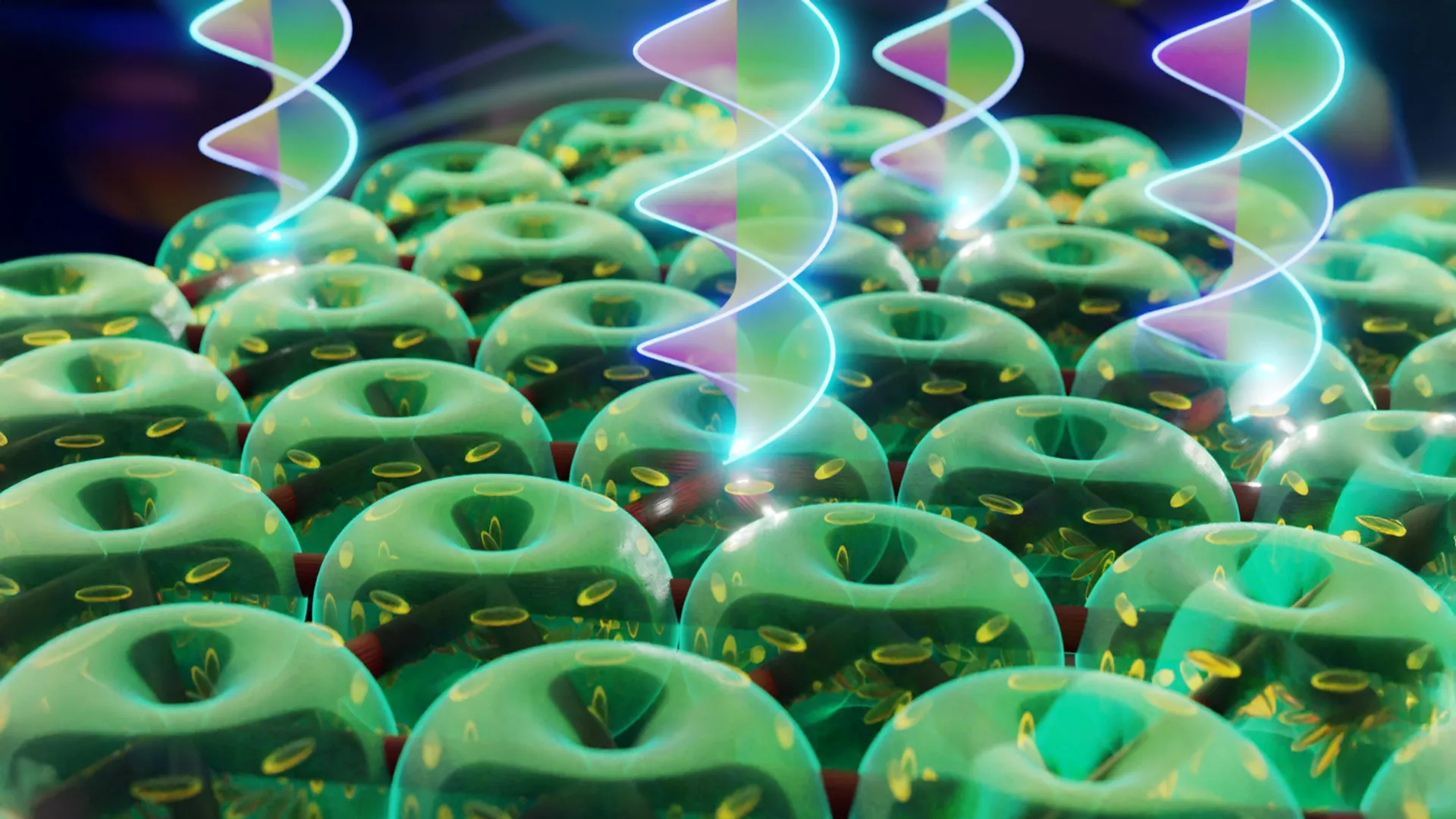
Physicists Create Optical Tornadoes That Could Revolutionize Quantum Communication, Because Regular Tornadoes Weren't Enough
Physicists have created tiny optical tornadoes using liquid crystals, potentially making quantum communication simpler and more scalable - because why settle for boring light when you can have spinning light?
Can light spin like a whirlwind? Scientists from the University of Warsaw, the Military University of Technology, and the Institut Pascal CNRS have answered with a resounding "yes," creating swirling "optical tornadoes" inside an extremely small structure. The advance points to a new way of building miniature light sources with complex shapes, which could support simpler and more scalable photonic devices for optical communication and quantum technologies.
"Our solution combines several fields of physics, from quantum mechanics, through materials engineering, to optics and solid-state physics," explains Prof. Jacek Szczytko from the University of Warsaw, the research group leader. "The inspiration came from systems known from atomic physics, where electrons can occupy different energy states. In photonics, a similar role is played by optical traps, which confine light instead of electrons." Dr. Marcin Muszyński, first author of the study from the University of Warsaw and City College of New York, adds: "You can think of it as an optical vortex. The light wave twists around its axis, and its phase changes in a spiral manner. Moreover, even the polarization - the direction of oscillation of the electric field - begins to rotate."
These structured light states are attractive for applications like quantum communication and controlling microscopic objects, but producing them has typically required complicated nanostructures or large experimental systems. The team chose a different strategy, using a liquid crystal - a material that flows like a liquid but whose molecules arrange themselves in an ordered way, like a crystal. Within this material, special defects known as torons can form. "They can be imagined as tightly twisted spirals, similar to DNA," explains Joanna Mędrzycka, a nanotechnology student at the University of Warsaw who, with Dr. Eva Oton from the Military University of Technology, prepared the liquid crystal samples. "If such a spiral is closed by joining its ends into a ring resembling a doughnut, we obtain a toron."
To strengthen the effect, the toron was placed inside an optical microcavity - a structure of mirrors that repeatedly reflects light and keeps it confined. "This makes the field much stronger," says Dr. Muszyński. "Additionally, we can control the size of the trap, and thus the properties of the light, using an external electric voltage." The team also achieved something new: stable light vortices in the ground state, the lowest-energy state. "For the first time, we managed to obtain this effect in the ground state," explains Prof. Guillaume Malpuech from Université Clermont Auvergne and CNRS, who developed the theoretical model with Prof. Dmitry Solnyshkov and post-doc Daniil Bobylev. "This is significant because the ground state is the most stable and the easiest for energy to accumulate in." To confirm lasing, the researchers introduced a laser dye, obtaining light that rotates, is coherent, and has well-defined energy and emission direction.
Prof. Dmitry Solnyshkov notes, "It's interesting that our approach draws inspiration from very advanced theories involving a so-called vectorial charge. So, in a way, we've managed to make photons behave not even like electrons, but like quarks." Prof. Wiktor Piecek from the Military University of Technology concludes: "This discovery opens a new pathway for creating miniature light sources with complex structures. Instead of relying on complex nanotechnology, we can use self-organizing materials. In the future, this may enable simpler and more scalable photonic devices, for example for optical communication or quantum technologies."
The Good Times
News in your inbox.
One sardonic roundup, delivered on your schedule. Free. Unsubscribe whenever your tolerance for wit runs out.
Already subscribed but we never reach your inbox? Check your spam folder and hit 'Not spam' (or 'Remove from spam') to bust us out of junk-mail purgatory. You'll be helping everyone else too.
Don't open any of our emails for a month and you'll be automatically removed from the mailing list.
Rewrite Article
Select parts to regenerate with a fresh AI pass. Translations will be updated automatically.
Generate AI Image
Creates a sardonic version of the article image using OpenAI.