Moon's Pull Creates 30-Foot Tides, Because Apparently It Needed a Hobby
The Moon's gravity, already doing too much, creates 30-foot tides in Western Australia, turning a bay into a buffet for birds and a workout for mangroves.
Tides: the Moon's most visible flex. Just 239,000 miles (385,000 kilometers) away, our celestial companion's gravity tugs on Earth's oceans and solid crust, stretching the planet into a slightly oblong shape with bulges pointing toward and away from it. You'd think after billions of years, we'd be used to it, but every so often, the Moon reminds us who's boss.
Nowhere is that reminder more dramatic than Roebuck Bay, a crescent-shaped inlet in the Kimberley region of Western Australia. Here, tides can swing a jaw-dropping 9 meters (30 feet) - enough to make your average beach day a logistical nightmare. Most of Australia gets by with tidal ranges of 2 meters or less, but Roebuck Bay is special, thanks to northwestern Australia's unusually wide, shallow continental shelf, which acts like a megaphone for incoming tides.
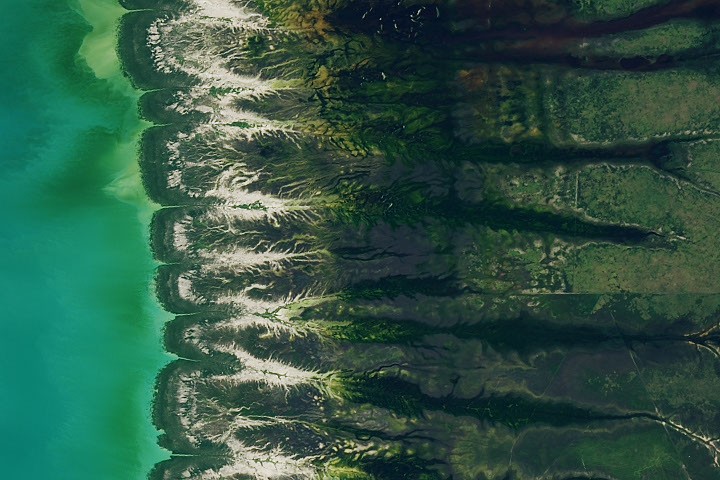
A satellite image from March 18, 2026, captured the bay during high water, showing thick green mangrove forests hugging the shoreline and lining the mouths of evenly spaced, linear tidal creeks. These mangroves aren't just sitting there looking pretty; they're actively advancing westward at nearly 2 meters per year, fueled by sediment from the waterways to the east. In other words, the bay is slowly but surely eating the landscape.
Farther inland, a network of tidal drainage channels branches out, giving the bay a feathered appearance that's partially hidden by vegetation in March but more visible when things thin out. And speaking of vegetation, monsoonal rains from December to March turn the area into lush grasslands and seasonal wetlands. Come May and June, the dry season takes over, and everything dies back to gold and brown. Nature's version of seasonal decor.
The consistent spacing of the tidal creeks, by the way, isn't the Moon's doing - it's likely influenced by the regular spacing of linear dunes in the region. Because why should the Moon get all the credit?
All this tidal drama supports a serious amount of life. Mangroves serve as nurseries for crustaceans and fish, while mudflats teem with snails, worms, crabs, clams, and cockles - sometimes reaching an abundance of 2,500 per square meter, according to the Australian government. That's a lot of potential seafood.
And where there's abundant marine life, there are birds. Roebuck Bay is one of Australia's most important sites for migratory birds, a key stop on the East Asian-Australasian Flyway, regularly hosting hundreds of thousands of plovers, godwits, and knots. They clearly appreciate the all-you-can-eat buffet.
So next time you complain about the tide coming in, remember: it could be a 30-foot swing in Roebuck Bay.
The Good Times
News in your inbox.
One sardonic roundup, delivered on your schedule. Free. Unsubscribe whenever your tolerance for wit runs out.
Already subscribed but we never reach your inbox? Check your spam folder and hit 'Not spam' (or 'Remove from spam') to bust us out of junk-mail purgatory. You'll be helping everyone else too.
Don't open any of our emails for a month and you'll be automatically removed from the mailing list.
Rewrite Article
Select parts to regenerate with a fresh AI pass. Translations will be updated automatically.
Generate AI Image
Creates a sardonic version of the article image using OpenAI.