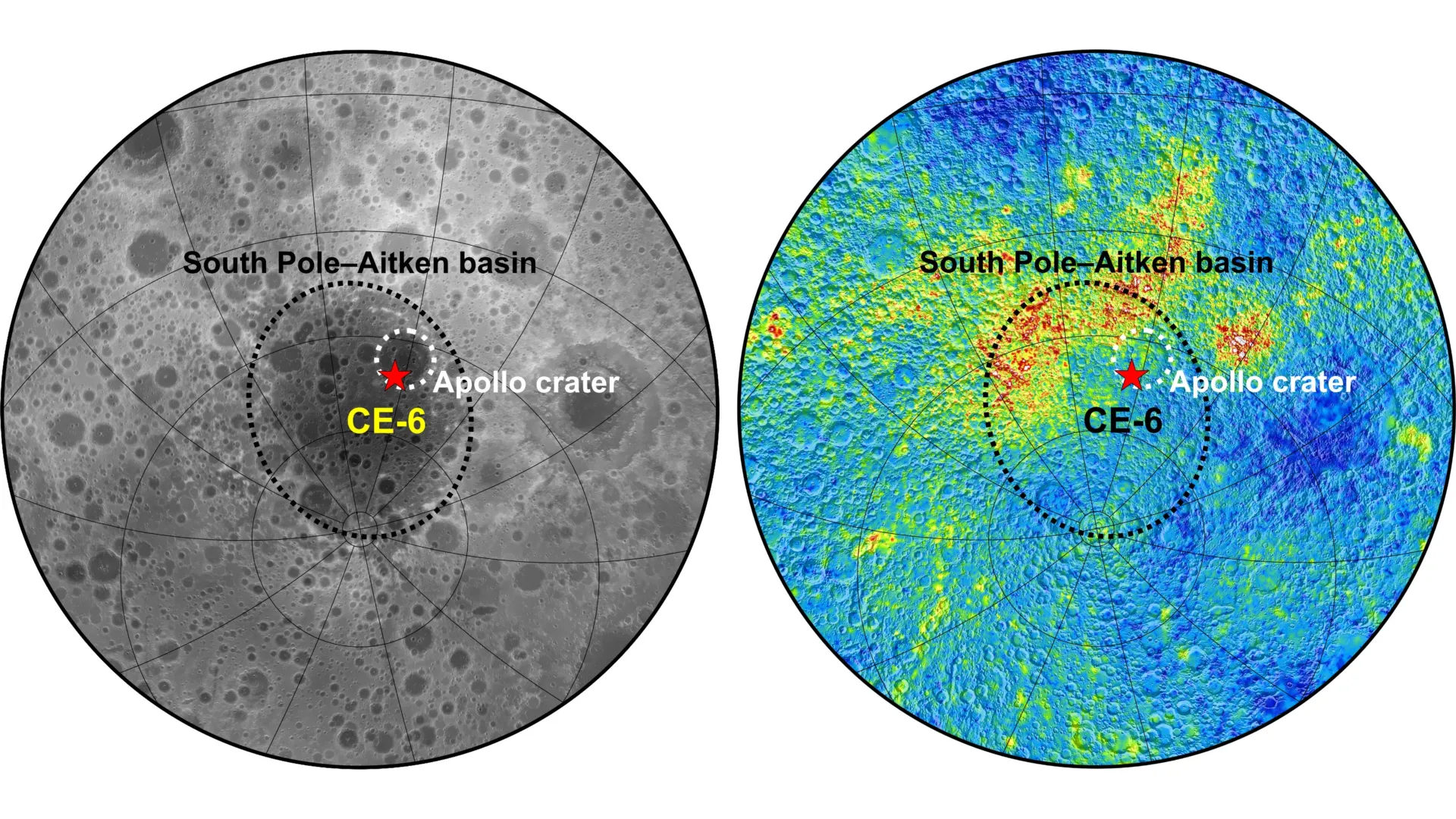
The Moon hasn't had a global magnetic field for billions of years, but apparently nobody told the rocks. Traces of ancient magnetism remain locked inside lunar soil, and scientists have now found something in samples from Chang'e-6 that they're calling - and we're quoting here - a "tiny magnetic fossil."
Researchers analyzing metallic iron inside impact glass from Chang'e-6 lunar soil have identified face-centered cubic γ-Fe for the first time in natural lunar samples. For those keeping score at home, that's a specific crystal structure of iron that normally only exists at high temperatures, which makes its presence on the Moon's surface roughly as expected as finding a snowball in a furnace.
The study was led by Prof. Haifeng Du of the High Magnetic Field Laboratory at the Hefei Institutes of Physical Science (HFIPS) of the Chinese Academy of Sciences (CAS). The findings were published in the Proceedings of the National Academy of Sciences (PNAS) on September 16.
"This tiny magnetic fossil may help us better understand the Moon's ancient magnetic history," said Dr. Long Li from HFIPS, a member of the team, presumably while holding a very small vial of very old dust.
To examine the samples, the researchers used focused ion beam preparation, transmission electron microscopy, and chemical analysis. These techniques revealed numerous nanoscale iron particles embedded throughout the glassy material. Closer examination showed that some of the particles consisted of face-centered cubic γ-Fe. In fact, γ-Fe was the dominant form of iron in the two impact-glass samples studied - which is the scientific equivalent of showing up to a party in an outfit nobody expected to see.
Under normal conditions, γ-Fe is stable only at high temperatures. As the material cools, it typically transforms into another form known as α-Fe. But the researchers found evidence that the unusual conditions produced by impacts on the Moon may allow γ-Fe to survive at the lunar surface. They proposed several factors could help stabilize the structure, including small amounts of carbon and other elements, the rapid cooling of molten material created during an impact, and protection from the surrounding glassy matrix. In other words: the Moon accidentally invented a magnetic time capsule and then forgot about it.
The team also used off-axis electron holography to investigate the magnetic behavior of individual γ-Fe nanoparticles. They found that relatively large γ-Fe particles could form a stable single-vortex magnetic state and retained a consistent magnetic response when exposed to an external magnetic field. That stability suggests γ-Fe could act as a previously unrecognized recorder of magnetic information in lunar material, preserving clues about conditions that existed during the Moon's past.
The discovery broadens the known variety of magnetic minerals found in lunar samples. Because γ-Fe and α-Fe form under different conditions and behave differently magnetically, each could potentially record information from separate stages of lunar impact events. Future research will be needed to determine exactly how much these minerals can reveal about the Moon's ancient magnetic field and how that field evolved over time - because the Moon, as always, is not making this easy.
Materials provided by Chinese Academy of Sciences Headquarters. Note: Content may be edited for style and length.
The Good Times
News in your inbox.
One sardonic roundup, delivered on your schedule. Free. Unsubscribe whenever your tolerance for wit runs out.
Already subscribed but we never reach your inbox? Check your spam folder and hit 'Not spam' (or 'Remove from spam') to bust us out of junk-mail purgatory. You'll be helping everyone else too.
Don't open any of our emails for a month and you'll be automatically removed from the mailing list.
Rewrite Article
Select parts to regenerate with a fresh AI pass. Translations will be updated automatically.
Generate AI Image
Creates a sardonic version of the article image using OpenAI.