
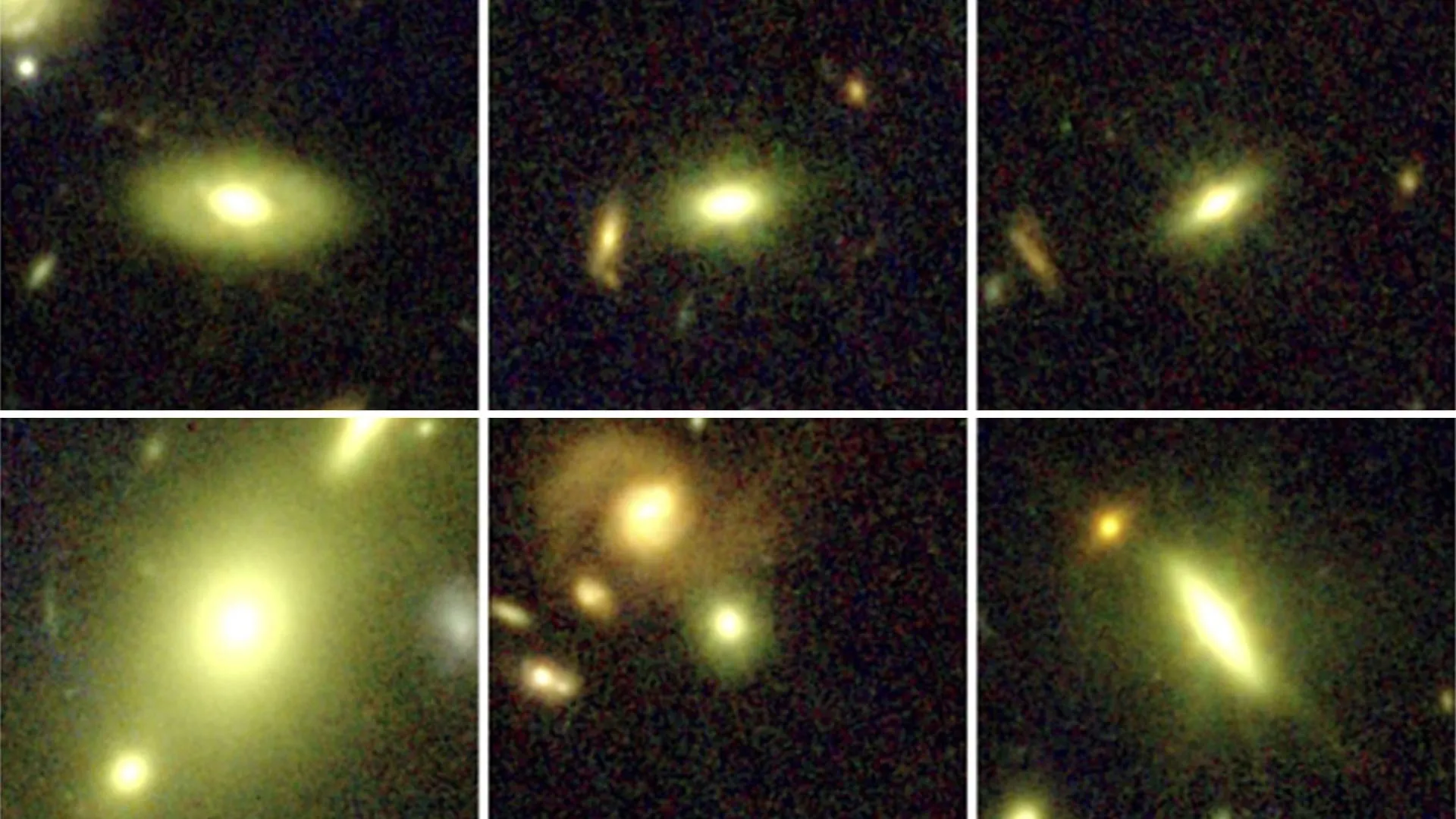
Astronomers have discovered that some of the largest galaxies in the early universe were secretly hoarding a bunch of small stars, making them potentially four times more massive than we previously thought. It's like finding out your neighbor's modest ranch house has a secret underground mansion.
The international team, including researchers from Penn State, published their findings in Nature Astronomy, adding yet another headache for scientists trying to figure out how the first galaxies formed and evolved.
Using NASA's James Webb Space Telescope (JWST), the researchers looked at nine massive, mature galaxies that stopped making new stars billions of years ago. They combined JWST's observations of the distant universe with earlier ground-based data from the Very Large Telescope - because why use one powerful telescope when you can use two?
For the first time, they could reliably estimate the relative numbers of small, faint stars and larger, brighter stars in galaxies at such mind-boggling distances.
"These galaxies are different," said Joel Leja, the Dr. Keiko Miwa Ross Mid-Career Associate Professor of Astronomy and Astrophysics at Penn State and coauthor of the paper. "They're different in the way that is really challenging to understand, because they are more massive than we expected - like a lot more massive, they have three or four times more mass than we expected." In other words, the universe keeps surprising us, and not always in a good way.
The astronomers separated each galaxy's light into a spectrum, looking for small variations in color that reveal which types of stars are present. The catch: big, bright stars hog the spotlight, while smaller stars are shy and hard to spot. Penn State researchers provided expertise and guidance for modeling the light from these galaxy systems.
"If a galaxy were a city, the brightest stars would be the skyscrapers that immediately catch your eye from afar," said lead author Chloe Cheng, a recent doctoral graduate of Leiden University. "Our models demonstrate that a far more numerous population of low-mass stars is concealed by those rare, bright stars, like houses hidden between skyscrapers. As a result, this galaxy turns out to be much more massive than previous estimates suggested." So, basically, the universe is full of cosmic suburbs.
Traditionally, astronomers assumed that stars formed in roughly similar proportions throughout the universe, but these findings challenge that long-standing assumption. The most massive galaxies in the early universe seem to be packed with more low-mass stars than smaller galaxies like our Milky Way.
One galaxy stood out, according to coauthor Martje Slob, a doctoral candidate at Leiden University. It likely formed less than one and a half billion years after the Big Bang and could be up to four times more massive than previously calculated.
"Until recently, measurements like these were simply impossible," Slob said. "We needed not only a telescope capable of magnifying very distant galaxies, but also spectra of exceptional quality and new analysis techniques to reliably detect the subtle signatures of faint, low-mass stars hidden within these cosmic titans." Because apparently, the universe's biggest galaxies like to play hide and seek.
These findings have major implications for understanding how galaxies developed in the young universe. Since JWST started observing, astronomers have repeatedly found unexpectedly massive and mature galaxies that existed soon after the Big Bang, putting pressure on existing models of galaxy formation.
"This discovery has crucial implications for our understanding of the early universe," said Leja, who is also affiliated with The Penn State Institute for Computational and Data Sciences. "Since the launch of JWST, astronomers have found surprisingly massive and mature galaxies that already existed shortly after the Big Bang. These very early galaxies are thought to evolve into the type of galaxies studied in this work; adding up to four times more stars to these massive, early-forming galaxies sharpens these tensions further." Because nothing says 'fun' like upending our entire understanding of cosmic history.
If galaxies like these contain substantially more stars than earlier estimates, theories of galaxy formation must account for how such enormous numbers of small stars could have appeared so early in cosmic history. Maybe they had a very efficient star factory.
The implications extend beyond galaxy formation. "This result shows that much more mass than previously thought is hidden in low-mass stars," said Mariska Kriek, who led the research and is a professor of extragalactic astronomy at Leiden Observatory. "That has consequences for many areas of astronomy. For example, as many planets orbit low-mass stars, this could even indicate that more planets formed in the early universe than we had previously assumed." So, a potential baby boom of planets we didn't know about.
Over the next several years, the researchers plan to use the same technique to study galaxies from even earlier periods, pushing observations closer to when the universe's first generations of stars and galaxies began to emerge. Because why not keep digging into the cosmic past and find more surprises?
Materials provided by Penn State. Note: Content may be edited for style and length.