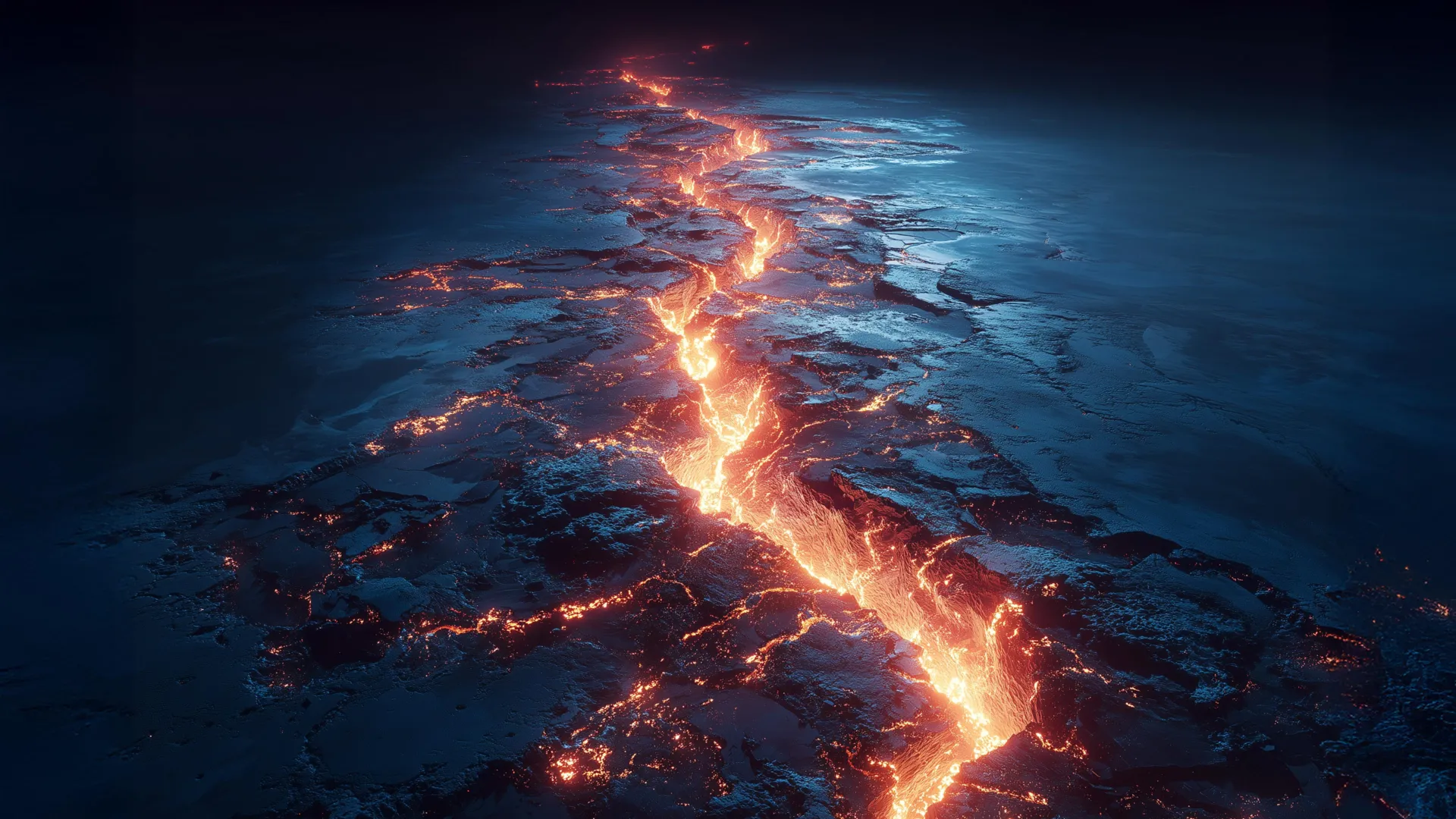
Scientists have discovered that one of Earth's most extreme volcanic events did more than build a massive underwater plateau. It also gave the oceanic plate beneath it a complete chemical makeover. A research team led by Lecturer Azusa Shito of Okayama University of Science, working with Associate Professor Akira Ishikawa of the Institute of Science Tokyo and Professor Masako Yoshikawa of Hiroshima University, used seismic waves to peer beneath the Ontong Java Plateau (OJP). Their findings, published in Geophysical Research Letters, suggest that enormous volumes of magma pushed through the existing plate, creating networks of vertical intrusions and chemically transforming the surrounding rock.
The oceanic plate beneath the OJP doesn't have the relatively simple structure expected of a typical oceanic plate. Instead, the researchers found evidence of a composite interior made up of horizontal layers crossed by swarms of vertical magma pathways known as dikes. These form when molten rock forces its way through cracks and cools inside them. Large groups of these intrusions, called dike swarms, preserve a record of intense volcanic activity long after the magma has solidified. The team also detected unusually low seismic wave speeds within the plate, suggesting that magma rising from deep inside Earth didn't just pass through - it likely changed the plate's chemical composition as well.
The OJP lies beneath the western Pacific Ocean and is the world's largest oceanic plateau, formed approximately 110 - 120 million years ago during the largest volcanic outpouring in Earth's history. Scientists have proposed that the eruption released enough heat, gases, and volcanic material to severely disrupt the global environment, possibly contributing to mass extinctions by altering ocean chemistry, climate, and oxygen levels. Recent research indicates the event may have been driven by a thermochemical plume rising from deep within the mantle - a column of unusually hot material that differs chemically from the surrounding mantle and may carry recycled ancient oceanic crust. But until now, scientists haven't fully understood how that magma affects an existing oceanic plate.
To examine the plate beneath the OJP, the researchers studied high-frequency seismic signals called Po and So waves, recorded by ocean bottom seismometers around the plateau and instruments on nearby islands. Under typical conditions, these waves travel through oceanic plates and scatter repeatedly through layered structures, allowing them to travel for several thousand kilometers. But waves recorded near the OJP behaved unusually: Po waves moved efficiently, while So waves weakened dramatically. This clue led the scientists to use seismic waveform modeling, which indicated that the plate contains layered structures (horizontal lamination) intersected by dike swarms (vertical intrusion). The horizontal layering allows some waves to travel long distances, while the vertical intrusions disrupt and weaken others.
The team also found that both Po and So waves traveled significantly more slowly beneath the plateau - a sign that the rocks are hotter, less rigid, fractured, or chemically different from typical mantle material. They concluded that structure alone couldn't explain the low speeds, and propose that magma from a thermal-chemical plume rose through the plate, created the dike swarms, and then reacted with the surrounding mantle rock, causing chemical modification known as refertilization. This occurs when magma restores chemical components to mantle rock that previously lost them during partial melting. The mantle is largely made of peridotite; when part melts, some elements are removed, and later magma can return them, changing the rock's mineral content and physical properties.
The results suggest that massive volcanic events can do more than cover the seafloor with lava - they can fracture an oceanic plate, form extensive dike networks, and alter the plate's chemistry. This model of physicochemical modification could improve understanding of how oceanic plates develop and how large volcanic provinces reshape Earth's interior.
The Good Times
News in your inbox.
One sardonic roundup, delivered on your schedule. Free. Unsubscribe whenever your tolerance for wit runs out.
Already subscribed but we never reach your inbox? Check your spam folder and hit 'Not spam' (or 'Remove from spam') to bust us out of junk-mail purgatory. You'll be helping everyone else too.
Don't open any of our emails for a month and you'll be automatically removed from the mailing list.
Rewrite Article
Select parts to regenerate with a fresh AI pass. Translations will be updated automatically.
Generate AI Image
Creates a sardonic version of the article image using OpenAI.